
Overview of Deployment Strategies in DevOps
As part of an effective deployment strategy, more than just a simple step-by-step process is involved, it encompasses multi-functional team collaborations, planning, implementation, testing and analyzing of the whole software deployment process in conjunction with cross-functional team collaborations.
Having an effective software deployment process strategy is essential if you want your users to have a positive experience with your software applications – rapid release and change roll-outs, minimal downtime for resolution of issues, streamlining operations, mitigating risks and analyzing and evaluating the software applications.
Types of Deployment Strategies in DevOps
Software deployment process strategies must be customized for the specific needs of the software. In spite of the fact that there are a number of strategies to choose from, let’s take a look at the most commonly used ones.
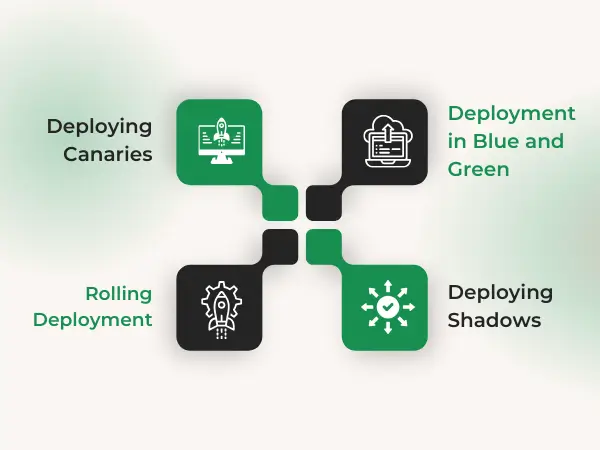
1. Deploying Canaries
In DevOps, canary deployment is a popular strategy. Based on miners’ use of canaries in the mines to detect toxic gasses, this approach involves deploying new software to a small group of users called ‘canaries’. In order to identify and resolve any potential bugs and issues, the deployment in DevOps team closely monitors and fixes the performance, stability and user experience.
With this deployment strategies, users can simply roll back the deployment if they are dissatisfied with the result or if there are any technical issues.
2. Deployment in Blue and Green
Red-black deployment in DevOps strategy that involves using two identical environments: ‘Blue’, the version in production and ‘Green’, the version for rolling out a new version.
When implementing a time-sensitive seamless shift, this method allows traffic to be diverted from the blue environment to the green environment while keeping the blue environment available in case of rollbacks.
3. Rolling Deployment
With this software deployment process, also known as “phased rollout”, new software versions are gradually deployed across the system. As a result, previous versions of an application can be slowly replaced by the latest version by replacing the infrastructure.It is faster to deploy this strategy than the blue-green deployment strategies, but it complicates rollbacks.
4. Deploying Shadows
Another common for deployment strategies are shadow deployment, which involves simultaneously running the old and new versions of an application. An exact replica of the live environment is created so that the DevOps team can analyze the performance of the latest application in a production-like environment without disturbing the users.
What DevOps has Done for Software Deployment
After gaining traction in 2007 and 2008, the DevOps movement emerged in response to the dissatisfaction expressed by IT professionals regarding the dysfunction between IT and software development teams. Deployment in DevOps was developed to improve the collaboration between developers and operations teams and to change traditional software development practices involving manual handoffs and lengthy development cycles. Keeping up with the demands of digitization and digital transformation, DevOps has come a long way since its inception.
1. Code Integration
Code integration in the source code repository has been automated through the integration of DevOps practices such as CD/CI. To ensure the software is deployable, tests are conducted to ensure the functionality of code and to resolve any bugs or issues that may arise as the project progresses.
2. UI/UX
A positive user experience can also be ensured by using deployment in DevOps strategies. Users receive software applications that undergo rigorous automated testing, monitoring, early detection of potential bugs and issues and repeated feedback loops.
3. Security
In addition to improving workflow, optimizing resources, agility and user experience, DevOps is also crucial for maintaining security at every stage of software deployment – or DevSecOps.
4. Managing Resources
With DevOps processes like Infrastructure as Code (IaC), manual infrastructure processes such as setting up, updating and maintaining operating systems, database connections and storage are replaced by code-integrated automated processes. Software development, testing and deployment can be performed time-efficiently and reliably.
Digital industry has experienced a significant improvement in software deployment and development due to the growth of DevOps. CD/CI (Continuous Delivery / Continuous Integration), IaC (Infrastructure as Code), Version Control System (VCS) and automation have enabled software deployment processes to become better, faster and more secure.
Software Deployment in DevOps with AI
The synergy between DevOps and AI is powerful and transformative because both place automation at the forefront. As a result of advancements in AI and machine learning, DevOps practices have significantly evolved. Building, testing, deploying and monitoring software applications have been revolutionized by the integration of AI into the software development lifecycle.
Check out some of the most significant impacts of AI on DevOps and software development.
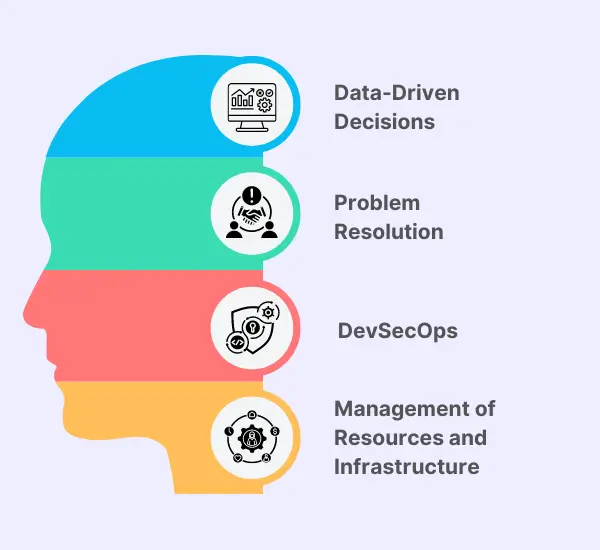
1. Data-Driven Decisions
Analytics powered by artificial intelligence provide actionable insights for DevOps teams on user feedback, business KPIs and performance metrics. In order to continuously improve and innovate in software development and deployment, DevOps teams use these comprehensive data-driven insights from the AI algorithm to build collaborative and strategic plans.
2. Problem Resolution
Incident management systems powered by artificial intelligence help build resilient IT environments. Through automated detection, response and identification of the root cause, AI systems can accelerate the issue resolution process. A machine learning system can also detect anomalies in real time by learning patterns from old data. It also improves the overall system service and provides a reliable, secure and reliable system.
3. DevSecOps
The use of artificial intelligence enhances security by automating threat detection, identifying anomalies and mitigating cyber threats. In order to detect malicious activities and mitigate the risks of breaches, machine learning algorithms continuously monitor and analyze network traffic. In addition to providing real-time alerts, AI can strengthen cyber defenses by identifying threats in real-time and safeguarding sensitive data.
4. Management of Resources and Infrastructure
The use of AI facilitates the efficient allocation of resources for DevOps teams. Artificial intelligence improves software development and deployment in DevOps processes by optimizing cloud infrastructure and automating resource allocation. The use of artificial intelligence and machine learning algorithms also enhances the management and scalability of complex infrastructures by analyzing workload patterns and minimizing downtime. An organization’s performance, scalability and resilience can be improved through the effective management of resources and infrastructure.
Conclusion
Even though DevOps has played a significant role in improving the software development lifecycle and revolutionizing it, its role and contribution to emerging technologies are also worth mentioning.
A time of continuous digital transformation is upon us and DevOps is at the forefront of seamlessly integrating technologies such as augmented reality, blockchain, the Internet of Things, edge computing and cloud computing.
It has always been Eiy Sys ‘s mission to be at the forefront of the latest trends and technologies when it comes to DevOps solutions and services. Eiy Sys’s company page can give you more information on our DevOps services, as well as our other products.
Frequently Asked Questions
Software deployment strategies are methods for releasing software updates to production environments with minimal disruption. Among them are rolling deployments, which gradually roll out updates to users; blue-green deployments, which switch traffic between two environments (blue and green) to ensure no downtime; and canary releases, which test updates on a small percentage of users before a full rollout. As a result of these strategies, risks can be managed and a smooth release process can be ensured.
DevOps deployment strategies minimize the impact of new releases on end-users, reduce the likelihood of deployment failures and allow for easier rollbacks if issues arise. Providing structured approaches to handle changes and updates, they enable continuous delivery and integration, improving software quality and reliability while maintaining operational efficiency.
Deployment strategies should be determined by factors such as the release's size and complexity, its potential impact on users and an organization's risk tolerance. Blue-green deployments might be appropriate for larger, more critical updates, while canary releases might be appropriate for frequent, small updates. It also depends on the team's infrastructure capabilities and whether a rollback option is needed in case of a failure.
DevOps deployment strategies require automation to ensure consistency, reduce manual errors and speed up deployment. Tools and pipelines automate the process of building, testing and deploying code, making it easier to implement and manage various deployment strategies. Scaling deployments, performing rollbacks and maintaining continuous integration and continuous delivery (CI/CD) practices are made easier with automation.