


A developer who wants to succeed in this fast-moving digital world must master the app development process. A Mobile app design and development and deployment encompass all the nuances that ensure it meets and exceeds user expectations. Rapid Application Development and low code workflow platforms can ease a developer’s workflow and increase productivity.
Keeping up with the latest trends and technologies in mobile app design and development is essential in this field. From ideation to testing, each stage of application development plays an important role in its success. Developing an app smoothly and user-friendly requires knowing these steps to develop an app for every developer.
Even the simplest apps undergo several critical stages, so developers should be aware of them all. In order to establish an efficient development cycle, you need to master these stages. In this blog, we explain the seven stages that every developer needs to be aware of and offer tips on how to optimize them.
How Does a Low Code Workflow Platform Aid App Development Process?
A low code workflow platform dramatically reduces the amount of time and steps to develop an app. In general, these platforms come with prefabricated elements and graphical interfaces for application development. In lieu of extensive coding, much time is spent on perfecting aspects of the mobile app design and development so that the delivered app looks professional and user-friendly.
During the development process of an app, low code workflow platforms also facilitate better collaboration among team members. Version control, project management and real-time feedback are already included in most tools, making communication and coordination easier. Using this method allows for quick iterations for a faster time-to-market in environments requiring rapid application development. Thus, developers can follow all the procedures for developing an app, from its Mobile app design and development to its deployment, easily.
Low code workflow platforms enable non-developers to contribute to the development process of an app. The tools listed here can be used by business analysts, designers and others without too much coding knowledge.
Through these platforms, application development is democratized, resulting in a faster workflow, as well as a product that reflects the business imperatives and needs of the end user exactly. At every phase of the development process, integrating a low code workflow platform will help organizations to get the steps to develop an app to their applications efficiently and effectively.
What are the Crucial Steps to Develop an App?
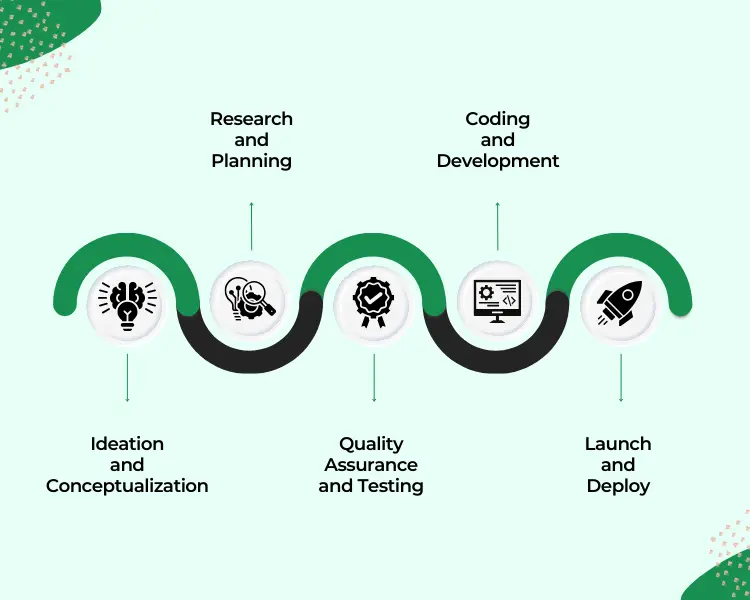
1. Ideation and Conceptualization
Conceptualizing and ideating are the two most important phases of the app development process. Basically, this is where you brainstorm the idea of the app, its target audience and what problems it’ll solve. Low code workflow platforms can be really helpful at this stage for modeling preliminary ideas and getting feedback quickly.
2. Research and Planning
The development of a distinct concept is followed by planning and market research. To achieve this, you must research consumer demands in that niche, analyze your competitors and comprehend market trends. Mobile app design and development with creation must be influenced by this. In order to set realistic goals, a comprehensive market analysis may be helpful.
3. Coding and Development
Following the approval of the design processes, the actual building of the app development process begins. Application developers start writing code for the required functionalities and ensure the application’s integration and performance. With a low code workflow platform, one can accelerate application development and reduce time to market.
4. Quality Assurance and Testing
In order to ensure that the app works as intended, testing and quality assurance are necessary. A thorough testing process is conducted at this stage to identify bugs and problems in the application, optimize performance and ensure that the app is compatible with multiple devices and operating systems. A rapid application development methodology allows each iteration to be tested quickly and improved.
5. Launch and Deploy
Once each round of testing is completed, the app can be launched and deployed. Now that the app has been published in app stores, it is essentially available to consumers. It is possible to boost user acquisition and early success with a well-executed launch plan.
How Do You Overcome Common App Development Process Challenges?
The development of an application is challenging; it creates inertia and affects the quality of the final product. Using modern tools and methodologies can help avoid many of these problems. In order to overcome these roadblocks, here are a few tips:
- Requirements Complexity: The majority of misunderstandings can be prevented by proper planning and communication. It is possible to adjust workflows quickly and visualize requirements with low code platforms.
- Time Constraints: With rapid application development techniques, the development cycle can be shortened, which aids in quick iterations and shorter time to market.
- Design and Usability Issues: User interfaces of mobile apps are more friendly when some investment is made in the details. User feedback and iterative design improvements go a long way towards ensuring optimum usability.
- Technical Challenges: In order to overcome technical challenges, one must stay up-to-date on changing technologies and best practices. In order to simplify the technical implementation and integration, low code workflow platforms can be used.
- Testing and Bug Fixing: By thoroughly testing every step to develop an app of the development process, problems can be detected and fixed in an early stage. It is important to use automated testing tools and to perform quality checks at regular intervals.
Conclusion
The development of apps that meet the needs and expectations of the end user has become a necessity for developers today in order to make their apps the best possible. With Eiy sys low code workflow platform and rapid app development process, every stage of development, from ideation to design, testing and deployment, can be effectively managed at every stage of the development lifecycle.
Achieving success can be difficult when a strict time schedule, sensitive requirements and technical challenges get in the way. As a result of these strategies and tools, it becomes easier for developers to create high-quality, user-friendly applications by increasing the process of development’s efficiency and effectiveness. As a result, quality applications can be created.
Frequently Asked Questions
Developing an app involves several stages, including planning, designing, developing, testing, deploying and maintaining it.
Developers write code for both frontends (user interfaces) and backends (server logic and databases). Connecting to databases, integrating APIs and setting up servers are all part of the process.
An app is deployed once it has been uploaded to a distribution platform or app store, making it available to users for download and installation.
The best way to ensure that a mobile application fulfills the needs of users and provides them with a good experience is to conduct user research, gather feedback and perform usability testing.
