The incorporation of AI and machine learning within DevOps services is exactly what will cause the sea change in 2024. Through predictive analytics and automation, machine learning is being integrated into DevOps services to redefine development and operations management.
Azure Machine Learning enables companies today to optimize workflows before system failures occur, improving resource allocation and detecting failures in advance. By combining technologies, a culture of continuous improvement and agility is developed, which not only increases productivity but also contributes to an increase in productivity.
Artificial Intelligence and Machine Learning are the future of DevOps services, since they pretty much reshape them. The use of technology gives an organization a competitive advantage on subjects ranging from automated testing to sophisticated data analysis.
How Does DevOps Services Work?
Software Development (Dev) and IT Operations (Ops) are two major concepts that DevOps aims to bring together. By reducing the lifecycle of software development, high-quality software can be delivered continuously. As a result, you will be able to scale your business and grow slowly and consistently over time.
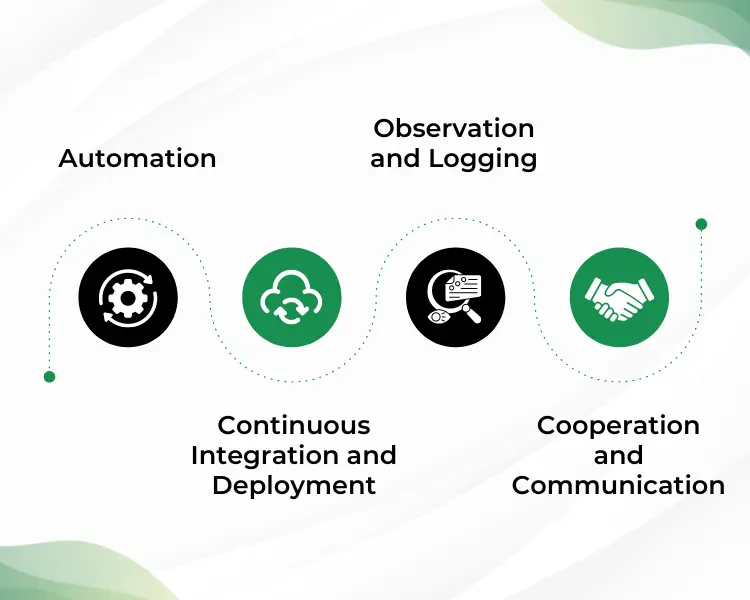
DevOps Services includes:
- Automation: Enhance efficiency and reduce the likelihood of human error by automating repetitive tasks like testing codes, integrating them, and deploying them.
- Continuous Integration and Deployment : This is the process of integrating code changes into the main code at frequent intervals as well as monitoring the results.
- Observation and Logging: This means the applications and infrastructure are monitored continuously for any problems and are fixed to maintain uptime.
- Cooperation and Communication: Building a culture of shared responsibility and continuous improvement between development and operations teams.
By making machines do things typically associated with human intelligence, ML and AI have revolutionized many industries.
What are Artificial Intelligence And Machine Learning?
Machine Learning(ML)
Artificial intelligence is undoubtedly a broader term, referring to the concept of building machines that can compete with human intelligence in terms of the tasks they can accomplish. As a substitute for human intelligence, ML can be summarized to learn machine learning.
Artificial Intelligence (AI)
An artificial intelligence is a machine that can perform a variety of tasks that are comparable to those that can be performed by humans. ML, in other words, can serve as a replacement for human intelligence.
Why Do We Need to Learn Machine Learning (ML) and Artificial Intelligence (AI)?
The application of artificial intelligence and machine learning can be found in a variety of fields, including:
Healthcare
These algorithms are used to analyze medical images to be able to predict patient outcomes through the analysis of medical images.
Finance
Business intelligence is used by the finance industry to detect fraud, assess risks, and automate trades using Artificial intelligence and machine learning algorithms.
The Retail Industry
By applying these technologies to the retail industry, one can tailor the shopping experience for each and every customer.
In Everyday Technology
Artificial Intelligence is used to run virtual assistants like Siri and Alexa, while Azure machine learning is used to improve the user experience.
How do AI and ML Affect DevOps Services Growth?
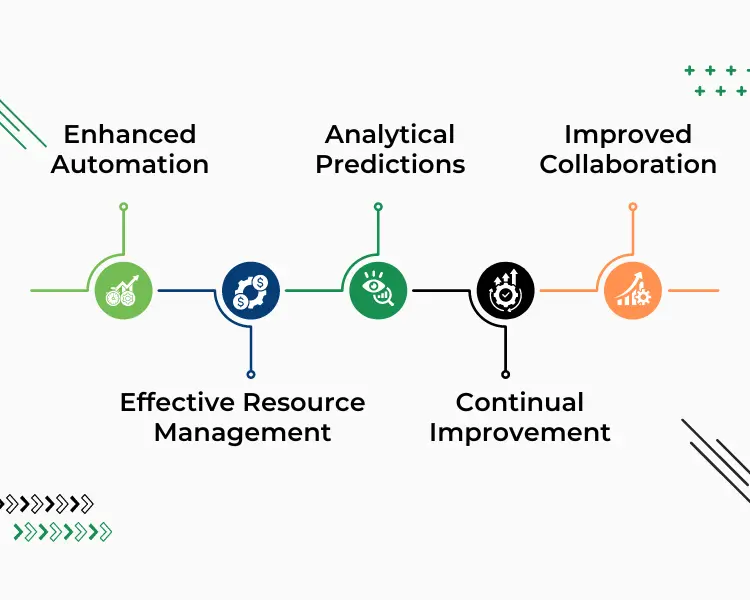
These technologies have a significant impact on the growth and evolution of DevOps, transforming efficiency, innovation, and performance. Here are some key impact areas:
1. Enhanced Automation
In addition to enhancing operational efficiency, these technologies have reduced human error by automating repetitive testing, integrating, and deploying tasks.
2. Analytical Predictions
Technology of this type can analyze huge amounts of data to predict potential problems way ahead of their occurrence, whether they involve performance bottlenecks or security vulnerabilities.
3. Improved Collaboration
Furthermore, these tools provide teams with real-time insights and recommendations through data analysis, which can be used to align goals for more productive and coherent work.
4. Effective Resource Management
Because applications can easily be scaled up, the technology allows better utilization of computing resources, reduced costs, and good performance at peak times.
5. Continual Improvement
Increasing velocity and improving software quality is achieved through a culture of continuous improvement within DevOps services.
6. Sensitive Data Protection
With these technologies, abnormal patterns can be recognized and security threats can be mitigated and protected as early as possible, resulting in faster mitigation and protection of sensitive data.
What Tools Enable DevOps and AI Integration?
Artificial intelligence and azure machine learning play a significant role in DevOps, catalyzing growth and innovation and enhancing performance. The following are some of the key impacts:
1. Jenkins
It is an open-source, extensible automation server used for continuance integration and continuance deployment. It is possible to automate testing processes, building processes, and deployment processes with Artificial Intelligence.
2. Ansible
The Ansible tool is an open-source tool that provides infrastructure provisioning, configuration management, and application deployment capabilities. With the power of artificial intelligence, Ansible can further automate more complex workflows.
3. Docker
Docker provides developers with a platform that automates the deployment and running of applications inside lightweight and portable containers. Docker now uses artificial intelligence (AI) to assess container performance and predict potential problems.
4. Kubernetes
The deployment, scaling, and management of containerized applications can also be automated with an open-source container orchestration system.
5. Nagios
Nagios is a freely available monitoring tool that provides detailed alerts and monitoring of servers, network devices, and software applications. Nagios can be empowered with advanced analytics, anomaly detection, and predictive maintenance thanks to artificial intelligence.
What is Python Machine Learning?
In the field of machine learning, Python machine learning is a leading language because of its simplicity, versatility, and rich ecosystem of libraries and tools. A wide variety of machine learning libraries are available in Python, including scikit-learn, TensorFlow, Keras, and PyTorch. TensorFlow and Keras provide robust tools for design and deployment of deep learning models, while scikit-learn provides tools for preprocessing data, building models, and evaluating them.
With its ability to perform dynamic computations and flexibility, PyTorch is favored by many developers. In Python,machine learning typically involves collecting and preparing data, selecting and training models, evaluating performance using metrics like accuracy and F1 score, and deploying the model.
In addition to offering an interactive environment for coding, visualizing, and documenting, Jupyter Notebooks are essential. Its comprehensive resources and community support make Python an accessible and powerful tool for azure machine learning projects.
Conclusion
Ultimately, the integration of artificial intelligence and machine learning into DevOps services, especially through platforms like Azure Machine Learning, will transform the technological landscape in 2024. As a result of Eiy sys AI-driven predictive maintenance solutions, downtime is minimized, IT equipment is extended, and maintenance schedules are optimized, ensuring continuous operations and lower maintenance costs.
Organizations can maintain a competitive edge by managing and scaling their operations efficiently with tools such as Jenkins, Ansible, Docker, Kubernetes, and Nagios. As we continue to learn machine learning and apply Python machine learning techniques, the synergy between AI and DevOps will be on learning machine learning and applying Python machine learning techniques, which will drive innovation and excellence in software development and IT operations by combining AI and DevOps. Finally, this confirms DevOps will lead the way with AI and ML.
Frequently Asked Questions
DevOps benefits from AI by automating tasks, improving performance monitoring, predicting issues, and optimizing CI/CD pipelines.
Using machine learning in DevOps enhances system reliability and efficiency by enhancing predictive analytics, automated testing, and anomaly detection.
Artificial intelligence enhances continuous integration and continuous delivery by automating code reviews, optimizing build and deployment processes, and predicting deployment outcomes.
There are many benefits to using the software, including greater efficiency, improved accuracy, and proactive issue resolution.