Understand the differences between B2B vs B2C eCommerce trends and how you can optimize your presence online. With our expert guide, we examine the key differences between B2B vs B2C eCommerce trends websites, such as target audiences, product offerings and pricing. No matter whether you’re just starting out or want to take your business to the next level, this guide offers actionable advice and insights. If you run (or plan to start) an eCommerce business, your website is your most valuable marketing tool. Invest in other forms of advertising after you have checked your website for conversion factors.
If you are running a business-to-business website, then your approach to optimizing conversions will differ greatly. Do you run an eCommerce website? Are you targeting business-to-business websites customers or business-to-consumer (B2C) customers on your website?
What is main B2B eCommerce and B2C eCommerce?
-
B2B eCommerce
The term B2B platform refers to a platform that facilitates business-to-business website transactions. Complex transactions are usually handled by these online retail platforms, so they are developed accordingly. It is called a B2B online retail platform, for instance, if it is used by a manufacturer or wholesaler to sell items to retailers. In terms of B2B eCommerce trends, Amazon Business is one of the best online retail platforms. It includes business-to-business website features such as multi-user accounts, invoice-based payments and more.
-
B2C eCommerce
The term “B2C” describes eCommerce solution models where products and services are directly sold to end users, rather than via third parties. A B2C transaction involves the end-user purchasing the product for the purpose of using it for their own purposes and not to be sold to others. Walmart, which is a perfect example of B2C eCommerce, can be seen as the best example of B2C eCommerce solutions. Essentially, it is a company that buys products from manufacturers and wholesalers all over the world and sells them to consumers around the world.
What is the difference between B2B e-commerce and B2C ecommerce?
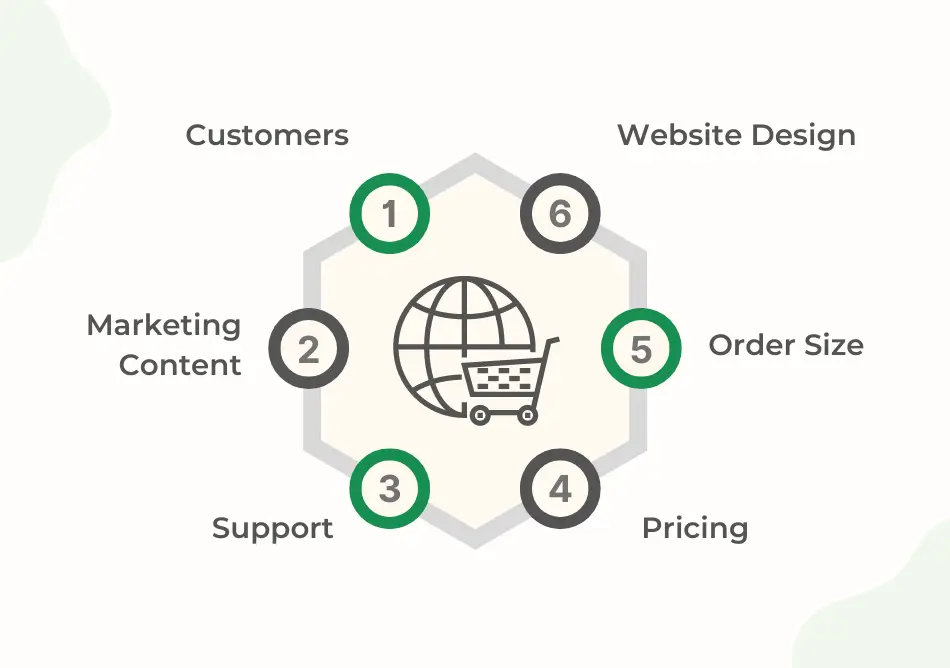
B2B and B2C e-commerce websites allow customers to purchase products and services online. In spite of this, they have different customer bases and use different marketing approaches, support strategies, pricing options, order sizes and website designs.
1. Customers
In B2B organizations, products and services are sold to businesses, while in B2C organizations, products and services are sold to individuals. There is a difference between the purchasing behavior of businesses and consumers since organizations make much larger purchases than consumers. Insurance companies, for instance, may order hundreds of laptop computers at once to equip their remote contact centers. Contrary to B2B customers, B2C user experience tends to make small, frequent purchases, such as clothing or toys for their children.
Due to the fact that business purchases involve many players, the sales process can take longer in B2B than B2C. Compared to consumers, organizations make purchases less frequently, but those investments affect hundreds of people. The purchase of new content management software by a pharmaceutical company affects employees in IT, marketing, finance, graphic design, sales and human resources. Each department’s leaders may also be involved in sales.
2. Marketing Content
Businesses tend to make larger purchases than consumers, so they research products more heavily. Buyer guides, specs, FAQ pages, blogs and video demonstrations are all part of B2B eCommerce trends. It’s not uncommon for people to purchase products spontaneously in B2C marketing. In B2C marketing, fun, flashy and creative messaging often resonates with the consumer.
B2B eCommerce trends also aim to build strong relationships between businesses and their clients. There are often click-to-call buttons or live chat windows that connect shoppers with sales representatives. Since B2B shoppers make high-value purchases and often stick with one vendor for all their purchases, business-to-business websites place a great deal of effort into their customer relationships.
The goal of B2C marketing content is to facilitate speedy checkouts rather than build personal relationships. To create personalized discounts and product recommendations, these organizations increasingly use customer data.
3. Support
Due to the complexity of their products and business relationships, B2B e-commerce organizations require more elaborate support teams than B2C e-commerce organizations. There may be agents, community forums, 24/7 chatbots, FAQ pages, product demos and troubleshooting videos available for support. Businesses invest in strong support infrastructures to quickly resolve complex issues for B2B customers with a high customer lifetime value (CLV).
B2C e-commerce organizations also need customer support teams, but their customers ask simpler questions. Many common inquiries can be handled by chatbots and FAQ pages and agents don’t always need to have extensive product knowledge. It is common for B2B customers to consider their purchases over a long period of time, while consumers may buy products spontaneously.
4. Pricing
In B2B, pricing is usually negotiable, whereas in B2C, it is fixed. Since B2B customers have high CLVs, B2B organizations focus on long-term sales cycles. Vendors may be willing to reduce prices for growing startups with limited budgets if they expect the company’s growth to be significant in the next few years. In the future, the software vendor can expect to sell the startup more licenses as it grows.
As a result of the complexity of their products, B2B eCommerce trends may offer negotiable pricing. Many B2B software vendors offer highly customizable products with different microservices and deployment requirements for different customers. Prices can vary between customers due to this complexity.
In contrast, B2C pricing is usually fixed. Due to consumer products’ simplicity and customization, sellers don’t need to adjust prices for unique product customizations. In order to boost customer engagement, retailers often offer discounts and personalized offers.
5. Order Size
B2B e-commerce organizations have fewer customers, but their customers make larger purchases. The minimum price level is set by B2B vs B2C eCommerce solution companies because they sell in bulk. B2C retailers, like Home Depot, may not require customers to buy at least $5,000 worth of wood from lumber wholesalers.
Certain high-demand items may be restricted by B2C e-commerce organizations. In the holiday season, a retailer might limit the number of gaming consoles a customer can purchase. Unlike B2B retailers, B2C user experiences are concerned about a handful of customers buying up all their inventory.
6. Website Design
Since B2B vs B2C eCommerce websites serve different customers, the designs often differ. In contrast, corporate audiences don’t respond well to bright and busy B2C marketing techniques. For their eCommerce solution homepages, B2C user experience often makes them creative, loud and flashy.
Customers can also find extensive product information on B2B websites, such as demonstration videos, blogs and specs. Product information is also included on B2C e-commerce sites, although it is usually limited to basic descriptions and attributes.
Customers can easily contact sales and support representatives on B2B eCommerce trends websites using live chat windows and click-to-call buttons across product pages. Building relationships with customers can be achieved through these live interactions. In contrast, B2C user experience websites emphasize self-service and quick checkout.
Conclusion
As we’ve discussed in this guide, there are six major differences between B2B and B2C ecommerce businesses. The differences include branding, order fulfillment, shipping, customer assurance, marketing strategies, transaction volume and buyer intentions.
Despite the differences in their purchasing habits, businesses and consumers consider the same factors. People and companies alike are interested in purchasing reliable products at the lowest possible price. In the same way that individuals consider large purchases, companies do as well. In addition, there is usually a system for authorizing purchases.
It doesn’t matter if you’re in the B2B vs B2C eCommerce solution niche, you should provide the best service possible to your customers. Customer satisfaction is the key to business success. By choosing the service of Eiy sys online retail platform, you will be able to achieve that goal.
Frequently Asked Questions
B2B eCommerce targets businesses and organizations, focusing on bulk transactions and long-term relationships, while B2C eCommerce targets individual consumers, focusing on single transactions.
The answer is that B2B sites typically handle higher volumes of transactions with higher average order values and recurring orders, while B2C sites typically handle smaller, more frequent transactions.
B2B transactions typically involve longer sales cycles, multiple decision-makers and complex approval processes, whereas B2C transactions are usually quicker and involve fewer decision-makers.
In contrast, B2C websites typically have fixed prices with occasional promotions or discounts, whereas B2B websites often offer customized pricing, bulk discounts and negotiated rates.