An MVP for mobile app development is essentially the most basic version of an app that includes only the essential features needed to attract initial users, test the core idea, gather feedback, validate the concept, assess market interest, and refine the app. By focusing on the most critical aspects, an MVP helps to reduce unnecessary development costs while delivering a functional product more quickly and affordably.
The concept of the MVP was first introduced by Eric Ries in his book The Lean Startup. Developing an MVP allows for a more user-centred final product that is more likely to succeed in the market.
Before you begin building an MVP, it’s important to clearly understand its purpose, define your target audience, and identify the core features that will meet their needs. On average, developing an MVP can cost anywhere from $15,000 to $50,000, depending on the complexity of the app and its features.
What Are The Benefits Of MVP In App Development ?
The benefits of MVP in app development are :
- With an MVP, you can concentrate on the app’s essential features, allowing you to quickly identify what works and what doesn’t.
- It provides a clear direction, helping you better understand user needs and market demand.
- An MVP enables early interaction with customers, so you can deliver the desired results in a shorter time frame.
- By launching a minimum viable product, you can introduce your app to the market with minimal effort and cost.
- The greatest advantage of an MVP is the reduced risk and pressure of failure, as it’s designed for testing new business ideas and concepts with fewer resources.
What Is The MVP Mobile App Strategy ?
The strategy of developing a mobile app with just the essential features is known as the MVP mobile app strategy, and it involves using user feedback to guide further improvements.
- Validate the Idea : An MVP helps confirm whether there’s demand for the app idea in the market.
- Attract Early Adopters : Launching an MVP allows you to engage with early users who are willing to try new apps before they’re fully developed.
- Gather Feedback : The MVP offers a chance to collect valuable feedback from users, which can shape the direction of future development.
- Refine the Product : By using feedback and data, an MVP helps identify areas that need improvement, allowing the team to make informed adjustments.
- Iterate and Improve : The MVP approach encourages continuous learning, enabling teams to enhance the app by adding features based on real user needs.
- Embrace Criticism : The purpose of an MVP is to uncover flaws in the concept, so constructive criticism is an important part of the process and a tool for growth.
- Incorporate Early Testing : Using automated testing from the start helps identify bugs early, preventing time-consuming rewrites later in the development cycle.
Why Should You First Start With An MVP (Minimum Viable Product)?
When launching a new product, it’s important to consider the most effective approach to ensure success. Starting with an MVP first is often the most strategic choice, especially during the early stages.
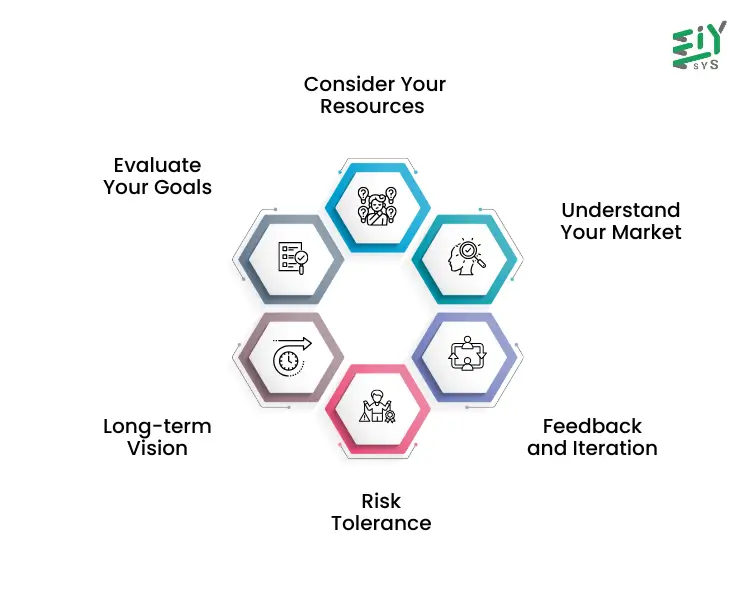
- Evaluate Your Goals : If your main objective is to quickly test and validate your idea with limited resources, starting with an MVP first makes a lot of sense. It allows you to launch a basic version of your product to see how the market responds without investing heavily upfront. However, if your goal is to create something that stands out in the market and provides a memorable user experience, then starting with a more developed version, such as an MDP or MAP, could be a better fit.
- Consider Your Resources : One of the biggest advantages of starting with an MVP first is that it requires fewer resources in terms of time, budget, and team size. If you have limited resources, an MVP enables you to move quickly and learn from real user feedback.
- Understand Your Market : Your decision on which product stage to start with should take into account the competitiveness of your market. In highly competitive industries, launching with just an MVP might not be enough to attract attention or differentiate your product. You may need to move straight to an MLP or MDP to truly stand out.
- Feedback and Iteration:A key benefit of launching an MVP is the ability to collect user feedback early. This iterative process helps you understand what your customers truly want, allowing you to make informed decisions about the next steps. If your MVP receives positive feedback and users are willing to pay for it, this could indicate that it’s time to evolve into an MMP or MDP for broader market appeal.
- Risk Tolerance : Launching an MVP involves less financial and operational risk compared to more fully developed products like an MAP, which require significant investment. However, an MVP means lower potential immediate returns, as it’s a simpler version of your product. If you’re comfortable with taking higher risks and have the resources to back a more polished product from the start, you might choose to go straight to an MDP or MAP in hopes of higher rewards.
- Long-term Vision : Your product’s long-term success will depend on your vision. If you want to create a product that not only solves a problem but becomes essential to users’ lives, you might need to skip the MVP and move directly to a more comprehensive version, like an MLP, MDP, or MAP. That said, launching with an MVP helps you refine the product based on actual user insights, making it easier to eventually reach your long-term goals.
Starting with an MVP first gives you the opportunity to test your idea with minimal risk and expense.
Why Should You Build An MVP First?
A. Validating Market Need
Why build an MVP first? Here are the reasons:
- Market Research: An MVP allows you to study industry trends, analyze competitors, and understand customer preferences, ensuring your product aligns with market needs.
- Identifying Audience and Pain Points: It helps pinpoint your target audience and their specific problems, using early feedback to tailor your product.
- Testing Product-Market Fit: The MVP serves as a testing ground to assess whether your product resonates with users, allowing adjustments before a full launch.
Validating the market need through an MVP minimizes the risk of investing in a product that might not connect with customers, increasing the chances of long-term success.
B. Minimizing Development Costs and Time
- Focus on Core Features: By developing only the essential features, you avoid wasting time on unnecessary complexity and reduce initial costs.
- Efficient Development: The MVP approach avoids over-engineering, ensuring that resources are spent only on what truly matters.
- Rapid Prototyping and Iteration: Instead of building a fully developed product, an MVP lets you quickly test, get feedback, and refine your offering in short cycles, speeding up the process.
C. Mitigating Risks and Uncertainty
An MVP helps minimize risks and uncertainty:
- Early Risk Identification: It allows you to spot potential challenges early, enabling adjustments before heavy investment.
- User Feedback: Early feedback helps you understand user needs and refine your product to fit the market better.
- Data-Driven Decisions: An MVP gives you concrete data on how users interact with your product, helping you make informed decisions.
D. Gaining Early User Feedback and Engagement
Building an MVP also helps you engage users early:
- Attract Early Adopters: MVPs create opportunities to build a loyal community of early adopters who provide valuable feedback and help spread the word.
- User Insights: Through direct feedback, you can improve the product by addressing pain points and aligning it better with user needs.
- Increased Retention: Engaging users early boosts satisfaction and retention, as users feel their feedback is valued.
E. Attracting Investors and Stakeholders
An MVP is key to attracting investors:
- Proof of Concept: It demonstrates that your product has potential and market demand.
- User Metrics: The MVP provides data on user engagement and growth, showing investors that the product is gaining traction.
- Credibility: A successful MVP enhances your credibility, helping to secure funding and support.
F. Iterative Product Development and Continuous Improvement
An MVP supports agile, continuous improvement:
- Agile Development: MVPs encourage a flexible, iterative development process, allowing you to quickly adapt to market needs and user feedback.
- Incorporating Feedback: Regular user feedback ensures your product evolves to meet customer expectations.
- Refined Product: With each iteration, the product improves, becoming more market-oriented and competitive.
Why build an MVP first? By focusing on these aspects, you can streamline your development process, reduce risks, and ensure the product meets the actual needs of your market.
What Is The MVP Approach For Startups?
The MVP approach for startups is a product development strategy that emphasises launching a product with just the core features necessary to attract and engage early adopters.
Primary Goal : The primary goal of this approach is to learn as much as possible about your target customers with minimal effort, time, and resources. By focusing on the essentials, startups can test their product idea quickly, reducing the risk of investing heavily in a full-scale launch before validating market demand.
The MVP approach offers several key benefits for startups.
- First, it helps mitigate risk by allowing companies to test the market with a scaled-back version of their product, making it easier to gauge whether there’s enough interest to justify further investment.
- It also enables startups to launch their products faster, saving valuable time and money in the early stages.
- This rapid launch provides an opportunity to gain valuable insights into user needs and preferences, which can inform the next steps in the product development process.
- The process of implementing an MVP typically involves prioritising the most essential product features, then delivering a version of the product that includes only those key elements.
- After the initial release, startups can gather feedback from early users to better understand their pain points and desires.
- Based on this feedback, companies can quickly release updates and improvements, iterating on the product in a way that ensures it better aligns with user expectations.
- This feedback loop is essential for refining the product, and it helps startups create a clear product roadmap that is shaped by real customer input, rather than assumptions.
- The concept of the MVP was popularised by Eric Ries as part of his Lean Startup methodology, which advocates for rapid experimentation and learning.
- An MVP can take various forms, depending on the nature of the startup and the product.
- Common types of MVPs include a landing page MVP, a concierge MVP, a digital MVP, a video MVP , a Wizard of Oz MVP , and a piecemeal MVP .
- By adopting the MVP approach for startups businesses can accelerate product development, minimise waste, and focus on creating a solution that truly meets the needs of their target market.
- This lean methodology not only reduces the financial burden of early-stage development but also helps ensure that the product evolves in a way that has a higher likelihood of success in the market.
Conclusion
At EIY SYS, we recommend starting with an MVP for mobile app development as an effective way to reduce risks and test your product idea. The MVP mobile app strategy allows you to focus on essential features, gather user insights, and refine the app quickly. Leveraging the benefits of MVP in app development helps save both time and resources while evaluating market demand.
By starting with MVP for apps, businesses can reduce costs, make informed decisions, and boost their chances of success. The MVP approach for startups speeds up development and ensures better market alignment.
Frequently Asked Questions
MVP, or Minimum Viable Product, refers to a streamlined version of a mobile app that includes only the core features essential to solve a specific problem and meet the needs of early users. It is designed to validate an idea quickly and cost-effectively while providing enough functionality for user interaction and feedback.
Starting with an MVP helps you minimize risks and costs while testing your app idea in the market. It allows you to focus on the app's primary purpose, gather real-world feedback from users, and validate your concept before investing in a fully-featured product. By prioritizing essentials, you can ensure a faster launch, address user needs effectively, and avoid unnecessary development expenses.
While both MVPs and prototypes are early-stage tools, a prototype is a visual or interactive representation of the app that demonstrates design and user flow without being functional. In contrast, an MVP is a working product with minimal features that users can interact with, offering tangible value and helping to validate the app's concept in real market conditions.
Developing an MVP offers multiple benefits, including cost efficiency, as it requires fewer resources than a full-scale product. It accelerates your time-to-market, enabling you to launch quickly and stay ahead of competitors. The user feedback collected from an MVP helps you prioritize improvements, validate assumptions, and reduce the risk of failure. Overall, it serves as a strategic tool to refine and scale your app effectively.
An MVP should focus on the app's core functionality, addressing the main problem it aims to solve. It should align with your unique value proposition while maintaining a simple and intuitive user experience. Avoid including extra features that could dilute the app’s purpose or delay the launch; instead, ensure that the basic features deliver value and usability.