
Mobile apps have become an integral part of everyday life, providing a variety of services and functionalities with just a few taps. Whether it’s shopping, banking, or entertainment, there’s an app for nearly everything. As a result, more business owners are opting for custom mobile app development services to meet their specific needs and enhance customer satisfaction. Knowing the Mobile App Development Timeline is crucial to managing the process and delivering a successful app.
For business owners, understanding the development process and timeline is essential. The Mobile App Development Timeline can differ greatly depending on the type of app being developed. A basic informational app may take less time, whereas a complex mobile game app might require more extensive testing and approval from app stores.
Several factors, such as the app’s features, design complexity, platform compatibility, and regulatory considerations, all contribute to determining the overall development time.
What Is The App Development Process?
The app development process refers to the complete journey of creating an app, starting from ideation and design to its development and final execution. According to Flora, H.K., Wang, X., and Chande, S.V. (2014), the MAD process is distinct from traditional software development because it requires a deep understanding of mobile applications. They argue that aspects such as functionality, reliability, flexibility, accessibility, portability, efficiency, maintainability, usability, and responsiveness, which are adapted based on user needs, set mobile app development apart from desktop application development.
How Can Businesses Reduce Mobile App Launch Time?
- Assess and evaluate: Analyze the mobile app launch time, considering both cold and warm starts.
- Optimize app size: Reduce the overall size of the app.
- Enhance code performance: Improve the efficiency of how the code is executed.
- Limit dependencies: Reduce the app’s reliance on external libraries and frameworks.
- Utilize mergeable dynamic libraries: Use dynamic libraries that can be merged.
- Implement lazy loading: Load content only when necessary and asynchronously to speed up mobile app launch time.
- Reduce binder calls: Minimize the use of functions that make binder calls.
- Cache repeated values: Store commonly used values to avoid unnecessary calls.
- Offload non-blocking tasks: Move tasks that don’t block other operations to background threads.
How Many Stages Are Involved In Mobile App Development?
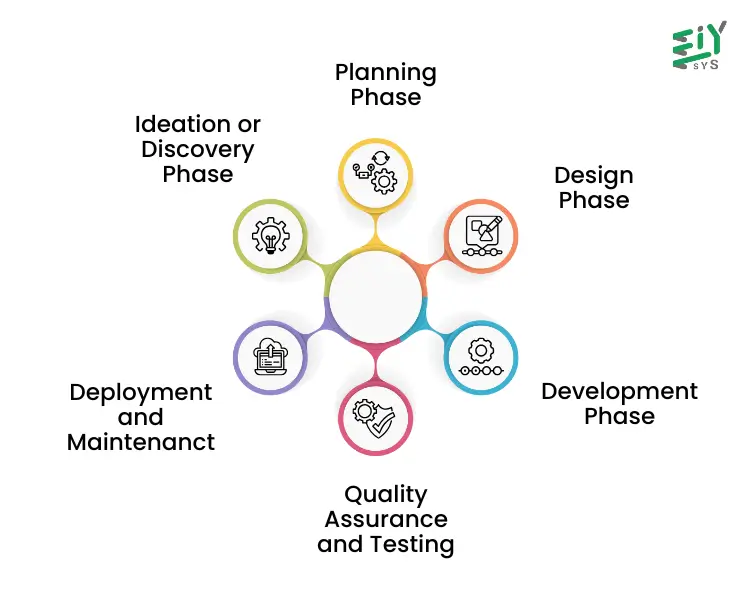
- Ideation or Discovery Phase: This initial phase involves gathering input from stakeholders to identify key ideas or problems. Developers define the app’s goals, target audience, and necessary features, ensuring they align with user needs. The aim is to convert ideas into detailed technical requirements, which is crucial for the app development stages.
- Planning Phase: In this stage, the team collects and organizes user requirements, defines the scope of the project, and sets cost and timeline estimates. Resources are allocated, risks are identified, and goals for performance, security, and usability are established, making sure the project is feasible and on track across all app development stages.
- Design Phase: During design, a prototype is created based on the app’s requirements. Feedback from users and stakeholders helps refine the design, ensuring a smooth user experience. A well-executed design avoids delays and issues that could derail the project.
- Development Phase: In this phase, the app is built according to the specified requirements using the appropriate technology. A team works on different components of the app to create a functional Minimum Viable Product (MVP), aligned with the project’s goals.
- Quality Assurance and Testing: Testing begins once development is complete to find and fix any bugs and ensure the app works as intended. This includes automated and real-world tests to check for functionality, security, and user experience before the app is launched.
Deployment and Maintenance: Once the app passes testing, it is deployed and released. Ongoing maintenance and updates are carried out to fix bugs, improve functionality, and respond to user feedback, ensuring the app stays relevant and efficient over time.
How Do You Calculate Development Time Estimates For An App?
- Utilizing Past Data: It is often helpful to refer to previous projects completed by the company when making development time estimates. However, this should not be the sole basis for estimating time, as each project is unique. Differences between the current project and past ones can significantly affect the development timeline.
- Analogy-Based Estimation: When estimating the time needed for a software project, it is essential to consider the differences between past and current projects. Instead of relying solely on previous projects, you should account for variations in scope or technology stack. This allows for more accurate development time estimates.
- Bottom-up Estimation: This approach involves breaking down each task in the development process and estimating the time needed to complete each step or milestone. While detailed and effective, this method can be time-consuming due to its comprehensive nature.
- Top-down Estimation : With top-down estimation, you start by calculating the overall time needed for the entire project before dividing it into smaller, more manageable tasks or phases.
- Parametric Estimation:This method uses statistical models based on data from past or concurrent projects to estimate the time required for a new project. By applying insights from previous work, developers can generate more accurate time estimates.
- Three-point Estimation:This technique involves creating three estimates for each task: optimistic, pessimistic, and most likely. The final time estimate is then calculated by averaging these three values.
- Function Point Analysis:Function point analysis estimates the time needed for a project based on the number of features or functions the software will have. Larger projects with more complex features typically require more time due to increased integration and development work.
- Agile Methodologies: Function point analysis is especially useful for agile projects. In agile development, estimation focuses more on the effort required for tasks rather than precise time calculations. Typically, the product owner presents user stories, and the development team discusses the features, providing estimates by selecting cards that represent their time estimates. If there is disagreement, further discussion occurs until consensus is reached, with all judgments recorded during the process.
Testing plays a crucial role in the mobile development cycles to ensure the app works correctly, performs efficiently, and remains secure:
- Testing from the start: Beginning the testing process early in the mobile development cycles helps reduce costs, as it’s more expensive to address issues later on.
- Comprehensive testing:The testing should be thorough, covering various aspects like usability, compatibility, user interface, security, performance, and stress.
- Real-world input : Involving the intended users in testing offers valuable insights into how the app behaves in real-life situations.
- Risk management: Testing early helps identify defects and failures, minimizing risks related to security, quality, and performance.
- Seamless user experience: Ensuring the app is optimized for common mobile operating systems guarantees a consistent user experience across different devices.
What Factors Influence The Mobile App Development Timeline?
The keyword Mobile App Development Timeline included:
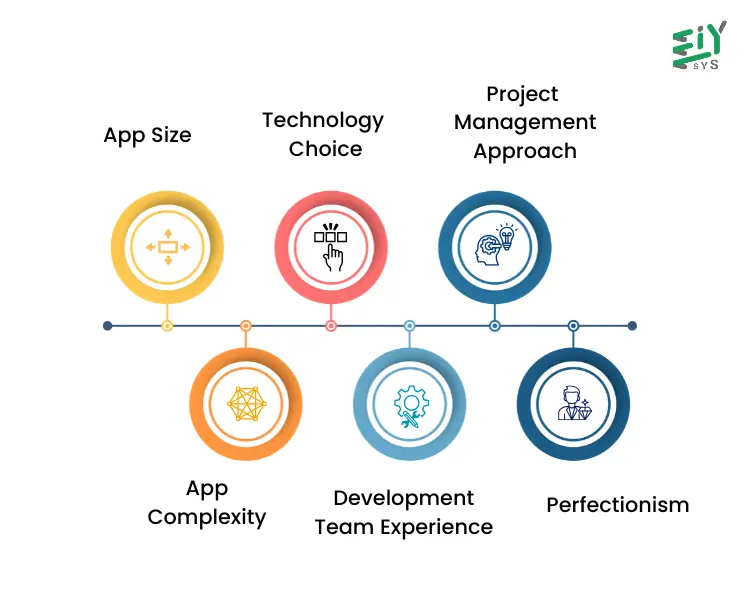
- App Size : The size of your app directly affects the Mobile App Development Timeline. Smaller apps with fewer features may take 2-3 months, while larger, more complex apps with features like e-commerce or social media integration will take longer due to the increased need for planning, coding, and testing. Larger apps also require ongoing maintenance.
- App Complexity : More complex apps with advanced features (e.g., AI or AR) take longer to develop. Adding multiple features or integrating third-party services means more time for coding and testing. Complex systems need careful planning to avoid breaking, ensuring better performance and user satisfaction.
- Technology Choice : The technology stack you choose impacts development time. Native apps take longer to develop since they’re built separately for iOS or Android, while cross-platform solutions can speed things up but may compromise performance. Third-party integrations like payments or social media logins can also complicate development.
- Development Team Experience : Experienced developers can navigate challenges more efficiently, saving time and money. They are better at foreseeing issues and ensuring quality, which can speed up the development process and avoid delays or reworks.
- Project Management Approach :How you manage your project affects its speed. Agile methodologies break the project into smaller tasks, allowing for flexibility and quicker problem-solving. This approach can result in faster development, while Waterfall is more linear but less adaptable.
- Perfectionism : Chasing perfection can stretch development timelines unnecessarily. It’s better to focus on creating a functional app that solves user problems, then improve it in future updates based on feedback. Strive for balance instead of aiming for an unrealistic ideal.
How Does The Complexity Of The App Contribute To Various App Development Challenges?
The complexity of an app introduces several app development challenges, including:
- Data Management:Handling large volumes of data across different devices and networks can be difficult, especially for industries like retail, healthcare, and finance that rely heavily on data.
- Development Cost: Developing more complex apps often requires additional coding, testing, and optimization, which can significantly increase the overall cost.
- Security: Complex apps, especially in enterprise environments, can be more vulnerable to cyber threats due to the number of services they integrate.
- Development Time: The development of more intricate apps can take an extended period, often ranging from several months to over a year.
- Multithreading: To support multiple users and requests, mobile apps need to be multithreaded, which can add to the development time.
Interdisciplinary Collaboration: Ineffective coordination between different teams can result in project delays, higher costs, and various other complications.
Conclusion
In conclusion, EIY SYS understands that the Mobile App Development Timeline is influenced by several critical factors, such as app size, complexity, and the chosen technology stack. By evaluating the app development process and considering key elements like user experience, security, and cost, businesses can better manage their development journey. The mobile app launch time can be optimized by focusing on efficient coding and testing practices, while the various app development stages help ensure the project is on track. Accurate development time estimates and a thoughtful approach to mobile development cycles are essential to avoid unnecessary delays.
Additionally, addressing common app development challenges, such as data management and cross-team collaboration, ensures a smoother development process. With the right strategies and expert guidance, businesses can successfully bring their mobile apps to market on time and within budget.
Frequently Asked Questions
The Mobile App Development Timeline refers to the amount of time it takes to develop an app, from the initial idea to its final launch. The timeline can vary widely depending on factors like the complexity of the app, the features it needs, the platform it will run on, and how the development process is managed. Simpler apps might be completed in a few months, while more complex apps could take much longer.
The app development process generally consists of several steps: it starts with the Ideation or Discovery phase, followed by Planning, Design, Development, Quality Assurance & Testing, and finally, Deployment & Maintenance. Each of these stages is important for ensuring that the app is user-friendly, functional, and secure.
To reduce mobile app launch time, businesses can focus on optimizing the app's size, improving the efficiency of the code, minimizing external dependencies, using lazy loading for content, and moving tasks that don't need to be immediate into the background. These strategies can make the app launch process smoother and faster.
Development time estimates are calculated through various methods, such as looking at past projects, comparing the current project with similar ones, or breaking the project down into smaller tasks. Factors like the complexity of the app, the technology being used, and the experience of the development team all play a role in these estimates.
Several factors can impact the Mobile App Development Timeline, including the app’s size, how complex the features are, the technology stack chosen, the experience level of the development team, how the project is managed, and how much emphasis is placed on perfection. These factors all contribute to how long the app development process will take.
When an app is more complex, it introduces development challenges like managing large amounts of data, ensuring a smooth user experience across different devices, increasing security risks, and raising costs. The development process also takes longer, especially if the app needs to handle multiple tasks at once or involve different teams collaborating.
Testing is crucial in the development process to make sure the app works correctly, performs well, and is secure. Starting testing early, performing thorough checks, and gathering feedback from real users helps identify and fix issues before launch, reducing risks and ensuring a smoother user experience.
To tackle app development challenges, businesses should focus on improving collaboration between teams, managing data efficiently, creating a consistent user experience across devices, and making sure security is a top priority. Clear communication and proactive planning help avoid delays and additional costs, ensuring the development process stays on track.