


An MVP focuses on quickly proving an idea by delivering minimal capabilities. An MVP full- scale product, on the other hand, is the final one designed for a wide market and has all the stated criteria. Every great product begins with a strong vision, but bringing that vision to life takes a strategic approach. For startups, developing a Minimum Viable Product (MVP) is an essential first step. An MVP launches with only the core features needed to address the main problem for early users, keeping initial costs and risks low while gathering important user feedback.
But moving from an MVP to a full-scale product involves more than just adding new features. It demands thorough planning, enhancements based on user feedback, and building a scalable infrastructure that can handle future growth and changes in the market.
Mastering this transition can set apart startups that struggle from those that succeed. This guide will help you navigate the key stages of taking your MVP to a fully developed product, empowering you to make smart, customer-focused decisions that drive your business forward.
How Do You Scale an MVP into a Full Product ?
Key Steps to Successfully Scale an MVP to a Full Product
1. Refining Your Product Based on User Feedback
One of the first steps in scaling MVP to product is measuring customer satisfaction by gathering feedback from early users. Analysing this data provides invaluable insights into areas that need improvement. Use the feedback to refine the product and ensure it aligns with user expectations and pain points.
2. Enhancing the User Experience
The user interface (UI) and design play a significant role in product success. As you move from MVP to a full product, pay close attention to making the UI visually appealing, intuitive, and easy to navigate. Simplifying menus, buttons, and processes ensures users can find what they need quickly, creating a seamless experience that encourages adoption.
3. Scaling Infrastructure to Meet User Demand
As you scale, your infrastructure must support increasing user demand. It’s essential to audit your current setup to identify bottlenecks that could lead to system crashes or poor performance. Work closely with your development team to upgrade servers, databases, and other critical components, ensuring your platform is robust enough for long-term growth.
4. Expanding Your Feature Set
After refining your MVP and scaling the infrastructure, you can focus on adding new features. The MVP development process includes identifying features that address the core needs of your target audience. Conduct market research and analyse competitor offerings to identify gaps and opportunities to expand your product’s functionality, adding new capabilities aligned with user preferences.
5. Pre-Launch Testing and Quality Assurance
Before launching your full product, rigorous testing is vital. Manual software and QA testing help identify and resolve bugs or usability issues, ensuring a smooth user experience. Testing can minimise negative reviews and customer churn. Frequent updates and a commitment to quality assurance ensure the product remains reliable and user-friendly.
6. Investing in Robust Security
Security is critical for building trust with users and safeguarding sensitive data. As your product scales, identify vulnerabilities in your infrastructure, code, and data storage systems. Conduct regular security audits, implement encryption, secure authentication, and access controls, and stay proactive with cybersecurity measures. These actions protect both your business and users while maintaining confidence in your product.
7. Developing a Marketing Plan
Having a great product is just one piece of the puzzle. To successfully scale your MVP to a full product, you need an effective marketing strategy. Start by outlining your target audience and creating buyer personas. Highlight how your product addresses their pain points better than competitors. Craft a compelling brand message that emphasises your product’s unique value and competitive advantage. Tailor your marketing efforts to resonate with your audience and drive engagement.
By following these steps, you can successfully transition from scaling MVP to product , ensuring that your full-scale product meets the needs of your market while providing a solid foundation for long-term growth. The MVP development process is essential for validating your core ideas, but it’s the careful planning, user-centred enhancements, and strategic marketing that will turn your MVP into a product that resonates with a wider audience.
What Is the MVP Development Process ?
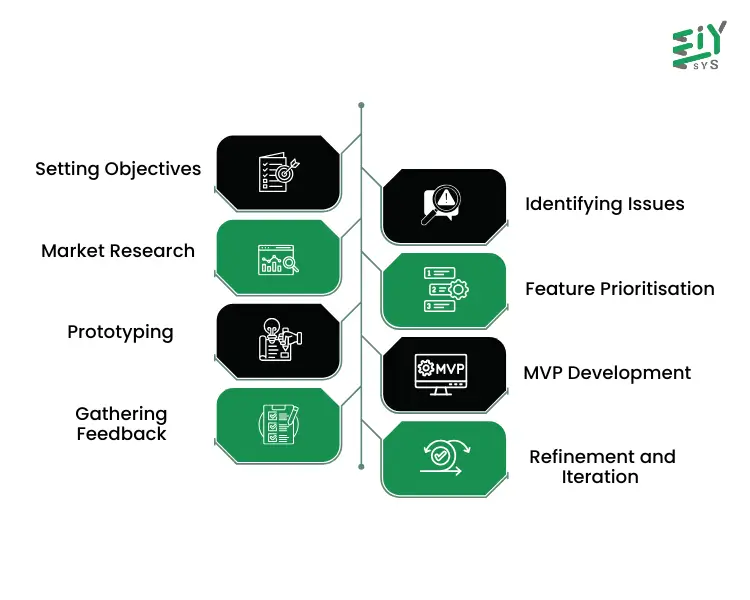
The process of MVP development are as follows :
The MVP development process is a structured approach that allows startups to validate their ideas with minimal investment and effort. It focuses on building a functional product that addresses core user needs, gathering feedback, and then refining the product based on insights from real-world users. Here’s an in-depth look at each step of this process:
- Identifying Issues: Before starting development, you need to clearly articulate the specific problems your product aims to address. This process helps narrow down the features and functionalities that are crucial to solving those issues. By focusing on solving real pain points, you ensure that the MVP remains simple and effective.
- Market Research: Conducting thorough research is critical. This involves analysing your competitors, understanding market trends, and learning about user preferences. Market research allows you to identify opportunities, avoid potential pitfalls, and ensure there is demand for your solution. It also helps you understand how your product can stand out in a crowded market.
- Feature Prioritisation: After identifying the core problems, it’s time to determine which features will address those issues most effectively. Prioritise essential functionalities that provide value to the user, and avoid overcomplicating the product with unnecessary features. The goal of the MVP is to deliver only what’s necessary to solve the problem, which enables you to test the core concept without investing in extra, unproven features.
- Prototyping : Prototyping allows you to visualise how your product will work. Building a prototype helps you test the concept in a low-cost, low-effort environment, providing valuable insights before investing in full-scale development. It’s a way to experiment and evaluate the viability of your idea before proceeding to the next stages.
- MVP Development : At this stage, you build a functional MVP, an early version of the product that includes only the most essential features. The MVP should be simple but effective in addressing the core problem, and should serve as a test model to gather initial feedback from real users.
- Gathering Feedback: Feedback is the cornerstone of the MVP process. Once your MVP is in the hands of early adopters, collect data on their experiences. Analyse their usage patterns, listen to their feedback, and observe any challenges or pain points they encounter. This data will provide critical insights into how well the product meets user needs.
- Refinement and Iteration: Based on user feedback, make necessary adjustments to your MVP. Refining and iterating on your product helps ensure that it better aligns with user expectations. By continuously improving the MVP, you can optimise the product, add features, and make necessary changes before expanding further.
This MVP development process emphasises speed and validation. Unlike full-scale product development, it’s designed to test assumptions quickly and affordably, enabling startups to refine their product based on real feedback. This agile approach minimises risk and allows businesses to evolve their ideas without significant upfront investment.
Why is an MVP Important for Startups?
An MVP is vital for startups because it provides a cost-effective way to validate ideas, gather insights, and test the market. Here are some key reasons why MVPs are invaluable for early-stage businesses:
- Faster Market Entry: Launching an MVP allows startups to enter the market more quickly. With a simplified version of the product, startups can start collecting feedback and making improvements while avoiding the long development timelines required for a full-scale product.
- Attracting Investors: For investors, seeing a working MVP provides tangible proof that the startup’s concept has potential. Rather than relying on theoretical business plans or concepts, an MVP allows investors to assess the product’s viability and user demand. This can help secure early-stage funding with a more concrete demonstration of the product’s worth.
- Cost and Time Efficiency: Building an MVP is far less expensive and time-consuming than creating a fully-featured product. This is especially important for startups with limited resources. By focusing on only the core features, businesses can save both time and money while still obtaining valuable user feedback.
- Identifying Weaknesses Early: Launching an MVP allows startups to spot issues in the product that might not have been evident during development. Whether it’s a feature that doesn’t resonate with users or a technical glitch, catching these problems early helps to mitigate the risk of costly mistakes down the line.
- Quick Iteration and Improvement: With an MVP, startups can rapidly adjust their product based on feedback. The ability to quickly implement changes and improvements allows the business to stay agile and respond to market needs more effectively.
- Confirming Product-Market Fit: The ultimate goal of an MVP is to confirm whether the product fits the market. Feedback from early users helps determine if the product solves the identified problem and if there is real demand for it. This step is crucial to ensure that the product is viable before scaling up.
Scaling Product After MVP
Scaling a product after MVP (Minimum Viable Product) involves transforming the initial version of your product into a full-scale offering capable of supporting a larger audience. This process requires a detailed strategy to refine and expand the product, ensuring that it can meet the demands of a growing user base.
The key considerations for scaling MVP to product include:
- Refining Based on User Feedback: After gathering feedback from your initial users, prioritize improvements based on what matters most. Look for common pain points and focus on enhancing the areas that will most positively impact the user experience. This feedback loop is critical in evolving your MVP into a full-scale product that truly resonates with your target audience.
- Improving Performance: As your user base grows, ensure that your product can handle increased demand. Focus on performance optimizations, such as faster load times, smoother functionality, and scalability to handle larger numbers of users. These adjustments will help transition your MVP to product effectively, allowing it to meet the performance standards required by a larger audience.
- Adding New Features: The MVP is just the starting point. As you learn more about your customers, begin incorporating new features that align with their needs and desires. Market research and competitor analysis can help identify opportunities for growth. Adding features that enhance your product offering can be a crucial step in scaling MVP to product and increasing user engagement.
- Building Strong Infrastructure: A scalable infrastructure is essential for supporting growth. Evaluate your current setup and work with your development team to ensure that your systems—whether they are servers, databases, or APIs—can handle increased traffic and more complex demands. Strengthening the infrastructure is a vital part of scaling your MVP to product effectively.
- Effective Team Development: Scaling a product requires a well-organized team capable of handling new challenges. As your product grows, you may need to expand your team, invest in training, and ensure that everyone has the resources needed to support the product’s development and growth. This step helps to maintain the efficiency and agility of your operations as you scale from MVP to product.
- Enhancing Customer Support: As the user base increases, providing excellent customer support becomes even more critical. Strengthening your customer support systems ensures that your growing user base has a positive experience with your product and is more likely to continue using it. This support system will be crucial as your product moves from MVP to a full-scale offering.
By focusing on these areas, you can effectively transition from MVP to full-scale product, ensuring that it is capable of meeting the demands of a larger, more diverse customer base.
MVP Scaling Strategies and Full Product Development Steps ?
When transitioning from an MVP to a fully developed product, follow a structured approach to ensure success. This includes expanding the feature set, refining infrastructure, and continuously iterating based on feedback. The full product development steps will guide you through this process, which involves adding new features, improving user experience, and investing in robust infrastructure to scale effectively.
By understanding the MVP development process and how to approach scaling product after MVP startups can confidently move from an early-stage prototype to a fully realised product that’s ready for the broader market. The key is to remain flexible, responsive to feedback, and focused on solving user problems while gradually expanding the product’s capabilities.
Confirm Product-Market Fit : The primary purpose of an MVP is to collect feedback and validate that the product meets market needs. Ignoring user feedback can result in a product that fails to address customer requirements.
What Are the Essential Steps in Full Product Development?
The full product development process is a comprehensive journey that transforms an initial idea into a finished, market-ready product. This process involves several stages, each essential for creating a successful product that meets both customer needs and business objectives.
The essential steps involved in the MVP development process and transitioning to a full product:
- Generate an Idea: The first step in product development is ideation coming up with an idea for a product. Many entrepreneurs struggle with this stage, often waiting for the “perfect” idea to come to them. However, the best products often come from iterating on existing ideas or improving an already successful concept. The key is to identify a real problem and brainstorm how your product will provide a solution.
- Conduct Market Research: Before diving into production, it’s essential to validate your product idea to ensure that there is demand for it. Market research helps you avoid wasting resources on a product that might not sell. Here are several methods for validating product ideas during the MVP development process .
- Surveys: Send out online surveys to potential users to gather feedback on your idea.
- Crowdfunding: Launch a crowdfunding campaign to test interest and raise funds.
- Test Marketing: Release your idea to a small group of your target audience and gather feedback.
- Google Trends: Research market demand using tools like Google Trends to evaluate interest in similar products.
- Pre-Orders/Email Opt-ins: Measure interest by offering pre-orders or tracking email sign-ups.
- Forums and Communities: Engage with communities for initial feedback on your concept.
- Feasibility Study: Run a feasibility study to determine whether your product idea is worth the investment.
- Develop a Plan: Once you’ve validated your idea, it’s crucial to develop a solid plan. Product development can be complex and multifaceted, so taking time to outline the key steps, milestones, and objectives is vital. Having a product roadmap will guide you through the process, ensuring that resources are allocated properly and timelines are met.
- Create a Prototype: Prototyping is an essential step in the MVP development process. A prototype is a working model of your product that allows you to test its concept, design, and functionality. This step involves creating different versions of your product,iterating and refining until you have a final version that you’re satisfied with. Prototyping may vary in complexity depending on the type of product, but it’s critical for visualising and testing your ideas before mass production.
- Source Materials and Production Partners: Once you have a prototype that you’re happy with, the next step is to source the materials and identify the right production partners. Building your supply chain involves securing vendors and establishing relationships with manufacturers or other partners who will help bring your product to life. At this stage, you’ll ensure that all materials and resources are available for mass production.
- Determine Your Costs: After finalising your prototype and securing production partners, it’s time to assess the cost of bringing your product to market. Calculating the cost of goods sold (COGS) , which includes all the expenses associated with manufacturing, packaging, and shipping your product. This helps you determine an appropriate retail price and profit margin. Understanding your costs early on is crucial for setting your pricing strategy and ensuring the product is financially viable.
- Launch Your Product: With everything in place, it’s time to launch your product to the market. The final step in the full product development steps is introducing your finished product to your target audience. A coordinated product launch is crucial for generating buzz and attracting initial customers. At this stage, your product development team will transition the project to your marketing team, who will drive awareness and sales through promotional campaigns.
By following these full product development steps From idea generation to launch, startups can create a successful product that is ready for the market. Whether you’re in the MVP development process or scaling a product after MVP, ensuring that each step is carefully executed will increase the chances of success and product-market fit.
What Are the Best Strategies for Scaling an MVP Successfully?
- Analyse User Feedback: Utilise both qualitative and quantitative data to understand customer preferences, needs, and areas for enhancement.
- Boost Performance : Focus on enhancing the performance of your product.
- Expand Functionality: new features that align with customer demands.
- Develop a Strong Infrastructure : Establish a reliable and scalable infrastructure for your product.
- Build an Effective Team : Ensure your team is well-equipped and efficient in supporting the product.
- Improve Customer Support : Strengthen and upgrade customer support services.
Conclusion
In conclusion, moving from an MVP to full-scale product is a crucial phase for any startup, and at Eiy Sys, we specialise in helping businesses navigate scaling MVP to product effectively. Through a well-defined MVP development process, startups can fine-tune their product, enhance performance, and scale smoothly.
Whether you’re working on scaling a product after MVP or applying the right MVP scaling strategies, careful planning and iteration are key. By following the full product development steps, companies can ensure their product is well-aligned with market needs and positioned for long-term success.
Frequently Asked Questions
The time to develop an MVP can vary depending on the app's complexity, feature requirements, and team expertise. On average, it may take between two to six months to design, develop, and launch a functional MVP. A well-defined scope and efficient collaboration with the development team can significantly influence the timeline.
Yes, an MVP can generate revenue if it includes basic monetization features such as in-app purchases, advertisements, or subscription plans. Launching an MVP with revenue models helps validate its profitability early on and provides insights into user behavior, allowing you to optimize future updates to increase earnings.
MVPs are beneficial across various industries, including e-commerce, healthcare, education, fintech, and social networking. They are particularly valuable for startups looking to test innovative ideas and for established businesses exploring new markets or product lines. MVPs enable quick market entry and ensure that resources are allocated to validated ideas.
You can collect feedback from MVP users through in-app surveys, app reviews, and ratings, or by analyzing data from analytics tools that track user behavior. Direct communication channels, such as email or customer support, also allow you to engage with users and understand their pain points and preferences.
Post-launch, the focus shifts to analyzing user feedback, tracking performance metrics, and identifying areas for improvement. This data informs the iterative development process, where new features are added, and existing ones are refined based on real user needs. As your app gains traction, you can scale the product and expand its reach in the market.
