In software development, testing your product is essential to knowing what your consumer wants. Creating an MVP development helps you to achieve this.Before releasing the full version of the program with all of its capabilities, an MVP (Minimum Viable Product) is a crucial stage in the development process that lets you test and preview it and make any necessary changes.
This MVP development service is really affordable, based on our experience at Trio. Before making a bigger commitment, you can test your ideas with a smaller one. Since it enables concept validation early in the MVP development cycle, we also suggest it as a tool for technology-driven business growth. I’ll talk about some of my experiences creating Agile MVP development in this post. When designing software or an MVP app development, understand the steps and why they are crucial.
What is Minimum Viable Product (MVP) Development?
Your Product validation techniques or service is in beta, or test, phase when it’s called an MVP, or Minimum Viable Product. Put another way, it’s a scalable technological solution that can assist your company in reducing waste and maximizing resources while helping it improve its Product validation techniques based on actual user feedback. It’s critical to comprehend the true needs of the end users when developing customer-oriented software.
In this sense, you’ll need to test your project—which is where MVP development comes in—to make sure you have the data and comprehension of what your customer wants. It is a component of an all-encompassing tech management approach that allows you to connect customer needs and product development in a way that is otherwise impossible. The Lean Startup methodology, which seeks to cut waste, streamline business procedures and make startup easier rather than harder, includes the concept of MVP (Minimum Viable Product).
What Are an MVP's Principal Advantages?
For businesses engaged in software and Agile MVP app development, the process of creating an MVP development has numerous advantages.You may have to pay more up front for software development and run more risk when releasing your Product validation techniques onto the market if you don’t have an MVP. MVP acts as a trial version of your idea that lets you see it in action and tweak it to improve its usability and appeal to the user.< It will be considerably more difficult to make adjustments later on if you launch your MVP app development with a lot of functionality. It is crucial to provide dependable technology solutions since it guarantees that your Product validation techniques fulfills consumer needs prior to widespread adoption.
Additionally, an MVP will assist you with smooth tech integration, enabling you to progressively roll out new features in response to user input. Additionally, because an Agile MVP is developed step-by-step, it is far less expensive to construct than a final version. In addition, you can put any money you make from the MVP app development sales back into creating new features. Finally, creating an MVP can help draw in investors. You will have more opportunities to attract capital and interest from venture capitalists or angel investors if your product is working.
What are the steps to create an MVP Development?
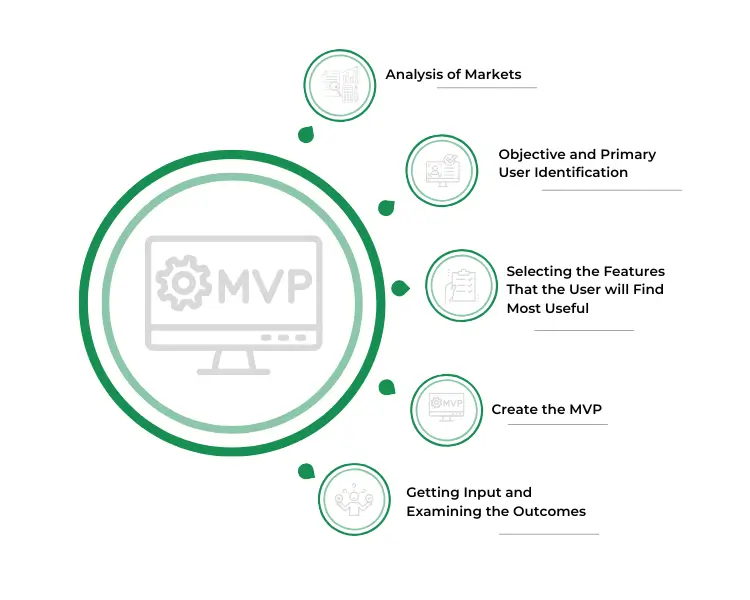
1. Analysis of Markets
To prevent major money and time losses, regardless of how creative and captivating your idea is, you must conduct market research to evaluate rivals and demand. Therefore, market research is a non-tech business solution that helps you establish the foundation for a successful MVP and, eventually, a finished Product validation techniques by offering crucial insights into customer wants and market caps. When you go to the MVP development stage, familiarize yourself with your target market. Before you even start building an MVP, market research helps you figure out who your target consumers are, what makes your concept special and workable, what problems it might solve and how to make your Product validation techniques fit their needs.
Remember that the secret to developing an MVP effectively is to demonstrate to your target market the benefits that your product will offer. Therefore, it’s critical to determine how the user may benefit and how to offer value to the customers throughout market research. It is important to conduct market research on a regular basis, not just in the beginning. Building a reliable tech solution greatly depends on making sure your product concept is proven before moving forward with MVP development and expansion.
2. Objective and Primary User Identification
This stage is essential for full tech management and may be accomplished by defining precise metrics that will be used to gauge the success of the launch. As a result, both user needs and specific business objectives are met by your development process. By concentrating on features that offer the most value, firms may use technology to expand by setting clear goals.
When creating Agile MVP app development, you can gauge:
- The quantity of downloads within a specific time frame
- The total quantity of downloads
- Score for review and comments
- How much time users spend using the MVP app development
- Anything else that enables you to determine whether your MVP needs to be adjusted or if it is satisfying your customers’ demands
Data and facts can give you a realistic perspective, help you set specific objectives and define what success looks like.
3. Selecting the Features That the User will Find Most Useful
It’s time to design your product once you have a firm understanding of the value you are providing to users, your business objectives and how to merge these two factors. Consider the end user while creating customer journey maps. This will help you determine the best course of action to take in order to address the user’s issue and will also give you information based on user behavior.The user’s journey also includes the ideas, emotions and choices that lead to the user acting. Journeys show how a customer interacts with your product in visual form.
It is important to remember that your users’ thoughts and emotions when utilizing your Product validation techniques will have a significant impact on how they make decisions. Additionally, you can use this information to reroute users from one Product validation techniques feature to another. Answer the questions about users and their personalities, decision-making processes, end goals and a sequence of steps that users must follow to achieve these goals in order to comprehend your user’s journey. Choose the one for whom you can deliver the greatest value the quickest if you have identified multiple categories of potential clients. It will help you save time when examining the test findings.
You need to decide which features will be included in the Agile MVP and which won’t at this point in the development process. As the central component of your product, concentrate on a smaller quantity that offers the greatest value to the user. Keep in mind that since this is a cost-effective development service, your main goal should be to provide the most value with the fewest resources possible.
4. Create the MVP
With all the facts at your disposal, it’s time to put your dependable tech partner approach into action and start developing an MVP to make sure the first product is solid and up to grade. Since the prototype is a reflection of the final product you are looking to produce, it should be engaging and user-friendly and by no means be able to fall short of quality standards. Pay close attention to the key elements that will provide users with the solution as quickly as feasible. Knowing that you will have the option of future scalability and feature expansion, after your prototype is published you can decide which feature will be prioritized when producing the final version of the product through simple and seamless tech integration.
5. Getting Input and Examining the Outcomes
Measuring the outcomes is, in my opinion, the most crucial step in developing an MVP. This is the actual test of your product’s viability and the results will dictate how the final product is developed moving forward. Pay close attention to what the users are saying. User input can provide you with a very specific concept of how to improve the features, even though you cannot please every user in the market. Reputable tech solutions must include feedback analysis in order to guarantee ongoing development based on actual customer data. Your product will need to be tweaked and modified as it develops, so you must be ready to adapt it to the demands of the market.
Conclusion
The approach of developing a Minimum Viable Product (MVP) has repeatedly shown to be advantageous in the software development life cycle. All of this is a component of a trustworthy tech partner strategy to make sure your products are well-founded and match market demands. Agile MVP development assists companies in gauging the market before making a commitment to ideas that might not work out or require revision to fit consumer demands.
Though it faces a number of challenges, it is a shining star in the Flutter sky. It is up to you to choose the right star from among them. We Eiy sys will leverage this technology to advance a step ahead of others. Do you feel ready? Then buckle up and begin your journey with Eiy sys.
Frequently Asked Questions
The simplest form of a product, known as an MVP (Minimum Viable Product), has the bare minimum of features to appease beta testers and quickly validate the concept while using the least amount of resources.
Before making a significant investment in full-scale development, entrepreneurs can test their product idea in the market quickly and affordably with an MVP, get customer feedback and make well-informed decisions.
The main processes are as follows: determining the central issue, specifying necessary functionalities, generating wireframes or prototypes, constructing the MVP, doing early user testing and refining the design in response to feedback.
Pay attention to features that tackle the main issue your product is meant to resolve. Sort features based on importance to users and make sure they support your main hypotheses.