


A decentralized exchange is an online marketplace where cryptocurrency traders transact directly with each other. Financial transactions can be made more smoothly with the help of DEXs, thereby reducing the need for middlemen such as banks and brokers.
Using a decentralized blockchain security network, decentralized exchanges allow peer-to-peer cryptocurrency trading without a central broker.
Unlike centralized exchanges, decentralized finance crypto exchanges operate through dispersed networks. A single centralized authority does not play a role in its ability to promote trade. In spite of this, it uses blockchain security functionalities, such as AMM algorithms and smart contracts, to facilitate the rapid exchange of cryptocurrency secure asset management. Therefore, DEXs are now more transparent, safer, and less prone to fraud and hacking. There are many famous DEXs, including PancakeSwap, Uniswap, and others.
What is The Function of DEX?
In terms of functionality, decentralized exchanges are not equipped with many features. In order to implement this process, we must create a smart contract. The contract will execute automatically whenever the terms of the agreement are met. The policies and tactics of all companies are governed by smart contracts. They are also capable of serving as a DEX order database without requiring a governing body.
An autonomous market maker (AMM) establishes the price of the token on a DEX using a connection between buyers and sellers. As a result of DEX trading, buyers and sellers can be matched based on the secure asset management available.
What Types of Decentralized Exchanges are Available in The Market?
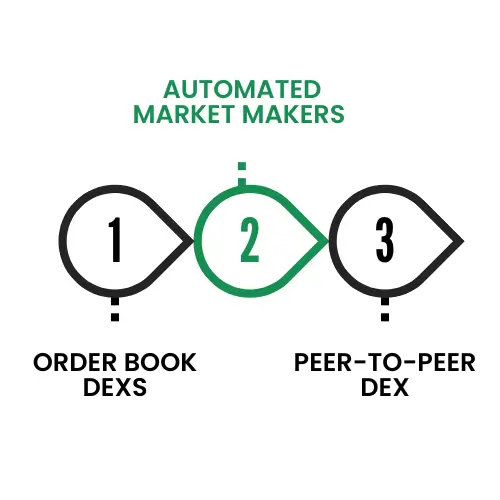
1. Order Book DEXs
- Order books are used during electronic exchanges to store and support buy and sell orders, making it possible for an internal exchange system to match buy and sell orders. DEXs operate similarly as centralized exchanges. Smart contracts, on the other hand, verify and execute smart contracts.
- DEX should display prices and quantities of cryptocurrency trading pairings on its interfaces. As a means of ensuring transparency and accountability, DEX transactions are documented on a public ledger.
- Order book DEXs may exhibit varying degrees of productivity, particularly in stagnant markets or low trading volumes. This might worsen the slippage of predicted transaction price differences. Therefore, order book DEXs can be further divided into off-chain and on-chain versions, each having different features and trade-offs.
2. Automated Market Makers (AMMs)
- Asset management values are determined by algorithms used by automated market makers, as shown above. The platform is also dependent on token availability. This type of DEX is most prevalent because it facilitates rapid liquidity and simplifies access to liquidity. In automated market makers, the difference in value between two secure asset management is constantly estimated by financial robots.
- Renouncing the use of an order book and changing the AMM can allow users to trade their tokens against the price set by an algorithm based on the percentage of tokens in the pool.
- With the help of automated market makers, you can access market liquidity instantly. It is possible for liquidity providers to earn passive income from trading fees, but users are able to receive an allowance for liquidity immediately. Combining faster liquidity with a large number of new coins has enabled the AMM to introduce a large number of new coins. A variety of themes and designs are also available based on the purpose of the application.
3. Peer-to-Peer DEX
- By eliminating the need for order books or market makers, P2P DEX allows traders to trade directly. Trading with low fees offers a major benefit in that you can decide the price on your own. A peer-to-peer system allows for the exchange of data, money, and secure asset management among two or more parties without the involvement of a central authority.
- P2P exchanges provide excellent verification features and allow users to trade directly with different parties, so they can choose their payment method based on the best rate available while benefiting from lower transaction fees.
- The P2P DEX operates on a decentralized finance network, which allows users to maintain control over their private keys. The trading process is facilitated through the use of smart contracts. The smart contract locks the asset management whenever users try to trade until the rules are followed by both parties.
How does trading crypto currencies on a DEX benefit you?
By using smart contracts, DEX trading ensures that they will operate exactly as intended by the user, independent of any centralized parties.
1. Transparency
The transparency of decentralized finance exchanges is generally greater than that of standard exchanges. All information is visible to traders and users using blockchain security smart contracts on the platform. Transparency and platform confidence have increased as a result.
2. Privacy
Traders on DEX find trading on the exchange to be the most advantageous because there are no KYC or AML requirements, nor do they have to provide any data. Users can trade without disclosing personal information to strangers, which protects their privacy.
3. Safety
Compared to centralized exchanges, decentralized exchanges are much safer. In addition to not being controlled by a single organization, they do not keep users in one location, reducing the risk of hacks, thefts, and insider fraud. Smart contracts also reduce the possibility of errors.
Conclusion
Across networks, decentralized exchanges allow peer-to-peer trading of digital secure assets without the need to use middlemen, making them a crucial part of the cryptocurrency ecosystem. Due to their capacity to democratize trading and liquidity provision, provide immediate liquidity for recently released tokens, and facilitate seamless onboarding, DEXs have become increasingly popular in recent years.
There is uncertainty as to whether most trading activity will shift to DEXs, and whether the existing architecture of DEXs will allow for institutional acceptance and growth in the long run. The decentralized exchange ecosystem, on the other hand, is expected to continue to see improvements in transaction scalability, smart contract, blockchain security, governance infrastructure, and user experience.
Frequently Asked Questions
A decentralized exchange (DEX) is a cryptocurrency trading platform that does not depend on a central authority. Smart contracts enable users to trade digital assets directly between each other, providing greater privacy and control than centralized exchanges.
A DEX offers several advantages, including increased privacy, a lower risk of hacking, and the ability to trade directly from one's wallet. In addition, they typically have fewer restrictions and greater access to a wider variety of assets.
As DEXs are decentralized , there is less risk of large-scale hacking, which makes them safe. Vulnerabilities do exist, however. Smart contract bugs should be avoided by using reputable platforms and following best security practices.
The availability of specific assets depends on the platform's liquidity pools and supported tokens, but DEXs support a wide range of cryptocurrencies. In addition to popular tokens and assets, DEXs may also support niche cryptocurrencies or assets.
