The primary aspect of blockchain technology security is the extensive risk management system, which covers blockchain networks from cyberattacks and prevents fraud.
Although distributed ledger technology, also known as DLT, is the core of all blockchains, their features and security varies.
In Spite of the many advantages and disadvantages of both public and private blockchains, their security models are fundamentally different because their networks are open or closed.
A distributed network of members contributes to the decentralization of blockchain technology. No single point of failure means that one user cannot alter the records of transactions. Despite these differences, blockchain technologies differ in some crucial security aspects.
How Blockchain is Structured?
Blockchain technology is based on the precept of cryptography, decentralization & consensus that helps to produce a well ingrained quality of securities, which assures the trust in chunks of transactions.
A blockchain consists of many blocks and each & every block of a blockchain holds at least a single transaction or piles of transactions.Blockchain technology allows decentralization through the involvement of members among the all even networks. It ensures minimal transaction failure & unlike other technologies, a single user cannot hold the strength to change the records of transactions here. Regardless, the Blockchain security system deviates in a few critical security phases.
What Are The Different Tools of Blockchain Security?
It is completely wrong to say that blockchain technology has any measure of threat in today’s world. Moreover, it is said that the peculiar construction of blockchain security tools helps boost the integral securities plats.
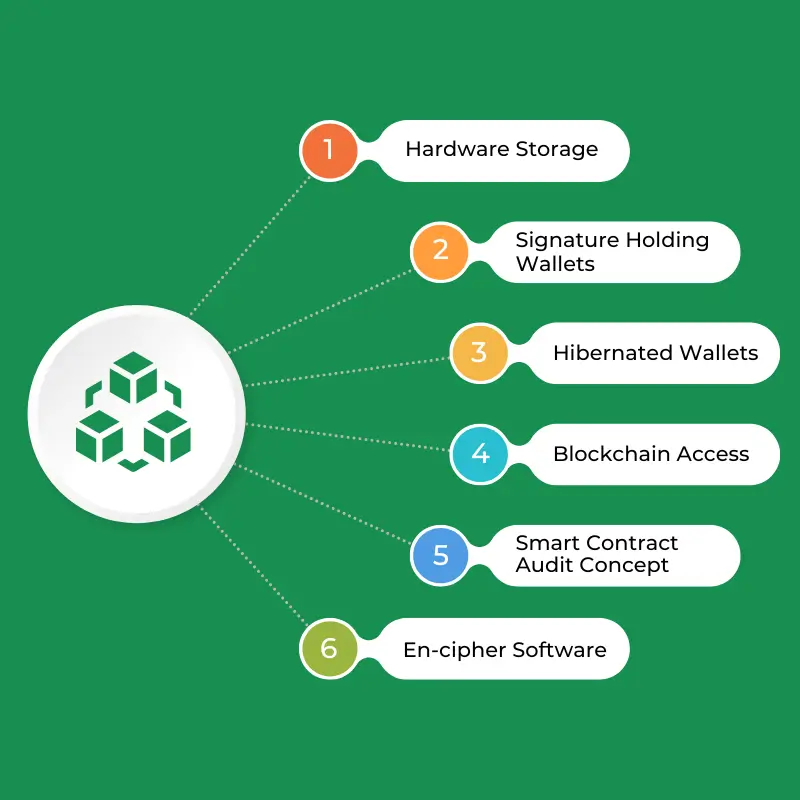
List of Blockchain Security Tools
1. Hardware Storage: Generally to keep the private keys of a transaction , wallet storage is built of hardware. Having the private keys protected from phishers and attackers is a great way to ensure their security. Ledgers Nano X, Trezon Model T & Keep key are currently trending as the most secure transactions hardware wallet.
2. Signature Holding Wallets: These types of wallets hold multi-signature to authenticate the transactions of users. The main feature of this type of wallet is to hold stacks of signatures but only gives access to a single transaction to a user which helps to keep it more secure transactions from attackers.
3. Hibernated Wallets: Hibernate wallets are also known as offline storage i.e. this type of storage keeps the digital assets offline which helps to safeguard and secure the assets from fraudsters.
4. Blockchain Access: This instrument enables the access of their assets, allows them to pump & authenticate through blockchain technology security tools.the users also detects and traces the malignant activities through blockchain technology security system tools that helps to enhance and furnish the transparency of blockchain technology.
5. Smart Contract Audit Concept: Through the concept of smart contract auditing, the users identify the phrases which signify them directly into codes.Somehow, in some cases there is serious violation of safety, but still this instrument accomplishes the trust on blockchain securities quality.
6. En-cipher Software: Protection of data on blockchain network technology is most important, that’s why development of software which encrypts the data in cipher text. This instrument enhances the strength of security & privacy level of the blockchain network.
Procedure to Secure Blockchain Technology Security
1. Encryption
Each transaction of blockchain is encrypted using cryptographic precept, which attest data integrity & validation. Public key Infrastructure (PKI) allows users a public key to avail assets and a private key to secure transactions.
2. Segregation
Rather than a centralized server or Hotshot, blockchain security system tools operate all over on a network of computers. This decentralized characteristic shows that if any network of computers or a bunch of networks is perilled, then the whole network will remain unaffected.
3. Concurrence
A Simple consensus algorithm involves Proof of Work (PoW) & Proof of Stake (PoS),which these tools help to give assurance of the validity of all transactions of blockchain.
Properties like this make the algorithm almost unfeasible for phishers & attackers to take control on networks of computers, which is also known as Sybil Attack.
4. Consistency
Blocks are uniform, which means that once the block has been added to the blockchain, it cannot be changed or removed in any way, for the reason that its uniformity is rigid. It is possible for a specific hacker or phisher to alter the data on a blockchain system, and the impact on the chain is not so significant.
5. Lucency
In particular, a large part of the blockchain is in the public record, which means that it is trivial to track and detect any malicious activity that takes place on the blockchain and detect it as soon as it is taking place and even before it is detected at all, as a large part of the blockchain is in the public record.
How Transactions On Blockchain System?

1. Transaction Commencement
Users connected to a blockchain network are able to initiate transactions quickly and easily, as well as share the details of their transactions with other people connected to the same blockchain network in order to facilitate the sharing of information.
2. Transactions validation
There is no doubt that blockchains are designed to be of assistance to nodes by managing the most personalized network of computers available to them.
While both identification and verification are crucial to ensuring that an assignment can be validated, they should not be considered as the determining factors.
3. Annexation of Blocks
The procedure for validating each transaction is completed by creating new blocks that are added to the list of new blocks after the piles of transactions have been verified and the procedures for validating them have been completed.
4.Block Merger
During the creation of a blockchain, each block is connected to the one before it through a series of links, which ensures that every block is linked to every previous block, resulting in a chain of blocks that is a complete chain for a new block to take its place in.
5. Safeguarding the Blockchain
Every block of the blockchain is protected by a layer of security measures, which makes it almost impossible for attackers to break through the security wall, which significantly reduces the chances of a hacking attempt being successful.
Conclusion
In conclusion, blockchain security systems will remain the most important component to secure transactions data in rapid advancement of technologies.Every other company in this field gives their best efforts to secure their users data from breach.
Selecting our eiy sys for your data protection for your data protection will be the utmost option. Our experienced & Expert team in blockchain technology will help you to secure transactions data & also helps to evolve your business in this progressing world.
Frequently Asked Questions
The risk management process or system known as blockchain security is meant to retain online threat makers and thieves out of a blockchain network. Blockchain security guards against scams and computer viruses (such as 51%, Sybil, Phishing, and Routing attacks) through the utilization of tried-and-true frameworks, technical insurance, and cybersecurity best practices.
Blockchain security is needed for making sure that only authorized users get access to nodes and the distributed ledger network as a whole, yet blockchains are cryptographically signed. Blockchain networks can use diverse cybersecurity frameworks and protocols in order to safeguard and obscure confidential user information.
The aim of blockchain security is to defend a blockchain network from invasions and attacks from malicious users and cybercriminals. In an analogous way, blockchains exploit their built-in safety mechanisms to supply immutability and transparency. Comprehensive preservation of data on any machine, network, or system, including blockchains, is at the core of cybersecurity.
In addition to being structured in blocks, linked by a cryptographic chain, and leveraging a consensus mechanism (involving the collective participation of some of its members), blockchains are very secure by design. Due to their increased vulnerability, blockchain networks are less secure.