


We are experiencing a constant change in the way we manage asset tokenization in the field of finance as a result of technological advancements that are constantly altering the way we manage assets as a whole. It can be argued that one of the most significant developments that we have seen in the last few years has been the expansion of the financial industry.
Using this blog, people will be able to learn more about the complexity of the real world asset tokenization process, the types of tokenization, how it changes the types of tokenized assets, and the possibilities of real world asset tokenization in the future.
What is Tokenization?
Text patterns are tokenized assets by breaking them up into smaller units called tokens. It might be possible to create tokens that are the size of words or as small as letters. It is important because it allows robots to understand human language by breaking it down into digestible chunks, which is a much more efficient method.
In addition to creating a unique, digital representation of a physical object, the tokenization blockchain can also be thought of as a comprehensive method of creating digital representations of physical objects. Token usage is often subject to certain terms and restrictions since Web3 apps make use of a fully private tokenization blockchain. In addition to tangible assets such as real estate tokenization or artwork, tokens can also represent intangible real world asset tokenization such as intellectual property.
The tokenization blockchain functions differently in the context of AI applications because it enables large language models (LLMs) to operate, classify, and create connections with the data – from entire sentences to single characters – through deep learning techniques. Payment tokenization has also been shown to protect sensitive data by generating a temporary code that can be used in place of the original.
How Can It Be Used for Real World Assets Tokenization?
1. Securities and Stocks
With digital tokens, ownership rights can be exchanged for digital tokens without requiring a formal clearinghouse or broker-dealer. This greatly streamlines the tokenization blockchain process. This makes trading more expensive for both buyers and sellers.
2. Collectibles
Investing in tokenized assets, such as rare basketball cards and traditional artwork, provides investors with the opportunity to acquire valuable items. Data can be evaluated and stored transparently while expanding the market for art and collectibles and eliminating fraud at the same time.
3. Goods and Services
By demonstrating interest in cross-border trade of these commodities, tokenizers such as RWA tokenization can provide investors with exposure to commodities such as oil and rare minerals without requiring physical ownership or associated costs. By doing so, more liquidity and diversification are possible on the market.
4. Intellectual Estate
The tokenization of works offers investors, musicians, artists, and other creatives a number of opportunities to profit. In order to create a new market for investors who wish to purchase and sell intellectual property or earn income passively, copyrights, patents, and incentives will be added to the tokenization blockchain.
What are The Topc?
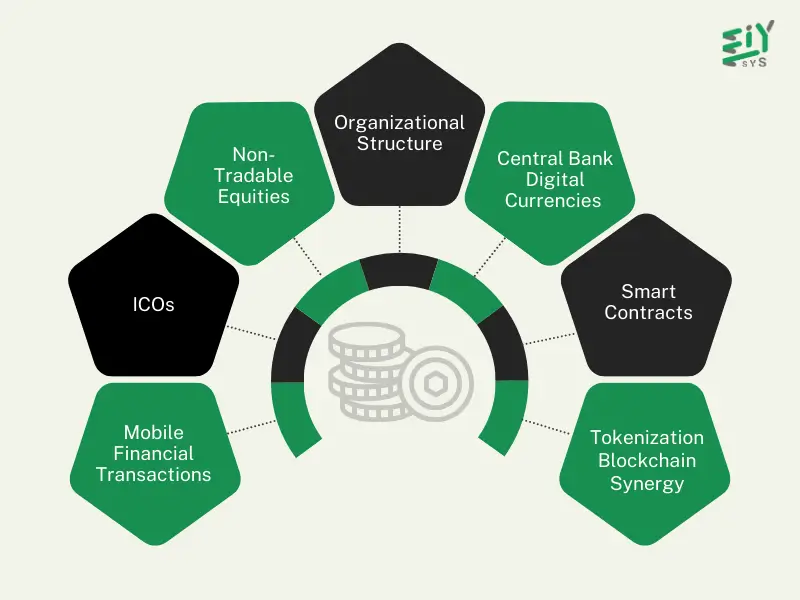
1. Mobile Financial Transactions
As mobile payments grow, it has become an increasingly significant trend in the real estate tokenization industry. Using real estate tokenization, payment information can be stored safely and securely on mobile devices.
Moreover, this is a driving force behind the popularity of mobile payments and applications. Transactions are made easier with mobile payments because personal information and card numbers are tokenized.
2. ICOs
It is the use of cryptocurrencies that contributes to the increase of company capital, which is the reason for the current trend in the investment community and the tokenization blockchain community. There are also many venture finance specialists who are aware of this.
The fact that initial coin offerings (ICOs) are based on financial performance rather than stocks, providing the issuing company with greater independence, also contributes to their current popularity. The reason for this is that many companies make use of ICOs to modify their initial public offerings (IPOs) rather than to add to them.
3. Non-Tradable Equities
Due to the fact that each token represents a unique entity, NFTs are well liked for their distinctive characteristics. There is no exchange rate for these commodities, which are usually handcrafted goods, digital artworks, etc.
As the name implies, a NFT manages the provenance verification procedure for a particular object. Purchasing virtual currency requires buyers to always have a digital wallet with virtual money. There are many of these wallets based on the Ethereum platform, so dealers can access a large amount of NFTs.
4. Organizational Structure
In recent years, more governments around the world have begun to understand the benefits of real estate tokenization as technology advances. All three have seen an increase in popularity, including voting systems, government services, and safe identity provisioning.
By utilizing this trend, we can strengthen the overall security of citizen information and accelerate government operations while reducing fraud.
5. Central Bank Digital Currencies (CBDCs)
In response to the growing popularity of personal cryptocurrencies and the decline of cash usage, central banks around the world are producing their own digital currencies. By definition, CBDCs are fiat money with a liability against the real world asset tokenization that is verified through tokenization blockchains.
CBDCs are also beneficial to society in a variety of ways. A great example of this is when they are responsible for managing the ongoing digitization of the global economy, allowing them to analyze digital transactions and track economic data more efficiently.
6. Smart Contracts
A smart contract contains the terms of the contract directly in the code, so the contract requires self-performance by you. By implementing smart contracts, it is possible to automate licensing agreements and ensure that material is utilized appropriately.
Smart contracts are enabling fast and safe management of digital rights through the use of swift and secure solutions.
7. Tokenization Blockchain Synergy
Blockchain, which offers an immutable record for storing tokenized assets, is perfect for tokenizing data due to its decentralized, tamper-proof characteristics. A robust and trustworthy data management solution is provided by this synergy through increased traceability, security, and transparency.
Integrating blockchain technology with tokenization is becoming more popular as a method of creating robust and complex security frameworks.
Conclusion
It is clear that asset tokenization can offer several unexpected benefits, including increased liquidity, accessibility for investors, and greater transparency and security. Moreover, a number of challenges, safety concerns, and uniformity issues need to be addressed.
Recent research suggests that tokenizing digital assets can lead to a more innovative and faster financial environment, and its full potential may be realized with the support of recent research. In order to improve the effectiveness, transparency, and security of real world asset tokenization management, Eiy Sys uses blockchain technology. As you explore tokenization, let the adventure continue!
Frequently Asked Questions
Tokenization is the process of converting real-world assets - such as real estate, art, and securities - into digital tokens on a blockchain. Providing greater liquidity and accessibility, these tokens represent the asset and can be traded or transferred easily.
By providing a decentralized, transparent, and immutable ledger, blockchain technology facilitates asset tokenization. Tokenized assets can be transferred and managed more efficiently when ownership records are secure, verifiable, and resistant to tampering.
Blockchains provide enhanced liquidity, allowing assets to be traded more easily, fractional ownership, which allows investors to buy smaller shares of expensive assets, and enhanced transparency and security.
Regulatory compliance is a challenge, as different jurisdictions have different rules; technical complexity in creating and managing tokens; and ensuring adequate security to safeguard against cyber threats and fraud.
