



The development of cloud-native applications has revolutionized the digital world today. Companies can use it to build resilient, scalable and strong applications that take full advantage of the benefits of cloud computing. Demand for cloud-native app development services will increase as more enterprises recognize the benefits of building cloud-native application services.
Cloud-native app development also has the advantage of smoothing the development process and empowering businesses to accommodate market changes and customer needs. Companies can create agile, adaptive applications through cloud-native app development. This modern approach is assisted by leading platforms like Oracle Cloud-native app Development, which offer full tools and services.
With cloud-native strategies, businesses gain flexible, cost-effective and secure environments for development. It doesn’t matter whether you are a startup or an established company, cloud-native app development can stimulate innovation and growth to achieve long-term success.
How and Why Should Companies Develop Cloud-Native Apps?
It is important to take into account that cloud-native app development offers unparalleled flexibility and scalability, making it easier to respond to changing market demands. As user demand increases, traditional applications scale less efficiently, resulting in performance bottlenecks and higher costs. In contrast, building cloud-native applications are designed to maximize the capabilities of the cloud infrastructure in order to enable automatic resource scaling and resource optimization.
The next compelling reason for adopting cloud-native app development is the speed and agility it brings to the development process. The microservices allows building cloud-native applications developers to create, deploy and update components independently. Business applications may now be iterated very quickly, incorporating new features and improvements in an unimaginable way just a short time ago, keeping them competitive in a rapidly changing environment.
Consequently, the security and resilience of the application are enhanced. Cloud-native tools and services can expose advanced security features to businesses, such as threat detection, automated analysis and real-time monitoring across applications. It ensures high availability even in the event of failures with cloud-native architectures because they are fault-tolerant, redundant and self-healing.
What are the Benefits of Using Cloud-Native Services?
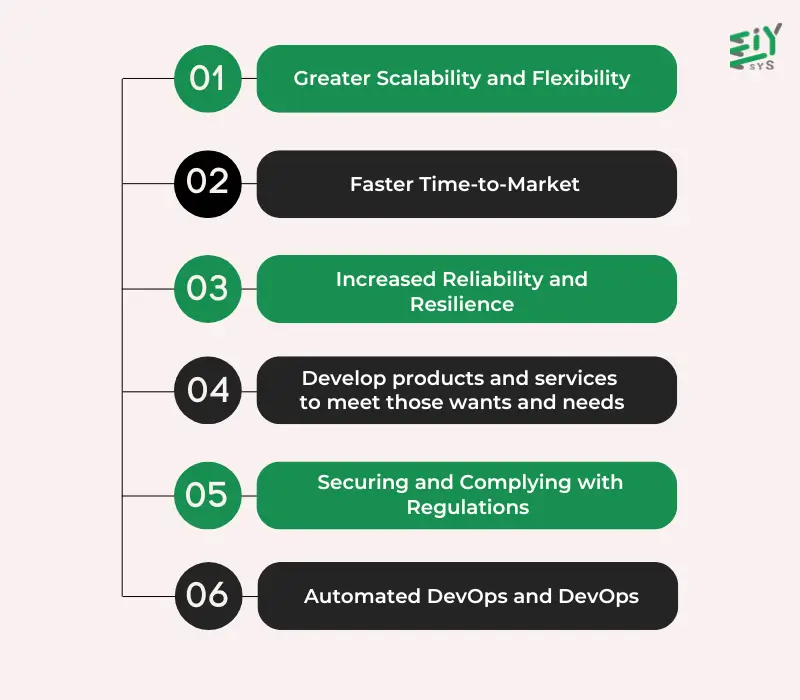
1. Greater Scalability and Flexibility
In light of surging demand, cloud-native app development services make it easier for businesses to scale their applications. Thus, performance remains optimal during traffic spikes without escalating costs.
2. Faster Time-to-Market
Businesses can quickly develop, test and deploy applications using cloud-native development. A company that can enter the market quickly and respond to changing market trends at such a pace will be more competitive and agile.
3. Cost-Effectiveness
Resources are optimized for cloud-native services, reducing the need for large on-premise infrastructures. Through pay-per-use based pricing models that scale expenses according to usage, businesses benefit from lower operational costs.
4. Increased Reliability and Resilience
Fault-tolerant and resilient building cloud-native applications developers are designed for the cloud. As a result, they are highly available and virtually eliminate downtime, ensuring continuity of service and a smooth user experience.
5. Securing and Complying with Regulations
With cloud-native development services, organizations are able to stay compliant with industry standards while protecting sensitive data with advanced security features, such as automated threat detection and encryption.
6. Automated DevOps and DevOps
DevOps practices are supported for cloud-native environments, allowing for continuous integration and delivery. The use of automation tools further improves this efficiency, making the development process smoother and more consistent.
What Role Can Cloud-Native Applications Play in Improving scalability?
Building cloud-native applications developers are more flexible than others due to its flexibility and distributed architecture. Scaling out is part of the design of these applications. Whenever demand changes, they add or remove resources efficiently. When peak usage occurs, this helps to maintain optimal performance without incurring additional expenses.
- Horizontal Scaling : Resources can be added or removed to meet demand. Overprovisioning should be avoided in order to provide consistent performance.
- Microservices Architecture: Due to their independence, microservices can be scaled independently without needing to dedicate resources to each component.
- Containerization: Application containers are lightweight, portable packages that package applications. As a result, replication and scalability across different environments are easier.
- Load Balancing: Traffic is distributed across multiple servers automatically, so no single point becomes overburdened.
- Elastic Infrastructure: Elastic infrastructure lets applications scale up and down as needed, meeting the dynamic needs of the application as they change.
What Role Does Oracle Play in Developing Cloud-Native Applications?
There is no doubt that Oracle cloud-native app development is one of the leading players in the cloud-native app development space, with a robust set of tools and services specifically designed to support modern applications. Powered by Oracle’s advanced infrastructure, cloud-native applications can be built, deployed and managed efficiently by businesses using Oracle Cloud-native App Development.
In most cases, these services address the entire lifecycle of an application, starting with oracle cloud-native app development and ending with its deployment. Through this process, companies can create applications that are scalable and resilient in the new cloud environment. Microservices, containers and Kubernetes are some of Oracle’s contributions to cloud-native app development.
Building Cloud-native applications using these technologies since they enable cloud-native applications developers to create modular, scalable elements that can be managed and updated independently. The Oracle cloud-native app development services provide integrated services for container orchestration, continuous integration and continuous delivery, so cloud-native applications developers can speed up development cycles and improve operational efficiency.
Conclusion
To summarize, cloud-native development is a game-changing paradigm for businesses seeking to stay competitive in today’s market. Businesses that build strong, agile applications on top of scalable, secure and flexible cloud-native services are well positioned to meet today’s market demands.
Now, businesses can confidently move into cloud-native environments to drive innovation and long-term success with the help of industry leaders like Oracle. Companies that adopt cloud-native strategies not only increase operational efficiency, but also set themselves up for success in the changing technical landscape.
A cloud-native app is being implemented at a leading pace by Eiy sys into the development of businesses. Our expertise allows us to increase data integrity, reduce administrative workloads and expedite compliance procedures for businesses. Development practitioners can effectively comply with regulations while maintaining the highest standards of data security and patient care by using the Cloud-Native App.
Frequently Asked Questions
Developing native-cloud applications involves leveraging cloud-native technologies and services in order to run on cloud platforms. Unlike traditional apps, native-cloud apps are built from the ground up to fully exploit cloud infrastructure, ensuring scalability, flexibility and integration with cloud services.
With native-cloud apps, you can easily handle varying loads by leveraging cloud resources. This contributes to scalability. As a result of optimized cloud service usage, greater resilience and fault tolerance and easier integration with other cloud-based tools and services, they also benefit from enhanced performance. In addition, cloud-native architecture allows these apps to achieve faster deployment and update times.
Applications can be packaged and deployed using containers, such as those managed by Docker or Kubernetes. They ensure consistency across different cloud environments by encapsulating all required dependencies. Native-cloud apps can be developed more efficiently and reliably thanks to containers, which simplify deployment, scaling and management.
The development of native cloud apps enhances scalability by using cloud resources that can adjust to meet demand on an as-needed basis. In cloud-native applications, instances can be added or removed based on traffic, ensuring consistent performance even during peak periods. Applications can handle varying workloads efficiently and cost-effectively with this dynamic scaling capability.
