


The Container Storage Interface (CSI) is a standardised method for integrating various block and file storage systems into containerized environments on container orchestration platforms like Kubernetes.
This allows third-party storage providers to develop and deploy plugins that expose new storage systems in Kubernetes without modifying the core Kubernetes code.
This site’s primary audience includes developers interested in creating CSI drivers for Kubernetes. Kubernetes users who wish to deploy or manage an existing Container Storage Interface driver should refer to the documentation provided by the CSI driver author for detailed instructions.
What Is Kubernetes Storage?
- Storage has long been a difficulty for IT professionals, with challenges such as data integrity, preservation, replication, and migration.
- Kubernetes is the most widely used container orchestrator.
- Because containers are ephemeral, they by default destroy all stored data, posing significant issues for many types of workloads.
- However, Kubernetes offers a number of characteristics that help to alleviate this issue and enable stateful applications in a containerized environment.
- Kubernetes manages the entire container lifecycle, including creation, management, automation, load balancing, hardware interfaces, and storage device interfaces.
- Kubernetes storage introduces persistent volumes, which are introduced by Kubernetes and may be requested and consumed by containerized workloads.
- They exist independently of containers, survive even when containers are shut down and can be requested and consumed by containerized workloads.
How Does CSI Integration Work In Kubernetes?
CSI integration helps Kubernetes connect with third-party storage systems for containerized workloads:
- CSI Drivers: Storage companies create CSI drivers for their storage products, and Kubernetes administrators install these drivers in the clusters.
- CSI-compliant Plugins: Kubernetes uses a plugin that follows the CSI standard. This plugin acts as a bridge between the container workloads and the storage system.
- Storage Classes: Administrators set up storage classes using the CSI drivers, which help manage how storage is provided.
- Operations: The driver and plugin work together to handle tasks like attaching, detaching, mounting, unmounting, and creating or deleting storage volumes.
What Are The Common Challenges When Using CSI In Kubernetes?
There are several challenges when using CSI Integration in Kubernetes:
- Performance: Since CSI Integration drivers rely on making API calls to external storage systems, it can slow down the performance at the Kubernetes control plane. This issue tends to worsen as the number of Persistent Volumes (PVs) and storage features increase.
- Provisioning times: CSI drivers may have difficulty keeping up with the volume provisioning needs in large Kubernetes clusters, leading to delays.
- Dynamic volume expansion: Although some underlying storage systems support dynamic volume expansion, this feature is not yet available through CSI and Kubernetes.
- Ephemeral local volumes: A Persistent Volume Claim (PVC) needs to be created for ephemeral local volumes, and referencing CSI volumes directly in pods is not supported.
- Topology awareness: CSI volumes don’t support topology awareness, meaning the Kubernetes scheduler cannot know where the volumes are provisioned, causing inefficiencies.
What Are The Key Components Of A Container Management System?
Container management involves tools that automate and oversee the deployment of containerized applications, which helps improve scalability, resource efficiency, and the reliability of applications.
- Docker: An open-source platform that enables developers to create, deploy, and test applications in containers.
- Kubernetes: A tool designed to manage the deployment and scaling of containers across multiple systems.
- Container security: A way to secure containerized environments, which can be more complex compared to traditional workloads.
- Container image supply chain: The process of how containers are built and prepared for deployment.
- Container runtime security and policy enforcement: Ensuring that containers operate as intended by enforcing security and policies.
What Are The Benefits Of Using Cloud Storage?
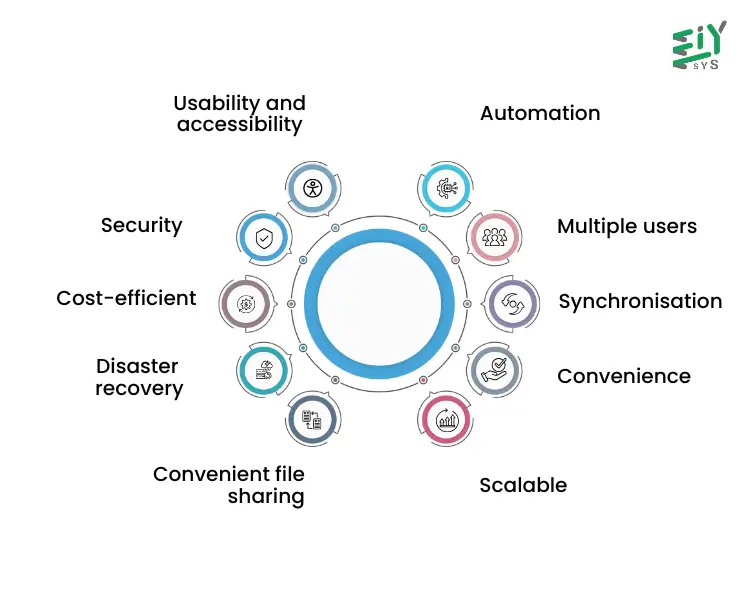
The benefits of using cloud storage are as follows :
- Usability and accessibility: Cloud storage is easy to use with simple interfaces like Google Drive or iDrive. You can upload files easily with drag-and-drop features. Once saved, you can access your files from any device with an internet connection, no matter where you are.
- Security: Cloud storage providers protect your data by storing it on multiple servers. Even if one data centre fails, your data is still safe and managed by others. Many providers also back up your data in different centres to ensure it’s not lost or corrupted.
- Cost-efficient: Cloud data storage reduces internal costs by eliminating the need for in-house data management and infrastructure. Providers offer affordable lifetime storage, which is ideal for small businesses or individuals. Additionally, technologies like Container Storage Interface (CSI) enable efficient and scalable storage management, further enhancing cost-effectiveness and resource optimization.
- Convenient file sharing: Cloud storage allows easy file sharing. You can share files with others or invite multiple users to access your data. Most providers allow users on the same service to share files, though only a few offer cross-platform sharing.
- Automation: Cloud storage services work like a hard drive, but without interrupting your tasks. Multiple users can use the service at the same time without affecting each other’s work, as everything is automated and managed by the provider.
- Multiple users: Cloud storage lets many users work together on the same file. Authorised users can access and edit shared files from anywhere in real-time.
- Synchronisation: Your files are synchronised across devices. You can access your data from any device with proper credentials and a good internet connection. There’s no need to manually transfer files from one device to another.
- Convenience: It eliminates the need for external drives. You can view and store data online, and if needed, download it to your device. Any changes made to your data will be reflected across all synced devices. You don’t need technical skills to use it, as the vendor manages everything.
- Scalable: Cloud storage is flexible. If you need more space, you can easily upgrade your plan without moving data. Additional space and features will be added to your environment.
- Disaster recovery: Cloud storage offers a great solution for business continuity and disaster recovery. It allows you to back up your entire system quickly, making it easier to retrieve data in case of an emergency. Using CSI, cloud storage services provide smooth disaster recovery without the need for a separate data centre.
Why Is Persistent Storage Important In Kubernetes?
Persistent Storage is Important In Kubernetes because :
- It is crucial in Kubernetes because it ensures that applications can retain their data even if the system undergoes updates, failures, or restarts.
- Without persistent storage, data would be linked to the life of a pod or container, meaning it would be lost if the pod crashes or is stopped.
- This feature allows applications to preserve their state across different instances and changes, essential for maintaining data consistency and reliability.
Conclusion
EIY SYS helps businesses manage containerized environments by offering solutions that ensure reliable Persistent Storage. Combined with Container Storage Interface (CSI) , Kubernetes allows easy integration with external storage systems, helping applications retain their data even when containers restart or fail. Using Kubernetes Storage, businesses can ensure data is preserved across various instances. Additionally, leveraging Cloud Storage makes it cost-effective and scalable for growing needs. With the right CSI Integration and Container Management tools, companies can seamlessly manage their data storage needs in a dynamic containerized environment .
Frequently Asked Questions
The Container Storage Interface (CSI) is an industry-standard API that allows container orchestration platforms like Kubernetes to interact with various storage systems. It enables seamless integration of storage providers without requiring changes to the core Kubernetes codebase.
CSI enhances Kubernetes storage management by providing a unified and extensible framework. It simplifies the deployment of diverse storage solutions, supports dynamic provisioning, and ensures scalability and flexibility in managing storage resources.
CSI operates through plugins that are deployed as containers. These plugins interact with the Kubernetes Control Plane to provision, attach, and mount storage volumes. Kubernetes uses the CSI driver to communicate with underlying storage systems via standard API calls.
No, CSI is designed to be platform-agnostic. While it is widely used in Kubernetes, it can also integrate with other container orchestration platforms like Mesos and Docker Swarm.
By decoupling storage management from Kubernetes’ core, CSI ensures that developers can seamlessly switch between storage solutions without altering application configurations. This promotes portability across hybrid and multi-cloud environments.
