The de facto standard for orchestrating containerized apps has quickly evolved into Kubernetes. Kubernetes adoption delivers flexibility, Kubernetes scalability and efficiency as enterprises embrace cloud-native technology to optimize operations. But there are difficulties in setting up and maintaining Kubernetes in a production environment. We’ll go over important Kubernetes deployment factors in this blog post to make sure container orchestration runs smoothly, effectively and securely. We’ll go over important topics like cloud integration, Kubernetes best practices, Kubernetes scalability, Kubernetes architecture and administration techniques.
Unprecedented cloud Kubernetes scalability and portability are promised by container development. DevOps development and culture techniques also improve responsiveness and business value. But before you embark on your first container development project, there are a lot of things to think about: Which operating system do we need to employ?
Should our Kubernetes platform be built or purchased? What impact will this new course have on the organization? You can make sure that your Kubernetes deployment will assist your organization both today and in the future by taking into account the ten points listed below.
What is Kubernetes Architecture?
It’s important to comprehend the fundamentals of Kubernetes architecture before delving into the particular factors to take into account when deploying the system. Based on a master-worker Kubernetes architecture, Kubernetes requires the proper operation of multiple components in order for the platform to perform as intended.
- Master Control Plane: This comprises the controller manager, scheduler, etc (a key-value store for configuration data) and API server. The control plane is in charge of overseeing the Kubernetes cluster and making sure your application stays in the proper state.
- Labor Nodes: These are in charge of maintaining the containers. Every node is running kube-proxy, which manages network routing, a container runtime such as Docker and kubelets, which are agents that interact with the master.
Deployment Consideration:
- High Availability (HA): The control plane’s high availability is crucial for workloads in production. To prevent single points of failure, a multi-master configuration that distributes control plane components over several nodes is advised.
- Node Configuration: To maximize application performance, carefully set up worker nodes with the right resources (CPU, memory), as well as isolation strategies like namespaces.
What is the Scalability of Kubernetes?
Second, Kubernetes scalability One of the best things about Kubernetes is its Kubernetes scalability, but planning and configuration are key to making it work well. By dynamically adjusting the number of nodes and containers, Kubernetes scalability describes the platform’s capacity to meet expanding application needs.
Key Consideration
- Horizontal Pod AutoScaling: Based on other application parameters or observed CPU consumption, Kubernetes can automatically scale the number of pod replicas. Your program will be able to manage varying workloads without over-provisioning resources if you implement HPA.
- Cluster Autoscaler: Cluster autoscaler adds nodes automatically if the cluster is underpowered. You just pay for the resources you use in Kubernetes in cloud environments, so this is quite helpful. Achieve cost and performance optimization by configuring node pools.
- Balance of Loads: As your application grows, it becomes increasingly important to distribute traffic effectively. Although load balancing is already included in Kubernetes through services and ingress controllers, for more complicated use cases, external load balancers can also be incorporated.
- Effective Allocation of Resources: To avoid resource famine or overuse, each container must have its own set of proper resource requests and restrictions (CPU and RAM). Erroneous setups may result in reduced efficiency or increased expenses.
How Does Kubernetes in a Cloud Environment Operate?
Because Kubernetes is cloud-agnostic, it may be installed on on-premises infrastructure or on any cloud provider. Due to the unique features and constraints of every cloud platform, Kubernetes in cloud environments comes with its own set of considerations.
Cloud Deployment Considerations:

- Selecting a Kubernetes Managed Service: Managed Kubernetes services, such Google Kubernetes Engine (GKE), Amazon Elastic Kubernetes Service (EKS) and Azure Kubernetes Service (AKS), are provided by the majority of cloud providers. Operational overhead is decreased when using a managed service because the cloud provider takes care of most control plane maintenance, fixes and upgrades. Additionally, it enhances integration with cloud-native applications such as identity Kubernetes management, networking and storage.
- Cloud-Based Networking: Every cloud provider has a different networking paradigm. Make sure that your Kubernetes networking configuration—which includes ingress controllers, CNI plugins and other components—integrates smoothly with the cloud Kubernetes architecture to facilitate safe and expandable communication between containers and outside resources.
- Integration of Storage: Kubernetes in cloud environments persistent storage needs to be compliant with the persistent volume and persistent volume claim (PV/PVC) abstraction provided by Kubernetes. Cloud service providers frequently include specialized storage options (such as Google Persistent Disks and AWS EBS), which Kubernetes can employ to manage stateful applications.
- Safety: Even though cloud providers have security measures in place, Kubernetes cluster configurations still need to be secure. Role-Based Access Control (RBAC) is used to manage access control; secure pod communication is ensured; and cloud-specific identity services are used to manage credentials and secrets.
How does Kubernetes Management Take Place?
Managing Kubernetes effectively is essential to maintaining scalable and dependable clusters. This includes monitoring, logging and guaranteeing high availability in addition to the cluster’s operational Kubernetes management.
Best Ways to Handle Kubernetes:
- Updates to Versions: With regular releases that include security fixes, enhanced performance and new features, Kubernetes is evolving quickly. Updating your cluster on a regular basis is crucial to keep security fixes current. Many steps in this process can be automated by using a managed Kubernetes service.
- Observation and Record-Keeping: It’s critical to keep an eye on the applications running on your Kubernetes cluster as well as the cluster itself. Metrics from Kubernetes are typically collected and visualized using tools like Prometheus and Grafana and logging can be done with ELK (Elasticsearch, Logstash, Kibana) or EFK (Fluentd instead of Logstash) stacks. Keep an eye on memory, CPU and network utilization to spot resource underutilization or bottlenecks.
- Reconstruction after a Disaster: Assemble regular backups of important data, such as etc, application configurations and persistent storage and implement a disaster recovery plan. For storage volumes, use snapshotting; for multi-region or multi-cloud installations, establish a failover plan.
- Kubernetes Management of Security: Kubernetes has several security tiers, but their proper implementation is crucial. Control pod-to-pod communication with network policies; use RBAC to enforce least privilege access; and periodically check containers for vulnerabilities. It is also advised that you evaluate the security of your cluster using tools such as Kubernetes Security Benchmark.
What are Kubernetes Best Practices for Deployment?
Efficient, scalable and secure application deployment on Kubernetes is ensured by adhering to Kubernetes best practices.
Guidelines for Kubernetes Best Practices:
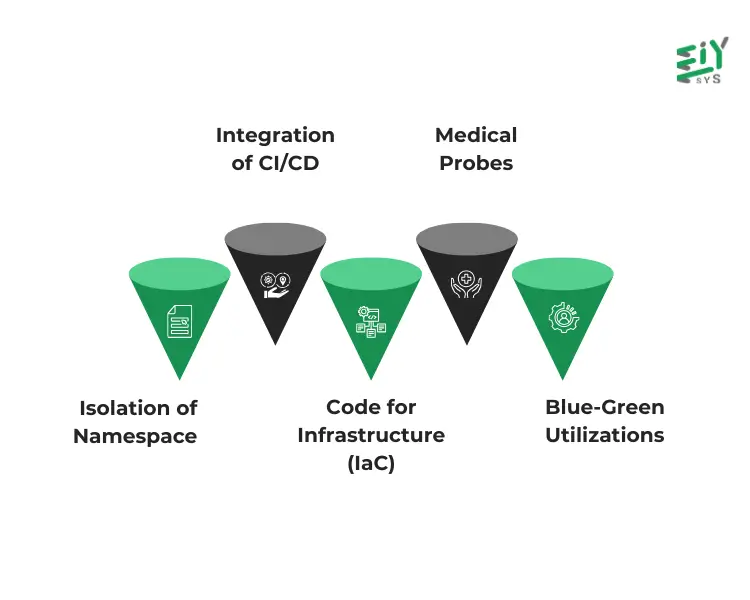
- Isolation of Namespace: To divide resources by team or environment (dev, test, prod), use namespaces. Better control over the distribution of resources and an improved organizational structure result from this.
- Integration of CI/CD: Automate the deployment of applications by integrating Kubernetes with CI/CD processes. Container builds, tests and deployments to Kubernetes clusters can be made more efficient with the use of tools such as Spinnaker, Jenkins and GitLab Continuous Integration.
- Code for Infrastructure (IaC): For declarative Kubernetes management infrastructure, use technologies such as Helm, Terraform, or Kubernetes Operators. Cluster configurations can be replicated, versioned and maintained more easily in various situations with this method.
- Medical Probes: For every container, define the liveness and readiness probes. This makes it possible for Kubernetes to more accurately determine when a pod is healthy and prepared to handle traffic, improving load balancing and minimizing downtime during rollouts.
- Blue-Green Utilizations: By default, Kubernetes enables rolling upgrades; however, to reduce downtime for mission-critical applications, blue-green deployments should be taken into consideration. This lowers the possibility of unsuccessful deployments by enabling fresh versions to operate alongside the outdated version.
What are the Strategies for Kubernetes and Multi-Cloud/Hybrid Cloud?
Multi-cloud and hybrid cloud methods are gaining traction as businesses want flexibility and want to avoid being locked into one vendor. One common orchestration layer for on-premises or cloud systems can be Kubernetes.
Considerations for Multi-Cloud/Hybrid Cloud :
- Networking across clouds: Make sure cloud providers network in the same way. Managing communication between services in several clouds can be made easier by using multi-cloud service meshes like Istio.
- Data Synceration: Data synchronization between clusters in various clouds might be difficult in a multi-cloud system. Use technologies that duplicate data over several clouds or storage options that are neutral to the cloud.
- Observance in Different Regions: Make that local rules are followed if your deployment is spread across several areas, particularly those pertaining to data residency (such as the GDPR in Europe). Using taints/tolerations or node selectors, Kubernetes can help isolate workloads by region.
How to Implement Cost Optimization in Kubernetes?
Although Kubernetes might reduce infrastructure expenses, improper setup or resource distribution may result in overspending.
Costs Consideration:
- Appropriate Resource Sizing: Make sure that each pod has the appropriate CPU and memory requirements and limitations specified. While under allocating resources can have an impact on performance, over allocating resources can result in wasted expenses.
- Preemptible/Spot Instances: For non-critical tasks in Kubernetes in cloud environments, think about utilizing spot instances (AWS) or preemptible virtual machines (Google Cloud). These instances are temporary and Kubernetes can manage that while saving money.
- Keeping an eye on expenses: To make well-informed judgments about resource allocation and scaling methods, use cost-monitoring tools such as Kubecost to examine resource utilization and associated expenses.
Conclusion
Kubernetes deployment needs thorough preparation and consideration of several aspects, such as adhering to Kubernetes best practices, controlling expenses and comprehending the Kubernetes architecture and Kubernetes scalability. Whether using Kubernetes on-premises or in the cloud, a careful strategy guarantees that your company can take full use of the platform’s capabilities while avoiding typical problems. In today’s fast-paced world, Kubernetes’ powerful features enable enterprises to create, grow and manage applications more efficiently, paving the road for a seamless digital transition.
Though it faces a number of challenges, it is a shining star in the Flutter sky. It is up to you to choose the right star from among them. We Eiy sys will leverage this technology to advance a step ahead of others. Do you feel ready? Then buckle up and begin your journey with Eiy sys.
Frequently Asked Questions
The API server, etcd, scheduler and worker nodes are among the fundamental parts of the master-worker architecture upon which Kubernetes is based. For a deployment to be dependable, it is essential to guarantee high availability of the control plane and appropriate node design.
By employing cluster autoscalers, effective load balancing and horizontal pod autoscaling (HPA) to dynamically scale applications based on resource consumption, Kubernetes scalability can be maximized.
For less operational overhead, think about utilizing managed services like GKE, EKS, or AKS when implementing Kubernetes in the cloud. Make that the networking, storage integration and security configurations are appropriate for the infrastructure of the cloud provider.
In order to preserve cluster health, effective Kubernetes management entails frequent version upgrades, rigorous monitoring (using tools like Prometheus and Grafana, for example), putting security measures like RBAC into practice and disaster recovery planning.