


Helm is an open-source graduated CNCF project originally created by DeisLabs as a third-party utility, now known as the Helm Kubernetes package manager. It focuses on automating the Kubernetes applications lifecycle in a simple and consistent way.
The objective of Helm Kubernetes as a package manager is to make the management (install, update, or uninstall) of Kubernetes application packages easy and automated, deploying them with just a few commands.
Helm Kubernetes is an indispensable tool for managing Kubernetes applications, enabling teams to deploy and maintain applications in a simpler, more efficient, and automated way. With Helm, managing complex Kubernetes environments becomes significantly easier, whether you’re deploying a simple app or managing a microservices architecture. By leveraging Helm, organisations can benefit from streamlined deployments, faster updates, and better configuration management, making it a vital component of any Kubernetes workflow.
How Do You Ensure Security In Kubernetes Management?
Role-based access control (RBAC) manages who can access specific resources and defines how they can interact with them. It enforces the principle of least privilege by restricting users’ access to only the resources they need in Kubernetes.
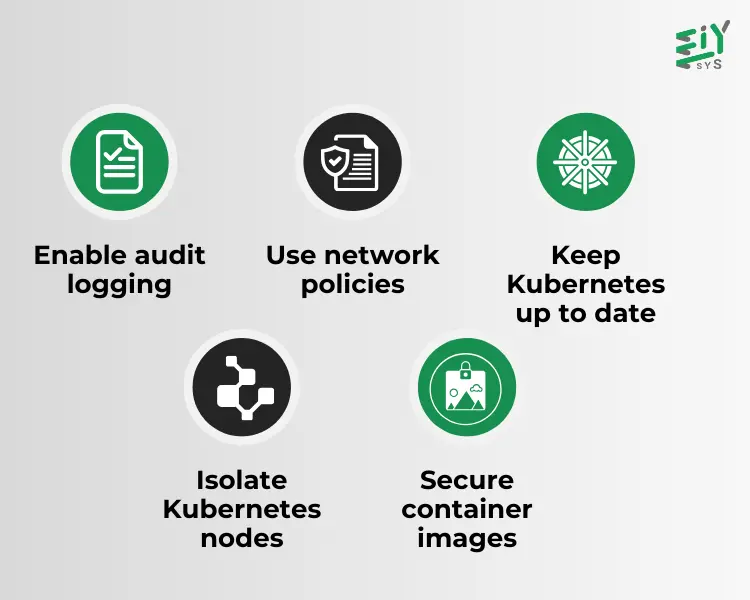
- Enable audit logging: Audit logs record all API requests and actions, which helps identify suspicious activities. This is a crucial aspect of Kubernetes management for tracking and detecting potential security threats.
- Use network policies: Network policies regulate the flow of traffic between pods and services, allowing you to specify which pods are allowed to communicate with each other, thereby minimising security risks.
- Keep Kubernetes up to date: Regularly updating your Kubernetes environment helps ensure that you benefit from the latest security enhancements and bug fixes. This is important for maintaining a secure and efficient Kubernetes management system.
- Isolate Kubernetes nodes: Place Kubernetes nodes on a separate network and avoid exposing them to public networks. This limits the risk of unauthorised access to sensitive parts of your infrastructure.
- Secure container images: Utilise tools like Trivy to scan container images for vulnerabilities or malicious code, ensuring that only safe images are deployed in your Kubernetes environment.
What Is The Role Of Templates In A Helm Chart?
Templates generate manifest files, which are YAML-formatted resource descriptions that Helm Kubernetes can understand. We’ll look at how templates are structured, how they can be used, how to write Go templates, and how to debug your work when working with a Helm Chart.
This Helm Chart focuses on the following concepts:
- The Helm Kubernetes template language
- Using values
- Techniques for working with templates.
What Is Container Orchestration?
- Container orchestration is the process of automating the networking and management of containers so you can deploy applications at scale.
- Containerization bundles an application’s code with all the files and libraries it needs to run on any infrastructure.
- Microservices architectures can have hundreds, or even thousands, of containers as applications grow and become more complex.
- Container orchestration tools aim to simplify container infrastructure management by automating their complete lifecycle from provisioning and scheduling to deployment and deletion.
- Organisations can benefit from containerization at scale without incurring additional maintenance overheads.
How Do You Secure Helm Charts In Helm Kubernetes?
- Secure default values: Avoid exposing sensitive data by securing default values.
- Use environment-specific configurations: Use different configurations for different deployment environments.
- Encrypt sensitive values: Use tools like Sealed Secrets to encrypt sensitive values.
- Ensure the security of external dependencies: Source external dependencies from trusted repositories and review their source code for vulnerabilities.
- Create a cluster with RBAC enabled: Configure each Tiller gRPC endpoint to use a separate TLS certificate.
- Use consistent versioning: Use consistent versioning on your charts to make it easier to respond to vulnerabilities.
- Use Checkov Scans: Use Checkov, an open-source tool, to check your Helm Kubernetes charts for security vulnerabilities and misconfigurations.
- Follow recommended practices: Follow recommended practices, such as avoiding using default passwords for MySQL pods and validating through the Helm template command.
- Secure containers: Ensure that the containers used in the main chart and subcharts are also secure and hardened.
- Helm Kubernetes security practices: Ensure that your Kubernetes environment is securely configured and managed through Helm.
What Is The Purpose Of Kubernetes Tools In Managing Persistent Storage?
Ensure data persistence
Kubernetes tools enable data to persist even after the lifecycle of a container or pod ends. This is crucial for applications that rely on stateful data, such as databases, message queues, and file systems.
Simplify storage management
By decoupling storage from individual pods, Kubernetes tools make storage management easier and allow developers to concentrate more on application logic.
Bridge the gap between apps and storageThese tools connect applications running in pods with the underlying storage systems.
How Does DevOps Handle Scaling And Managing Infrastructure?
The following are the steps for devOps to handle scaling and managing infrastructure :
DevOps manages scaling and infrastructure by leveraging automation, monitoring, and other strategies to ensure that infrastructure remains reliable and efficient as an organisation expands.
Infrastructure as Code (IaC) By using code to set up and manage infrastructure, organisations can easily track, validate, and reconfigure resources. This method helps enforce compliance and control changes made to infrastructure.
Microservices Architecture Dividing applications into smaller, independent services allows each component to scale individually, which boosts flexibility and resilience across the system.
Monitoring and Analytics Real-time tools like Prometheus, Grafana, and Datadog offer insights into system performance, enabling organisations to proactively detect and resolve issues.
Automation By automating processes, DevOps reduces the need for manual intervention. Automation also helps streamline development pipelines, ensuring that processes follow established control measures.
Security Security protocols can be applied dynamically at scale. For example, non-compliant resources can be automatically flagged for review or even fixed to meet compliance standards.
Conclusion
At EIY SYS, we understand the importance of combining automation, monitoring, and security protocols to ensure smooth Kubernetes management. Leveraging tools like Helm Kubernetes, container orchestration, and robust security practices allows organisations to efficiently manage and scale their Kubernetes environments. By utilising Helm Charts and Kubernetes tools, businesses can enhance reliability and address complex infrastructure challenges.
Our DevOps approach ensures secure, efficient, and scalable application management, helping clients optimise their Kubernetes workflows with confidence and security.
Frequently Asked Questions
Helm is a package manager for Kubernetes that simplifies deployment and management of applications in containers.
Helm streamlines application deployment, upgrades, and rollback processes, making Kubernetes environments more efficient and scalable.
Helm charts include templates, values files, and metadata that define application configurations and dependencies.
Yes, Helm supports application deployment and management in both environments, ensuring consistency and scalability.
Mastery of Helm simplifies complex deployments, enhances automation, and improves operational efficiency in containerized systems.
