



It is imperative for any organization to find a way to scale your business efficiently in the fast-moving digital world of today. With DevOps services offered, operations can be smoothed out, productivity can be increased, & grow and scaling your business can also be accomplished.
Scaling your business requires a holistic approach, which is provided by DevOps services. Ways to Scale your business to the level where it can compete on the same playing field as big businesses is best achieved with these strategies.
The use of DevOps services can bring out new opportunities for scaling a small business to grow and scale. In this scale up your business while remaining agile and responsive to changing times as well.
What is DevOps Scaling?
The term DevOps scaling your business refers to an extension of DevOps practices to accommodate a growing & scaling a business. As the company grows, stronger, more efficient and scaling a small business process are developed.
The automation of repetitive and manual tasks is a key component of DevOps scaling a business. CI/CD pipelines can help organizations test, deploy and monitor applications through automated testing, deployment and monitoring.
There are only two more of the most important elements left: improved collaboration and communication among teams. It is possible that the complexity of the projects being developed, as well as the number of stakeholders, will increase as companies grow. It is important for the team to work together by implementing DevOps practices, version control systems, integrated communication tools and collaborative platforms.
How Can Integrated DevOps Services Help in Scaling Your Business?
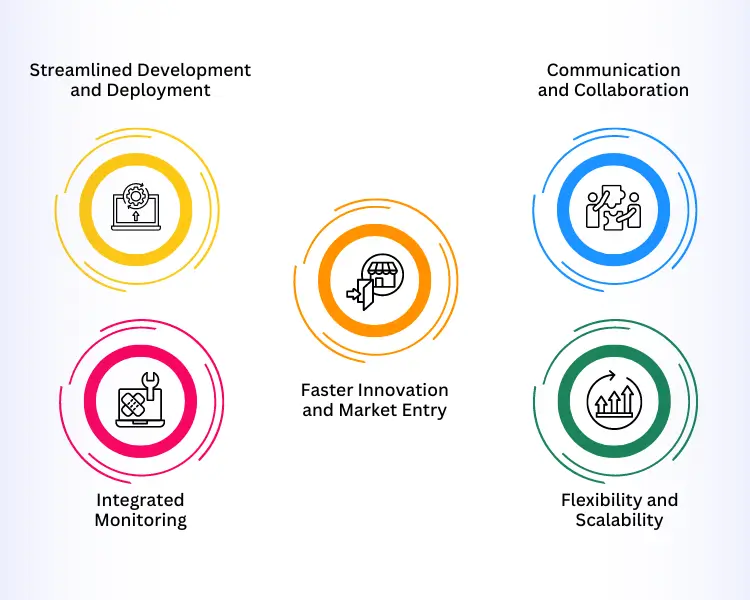
1. Streamlined Development and Deployment
You can accelerate the development and deployment cycles scaling a small business with integrated DevOps services. Continuous Integration and Continuous Delivery pipelines enable teams to automate the process of code integration, testing and deployment to significantly reduce the time it takes to release new features and updates.
2. Communication and Collaboration
Interaction and collaboration are key components of DevOps. Communication is improved by breaking down silos. DevOps practices and tools ensure everyone has equal access to information while increasing transparency and alignment between the team members.
3. Flexibility and Scalability
Scaling a small business can gain all the scalability and flexibility it needs to grow by integrating DevOps services. Scaling up your Businesses can scale their infrastructure with ease at any time thanks to cloud-based solutions and automation.
4. Integrated Monitoring
It is possible to increase operational efficiency in DevOps by automating a number of frequent and manual tasks. Team members can proactively identify problems and fix them by implementing integrated monitoring and logging, resulting in low downtime and higher availability.
5. Faster Innovation and Market Entry
DevOps services with integrated feedback loops can enhance innovation cadence by enhancing the innovation cadence among development and operations. Finding the ways to scale your Businesses can innovate and bring new ideas to market quickly through rapid prototyping, testing and iteration thanks to this technology.
How Is DevOps Beneficial?
Organizations can drive efficiency, innovation, and growth through DevOps that helps to scale up your business. The adoption of collaboration and process automation enables better development cycles, quality and scalability. The following are the major benefits:
- Faster Time-to-Market: Rapid development and deployment reduces the time spent launching new features, products, or services.
- Collaboration: The development and operations teams should be in close communication and collaboration to ensure efficiency and effectiveness.
- Automation: Automating repetitive tasks and processes increases operational efficiency and frees resources for strategic initiatives.
- Improved Quality: Automated testing and monitoring ensure high-quality code through continuous integration and continuous delivery pipelines.
- Scalability: A cloud-based infrastructure makes it possible for organizations to scale up your business and down according to demand.
- More Security: Embedding security practices into the development lifecycle, resulting in secure, law-compliant applications (DevSecOps).
- Higher Reliability: Timely detection of issues and quick resolution lead to a considerable reduction in downtime and improved customer satisfaction.
What are the Best Tools for Scalability in DevOps?
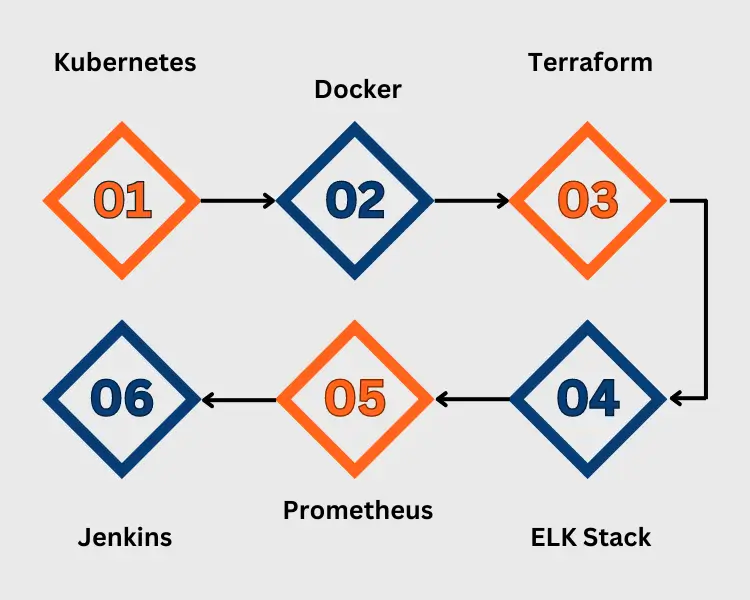
In modern DevOps, scalability is a primary concern and tools are designed with this in mind. Process automation, efficient infrastructure handling, and running applications with increased workloads are supported. Growing and finding the ways to scale your business processes without compromising performance or reliability.
Scalability Tools Include the Following:
1. Kubernetes
Container orchestration platform that automates deployment, scaling a business and operations of containerized applications. As a result, it provides a breeze to get the ways to scale up your business clusters of hosts.
2. Docker
Provides a platform for building, shipping and running applications in containers; simplifies the creation of scalable applications and abstracts them from infrastructure layers.
3. Terraform
With this infrastructure-as-code tool, you can easily declare and provision infrastructures using a high-level configuration language. In Terraform, you can automate the provisioning of resources against several different cloud providers to enable scalable infrastructure management.
4. Jenkins
It is an open-source server that automates continuous integration and continuous delivery. With Jenkins, you can automate the build, testing and deployment of your applications so that scaling a business is easier.
5. Prometheus
With Prometheus, you get the highest level of reliability and scalability in monitoring and alerting. The monitoring and alerting feature of Prometheus is integrated natively into the application. The application collects and stores metrics as time series data to make monitoring real-time, which ensures scalability.
6. ELK Stack
Elasticsearch, Logstash, and Kibana are tools used in real time to search, analyze and visualize log data. By providing insight into system performance, elastic stack supports scalability by helping teams code better and find problems sooner.
Conclusion
When it comes to scaling your business in the digital era, DevOps services are your best bet. Deployment and development processes are smoothed out. Eiy sys provides state-of-the-art solutions and knowledgeable direction to help companies on this path.
DevOps practices enable sustained growth and scaling of your business, whether you’re scaling a small business to compete with large enterprises or growing and scaling your business to meet increased demand.
These are the kinds of strategies that companies must adopt in order to grow, but they are also vital in order to remain competitive and responsive in a market that is constantly changing.
Frequently Asked Questions
DevOps involves combining software development (Dev) with IT operations (Ops) in order to improve collaboration, efficiency, and continuous delivery. With DevOps, businesses can accelerate software development, improve product quality and respond to market demands more quickly, which increases business growth and scales operations.
By automating the development pipeline, DevOps practices enable rapid and reliable deployment of new features and products. As a result, businesses are able to adapt to market changes and customer demands more quickly.
Improved operational efficiency, enhanced collaboration between development and operations teams, increased automation, faster release cycles and increased software quality are a few key benefits.
By breaking down silos between development and operations teams, DevOps fosters a culture of collaboration. When teams share tools, practices and goals, communication improves, problems are resolved faster and projects are executed more cohesively.
