In 2025, the digital world keeps on changing at lightning speed, and companies need to keep up by using the best Content Marketing Tools at their disposal. With changing audience tastes and platforms regularly changing their algorithms, marketers require tools that simplify strategy, fuel creativity, and provide quantifiable outcomes. Whether it is automating work, SEO, or campaign performance analysis, the correct tools can be the difference between underwhelming and impactful content marketing.
As competition grows fiercer in every niche, content marketers have to be more strategic than ever before. To succeed today, it’s not about generating content in bulk, but creating data-driven, personalised content experiences that connect with precise target audiences. This involves choosing AI-driven analytics, real-time content planning, and multi-channel publishing to provide a unified brand voice across channels. Adapting and making smart decisions quickly is no longer a choice but a necessity.
This blog examines the best-performing marketing tools of 2025 that are enabling brands to expand their content strategy and dominate the competition. From next-generation SEO assistants to all-in-one content management systems, these tools are raising the bar for productivity, innovation, and engagement. Let’s see the must-have tools transforming the future of content marketing.
What Are The Characteristics Of Best-In-Class Content Marketing Tools In 2025?
In 2025, leading marketing tools will need to be smart, integrated, and highly responsive. Although Artificial Intelligence and machine learning are no longer niceties, they’re at the heart of driving strategy and action. These tools should deliver real-time insights, predictive analytics, and optimisation recommendations based on user behaviour and competitive trends. With increasing content volume, the capacity to automate mundane tasks without sacrificing personalisation is essential.
Another identifying characteristic is multi-platform smooth integration. No matter whether they are working with blogs, social media, or video campaigns, marketers demand a tool that brings workflow under one roof. Integration with CRMS, design software, analytics tools, and project management tools helps in consistent messaging and smoother implementation. A tool like SEMrush, for instance, brings a set of capabilities under one roof, simplifying the process of marketing from concept through implementation.
User experience also took the stage when it came to designing tools. Simple-to-clean interfaces, smart features, and customizable dashboard features enable users to onboard smoothly and remain productive. With the increased adoption of remote collaboration as a norm, features that improve real-time editing, automated reports, and cloud storage are more coveted than before. The destiny of marketing tools is in intelligent automation, data-driven action plans, and shared ecosystems.
Where Are The Platforms Offering The Most Reliable Audience Analytics?
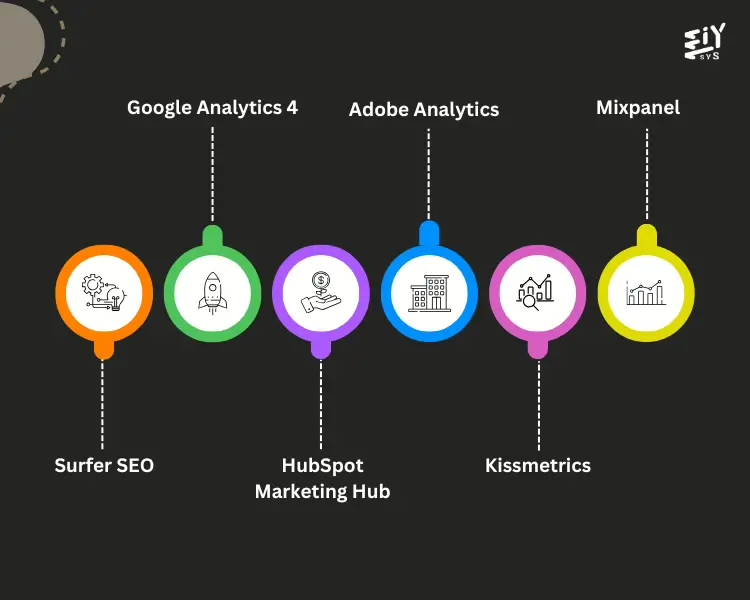
Precise audience insights are the building blocks of optimising content strategies and creating content that matters. In 2025, numerous Content Marketing Tools will provide granular, actionable insights into audiences that go far beyond simple demographics. These solutions aid brands in understanding behaviour, intent, and engagement patterns with greater accuracy than before. They allow for more intelligent content personalisation and more effective use of marketing budgets based on real-time user information.
1. Surfer SEO
SEO offers in-depth content audits and optimisation recommendations specific to user intent, allowing marketers to adjust tone and keyword application according to audience engagement metrics. Its SERP analyser and content editor provide strong recommendations based on competitive benchmarking.
2. Google Analytics 4
With event-tracking and predictive metrics, GA4 provides brands with a holistic understanding of user journeys on web and app platforms, improving attribution accuracy. It now has AI-driven insights that recommend actions based on patterns of user behaviour.
3. HubSpot Marketing Hub
This platform is best at merging CRM information with behaviour analytics to enable accurate audience segmentation and content delivery at a personal level. It offers comprehensive lifecycle tracking and conversion funnel reporting, simplifying the process of pinpointing bottlenecks and optimisation points.
4. Adobe Analytics
Renowned for enterprise-level tracking, Adobe Analytics applies machine learning to forecast audience behaviour and suggest content strategies in real-time. The tool supports multi-channel attribution modelling and heatmaps for close engagement tracking.
5. Kissmetrics
With a focus on customer lifetime value and retention metrics, Kissmetrics makes it possible to see how various types of content impact conversion within funnels. It monitors user behaviour by individual users across sessions, enabling micro-targeting and a customised content strategy.
6. Mixpanel
Perfect for product-driven businesses, Mixpanel delivers fine-grained user behaviour monitoring that can shape content development choices tied explicitly to user actions. It’s geared toward cohort analysis, funnel tracking, and A/B testing for measuring engagement and retention.
How Can SEO Tools Help With Organic Reach In 2025?
SEO tools in 2025 have come a long way from being simple keyword finders to strong platforms that comprehend user intent and assist in shaping content strategies accordingly. Today, these tools provide predictive features, analysing existing trends to predict future keyword prospects. They also assist in finding gaps in competitor content, providing marketers with a strategic advantage in strategising articles, videos, or social content that ranks quicker and connects deeper.
Along with keyword planning, advanced SEO tools help in optimising all aspects of on-page SEO. These include meta tag suggestions, readability, internal linking, and mobile performance. Platforms such as BuzzSumo play a crucial role in discovering top-performing content throughout the web, allowing marketers to reverse-engineer viral campaigns and align their content with trending topics and styles.
Another significant contribution lies in tracking performance and measuring ROI. Sophisticated SEO solutions now connect to analytics platforms to provide end-to-end perspectives of traffic sources, user actions, and conversion rates. Insights provide iterative refinement, so that not only do pages rank well but also drive business objectives directly. SEO tools in 2025 are not only vital for visibility but for sustained content development and acquiring customers.
How Are Brands Using Content Management Systems More Quickly?
Brands of 2025 are no longer employing content management systems (CMS) merely as publishing platforms, they’re utilising them as marketing centres. Current CMS platforms include inherent SEO capabilities, scheduling, analytics, and personalisation features that enable more calculated storytelling. They form the foundation for omnichannel content management, ensuring consistency between touchpoints.
The emphasis now is on modular content strategies. Brands use CMS to develop reusable content blocks that can be customised for various platforms or campaigns. This modularity accelerates production and allows for real-time updating without having to recreate assets. Grammarly and other tools are being utilised in conjunction with CMS platforms to keep content quality and tone on-brand in all formats.
In addition, CMS platforms are more collaborative and data-driven. Due to role-based permissions, cloud access, and content performance dashboards, teams work more effectively and openly. Also, marketing, design, and development teams are better integrated, accelerating workflows and the overall execution of content strategy. Brands are transforming CMS into dynamic ecosystems for content success.
What Is The Role Of Editorial Workflow Tools In Content Consistency?
Editorial workflow software is critical in ensuring content quality, tone, and delivery schedules, particularly for teams responsible for high levels of output. Software such as Clearscope guarantees that content is not only optimized but consistent in its formats and contributors.
- Task Assignment & Ownership- Workflow software ensures that each piece of content is assigned to a specific person, avoiding duplication and missed deadlines while making project management efficient.
- Version Control- These tools have clean records of changes, allowing editors and writers to keep track of history and revert if necessary.
- Content Templates- Semi-defined templates preserve brand voice and style, ensuring teams can stick to rules irrespective of authorship.
- Approval Chains- Internal review and approval workflows guarantee that only refined, quality-checked content gets published, limiting errors and inconsistencies.
- Real-Time Collaboration- Teams can work on content at the same time, giving feedback and making edits in real-time, which speeds up production without diminishing quality.
Publishing Schedules- Editorial calendars guarantee balanced, timely content delivery, which is essential for audience retention and campaign success.
Conclusion
By 2025, the online environment requires adaptability, data-based strategies, and frictionless collaboration, all facilitated by advanced Content Marketing Tools. These solutions equip marketers with the ability to create, publish, and optimise content with improved accuracy, allowing them to better engage with their audiences and reinforce their brand presence. From analytics and audience understanding to SEO and workflow management, these tools form the foundation of any quick content approach, assisting brands in maintaining their competitiveness within an ever-changing marketplace.
In the future, the convergence of AI, predictive analytics, and personalisation will continue to influence the way content is produced and consumed. Eiysys helps marketers use these technologies not just to automate production but also to create significant, relevant experiences for their audiences. As consumer and algorithmic expectations grow, the capacity to evolve and scale with smart tools will determine the next wave of content success.
Frequently Asked Questions
Marketing tools are used to plan, create, distribute, analyse, and optimise content across various digital platforms. They help improve workflow efficiency, maintain content consistency, and provide performance insights to improve engagement and ROI.
These tools identify high-performing keywords, suggest on-page optimisation strategies, and analyse competitors’ content. They also monitor rankings and provide real-time suggestions to improve visibility in search engine results.
Yes, many tools offer scalable solutions suitable for small teams, including affordable plans and automation features. These help small businesses simplify content production, reach targeted audiences, and compete effectively in digital spaces.
Important features include content scheduling, SEO integration, analytics dashboards, collaboration capabilities, and platform integrations (e.g., CMS, social media, CRM). AI-powered insights and automation are also valuable for enhancing efficiency.
No, AI tools are designed to support—not replace—human creativity. They assist with ideation, optimisation, and scaling, while human marketers remain essential for strategy, storytelling, and emotional resonance.