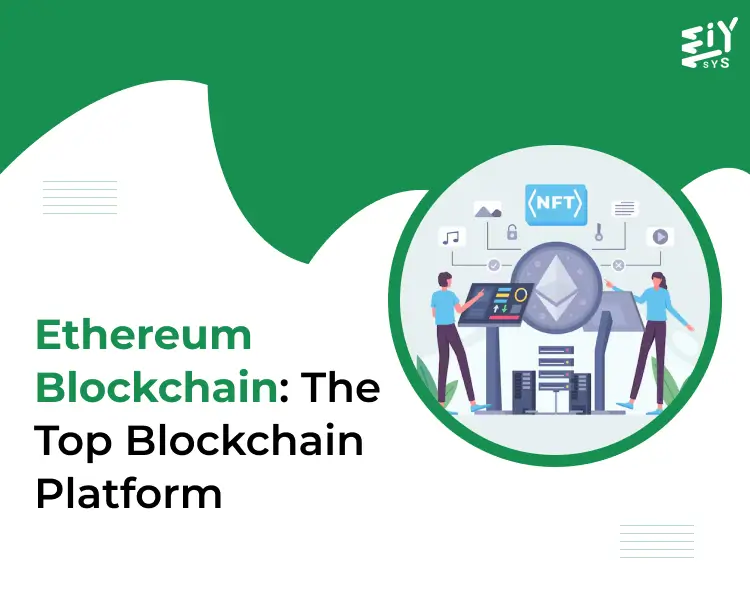
Ethereum blockchain is a decentralized blockchain platform that creates a peer-to-peer network for the safe execution and validation of smart contract application code. Without the need for a reliable central authority, participants can interact with one another via smart contracts. Because transaction records are disseminated securely throughout the network and are verifiable and immutable, participants have complete ownership and visibility over transaction data. Ethereum accounts that users have created are the sender and recipient of transactions. As a cost of processing transactions on the network, a sender must sign transactions and spend Ether, the native coin of Ethereum.
What are the Advantages of Developing on Ethereum?
With the Ethereum Virtual Machine and the built-in Solidity scripting language, Ethereum provides an incredibly flexible foundation for developing decentralized apps. The robust ecosystem of developer tools and well-established best practices that have come with Ethereum’s maturation are advantageous to decentralized apps developers that implement smart contracts on the Blockchain platform. The quality of the user experience for the typical Ethereum user is further enhanced by this maturity, as wallets such as MetaMask, Argent, Rainbow and others provide straightforward interfaces for interacting with the Ethereum blockchain and smart contracts that are implemented on it.
Since Ethereum development has a big user base, developers are encouraged to launch their apps on the network, solidifying Ethereum’s position as the main Blockchain platform for decentralized apps like NFTs and DeFi. The Ethereum 2.0 protocol, which is presently being developed and is backwards-compatible, will eventually offer a more scalable network for the creation of decentralized apps that need higher transaction throughput.
What Qualities Does the Ethereum Blockchain Offer?
-
Simple
The blockchain formulas for developing Ethereum apps are made straightforward and simple to use, which lowers the total cost of transactions. Nonetheless, Ethereum’s low execution utilization makes it well-known among developers and users may make most blockchains consume a lot of energy and resources in order to complete transactions.
-
Universal
Developers can create smart contracts that suit their needs by using Ethereum development. The Ethereum blockchain will open up a lot of opportunities for blockchain applications.
Transactions may be performed securely and be prepared for deployment if Ethereum apps are developed properly.
-
Modular
Ethereum contracts that are modular can be created in little parts that add up to provide the needed features. It allows for flexibility in case a change is needed soon. Modular adjustments are easier to implement than sweeping changes through the entire protocol.
-
Ethereum Virtual Machine
The purpose of the Ethereum virtual machine is to manage the runtime environments needed to compile and execute Ethereum-based smart contracts. It’s a kind of engine that can understand smart contracts written in the reliable Ethereum programming language. A sandbox is the operating environment for Ethereum virtual computers. As a result, you can evaluate intelligent contracts and see how well they function in real-world scenarios. You can use the performance going forward if you’re OK with it.
What are the Use Cases for Ethereum Blockchain?
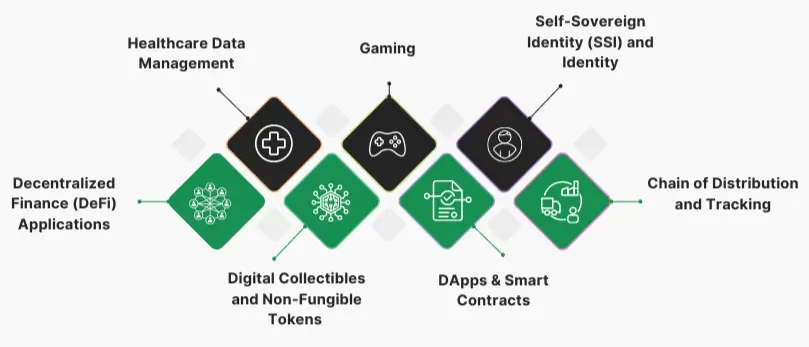
1. Decentralized Finance (DeFi) Applications
Ethereum’s most well-known product is DeFi. These apps don’t follow the rules of conventional financial systems; instead, they are developed on the blockchain.
These apps are safe, economical, transparent and unchangeable. No matter where they are or how much money they have, they are accessible to everyone. Additionally, the source codes are available for public scrutiny, guaranteeing security.
On the Ethereum blockchain, no transaction can be altered or reversed. This adds to the high degree of security and openness. Because DeFi apps are not subject to the same stringent laws and level of control as traditional services, they are also far less expensive.
2. Digital Collectibles and Non-Fungible Tokens (NFTs)
NFTs are digital assets that are specific to their representation and cannot be duplicated or swapped out for another asset. Ownership of items like artwork, collectibles, real estate, in-game components and even precious metals like gold is represented by NFTs.
NFTs are minted and traded using Ethereum, the most widely used blockchain technology. It is now simple to establish a safe and open market thanks to this. Transferring ownership of assets on the blockchain is also made easier by it.
3. DApps & Smart Contracts
Self-executing contracts known as “smart contracts” are stored on the Ethereum network. Let’s say you wish to hire a freelance developer to create the website for your business. It is possible to create a smart contract that would make things easy for you both.
You provide terms and conditions in this smart contract. After the conditions of the contract are satisfied, the agreement will then be automatically performed.
With this in place, business may continue without interruption and there is no need to rely on the honesty of the third party.
Conversely, decentralized apps, or DApps, operate on decentralized networks such as Ethereum. They are open source and not subject to centralized control.
4. Self-Sovereign Identity (SSI) and Identity
People are more cautious about who they identify with online than ever before. And with good reason—our identity authenticates who we are and grants us access to a host of services.
But because identity systems are managed by inefficient centralized entities, we are susceptible to identity theft, unauthorized access and other threats.Self-sovereign identity (SSI) is relevant in this situation. We have control over our digital identities with this strategy. We can select who we wish to share this data with and save it on the Ethereum blockchain.SSI can be used for work, travel, healthcare, banking services, voting and other purposes.
5. Chain of Distribution and Tracking
Organizing, planning and managing the flow of products and services from suppliers to consumers is known as supply chain management. Monitoring the movement of products and services along the supply chain is known as traceability.
In many respects, the Ethereum blockchain greatly enhances traceability and the supply chain. All transactions are open access because the ledger is transparent by nature. Additionally, it is secure since it is hard to tamper with, which makes it nearly impossible for counterfeit items to get into the supply chain.
6. Gaming
Numerous methods, including NFTs and DeFi applications, are already integrating the Ethereum blockchain into the gaming sector. Like in-game goods, NFTs can be bought, sold and exchanged much like real-world goods. On the blockchain, smart contracts are frequently used to generate NFTs.
The decentralized, transparent and secure Ethereum blockchain enhances gameplay and removes the worry of fraud or cheating.Axie Infinity, The Sandbox, Gods Unchained, Decentraland, etc. are a few of the well-known blockchain games.
6. Healthcare Data Management
Sensitive data, such as health records, should be securely stored to prevent data breaches and leaks. For this reason, the Ethereum blockchain plays a crucial role in protecting medical records. This reduces the number of individuals with access to only patients, researchers and experts.
To improve user experience and guarantee accuracy, blockchain oracles link Ethereum to other data sources. The Ethereum blockchain is not only efficient, safe and transparent—it is also compatible with other blockchains. The capacity to exchange healthcare data between various systems is known as interoperability.
Conclusion
Ethereum blockchain is expanding rapidly and blockchain technology will give Ethereum a Blockchain platform. Ethereum does, however, have certain benefits and drawbacks because it is a relatively new technology. Our developers are committed to offering the best services for developing Ethereum apps. Our developers’ exceptional skill and dedication to their job are the primary factors behind each customer project’s success and their happiness.
One of the top software Ethereum development firms with a focus on blockchain Technology is Eiy sys. Our company is already assisting numerous other clients with the requirements of their projects and has already supplied an abundance of blockchain solutions. Being among the first to use this innovative technology, Eiy sys for Ethereum development team is an ideal collaborating partner for your upcoming project.
Frequently Asked Questions
On its blockchain, Ethereum is a decentralized platform that lets programmers create and run decentralized apps (dApps) and smart contracts.
Its thriving dApp ecosystem, sizable developer community and strong smart contract capabilities all add to its notoriety in the blockchain industry.
Although it now has the most features for smart contracts, platforms like Binance Smart Chain and Solana are becoming more competitive since they provide quicker transactions and less costs.
Yes, by switching to proof-of-stake, Ethereum 2.0 seeks to improve sustainability, scalability and security, perhaps maintaining its leading position.