
Digital Marketing ROI is an important metric that measures the profitability of your on-line marketing efforts. It is calculated using the formula: (Net Profit / Total Digital Marketing Costs) x 100. This allows businesses to evaluate the monetary fulfillment in their campaigns by evaluating the profit generated in opposition to the charges incurred.
By measuring Digital Marketing ROI, you gain precious insights into the effectiveness of your techniques and apprehend which methods are delivering the best outcomes. Whether it’s social media advertising, electronic mail campaigns, or search engine optimization, calculating ROI allows perceive the most cost-powerful techniques for reaching your audience.
This technique enables agencies to make data-pushed decisions, optimize campaigns, and in the long run enhance the go back on their digital advertising and marketing investments.
What Is The Role Of Analytics In Digital Marketing?
Analytics in Digital Marketing plays a critical function in optimizing strategies and improving commercial enterprise performance. It involves amassing and studying information from diverse digital assets to extract actionable insights that manual advertising selections. By using Analytics in Digital Marketing tools, organizations can inspire new techniques, lessen churn rate (whilst clients prevent engaging), and boom customer cost via personalised stories. A 2020 survey found that ninety four% of companies don’t forget information and analytics crucial for digital transformation, yet only 30% have a clear information method.
What Are The Key Steps To Set Up Effective Marketing Performance Tracking?
1. Set Goals For Your Marketing Campaigns
To efficiently measure your marketing overall Track Marketing Performance , you first need to set clean, SMART dreams: Specific, Measurable, Attainable, Relevant, and Timely. For example, in preference to an indistinct purpose like advantage new leads, a SMART aim could be boom leads in keeping with month to a hundred by using the stop of the area.
2. Choose Data-Tracking Software
Using information-monitoring tools like Google Analytics four (GA4) helps you display user interactions, including clicks and purchases. Google Search Console (GSC) is some other essential tool for tracking your website’s search engine marketing overall performance, consisting of impressions, clicks, and cellular optimization.
3. Determine Your Key Performance Indicators (KPIs)
KPIs are important to evaluate the fulfillment of your campaigns. Metrics like impressions are useful for social media, whilst search engine optimization overall performance is crucial for seeking engine efforts. By monitoring KPIs that align with your marketing campaign’s objectives, you can make records-driven adjustments to improve performance.
4. Create A Schedule For Tracking Performance
Set an ordinary agenda for monitoring your marketing campaign’s metrics. For short-time period campaigns like PPC, tune performance day by day, whilst for lengthy-time period efforts like search engine marketing, non-stop tracking is needed. Regular monitoring ensures timely adjustments and keeps you on course to fulfill your business goals.
5. Metrics To Track To Measure Marketing Performance
Key metrics to degree include conversion charge , which tracks what number of visitors take a preferred movement, Cost according to Lead (CPL), and Customer Lifetime Value (CLV), which suggests the lengthy-time period price of a consumer. By setting goals, using data-tracking tools, selecting KPIs, and evaluating performance on a schedule, you can effectively Track Marketing Performance and make data-driven decisions to optimize your campaigns.
How Do You Measure ROI In Marketing?
To measure ROI in marketing, one common method is to calculate it by using the formula:
ROI=(Sales Growth−Marketing Cost)Marketing Costtext{ROI} = frac{(text{Sales Growth} – text{Marketing Cost})}{text{Marketing Cost}}
This formula helps determine the return on investment for a marketing campaign by comparing the profit generated (sales growth) to the marketing costs incurred. It is a fundamental approach for measuring ROI in marketing, providing a clear picture of how effective the marketing spend has been.
For example, if a business experiences a sales growth of $1,000 and the marketing campaign cost $100, the ROI would be:
(1000−100)100=900%frac{(1000 – 100)}{100} = 900%
This calculation shows that for every dollar spent on marketing, the company generated $9 in sales. This method is straightforward and effective for campaigns with direct, measurable outcomes. However, for long-term marketing strategies, like SEO or brand awareness campaigns, additional factors may need to be considered for a complete assessment of measuring ROI in marketing.
What Are Marketing Analytics Tools?
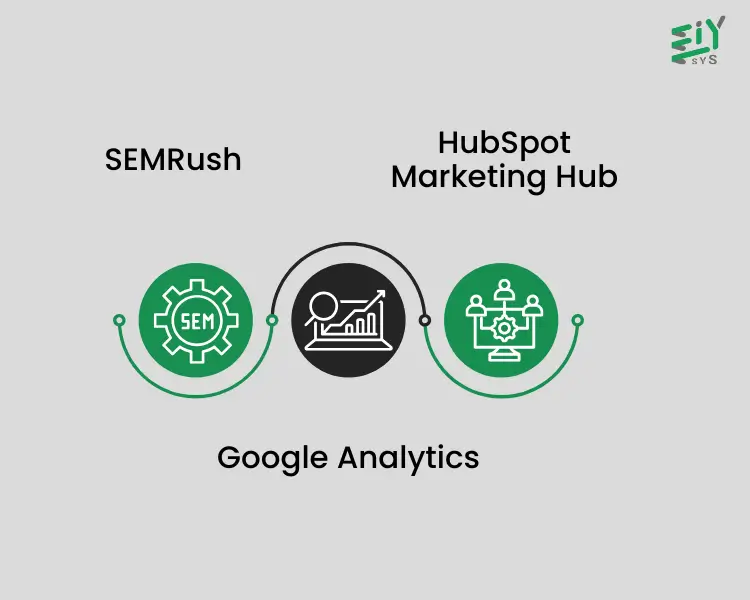
Marketing analytics tools are software solutions that help businesses track, measure, and analyze their marketing campaigns, customer data, and overall performance. These tools provide valuable insights, enabling companies to make data-driven decisions, optimize their strategies, and ultimately improve their return on investment. Here are a few examples of popular marketing analytics tools:
1. DashThis
It is a self-service analytics platform designed to help users customize their dashboards and integrate over 34 digital marketing tools for seamless data analysis. The platform offers flexible pricing starting at US$33 per month, with a 15-day free trial for users to explore its features before committing.
2. Google Analytics
A free and widely-used tool for tracking website traffic, audience insights, and user behavior. It integrates with Google Data Studio for data visualization and is perfect for anyone needing in-depth website analytics.
Pricing: Free.
3. SEMRush
It specializes in SEO, content marketing, keyword research, and backlink analysis. It’s particularly useful for improving organic search rankings and PPC ad performance.
Pricing: It Starts from US$99.95/month with a 30-day free trial.
4. HubSpot Marketing Hub
It is an all-in-one marketing platform that includes powerful reporting and web analytics tools. It integrates with HubSpot’s CRM, providing a seamless experience for sales and marketing teams.
Pricing: Tiered pricing plans based on the number of marketing contacts.
These marketing analytics tools help marketing professionals make informed decisions and improve the effectiveness of their marketing efforts by providing insights into website performance, SEO, customer behavior, and more.
How Do Data-Driven Marketing Insights Contribute To Measuring ROI?
Data-Driven Marketing Insights make a contribution to measuring ROI via permitting entrepreneurs to use client records to predict desires, goals, and destiny behaviors. By analyzing this data, entrepreneurs can increase surprisingly customized advertising strategies that are tailor-made to their audience, leading to extra effective campaigns. These Data-Driven Marketing Insights assist in optimizing logo communications, making sure that advertising efforts are more efficient and impactful.
Ultimately, through focusing on the proper strategies and procedures, facts-pushed advertising maximizes ROI via enhancing focus on, engagement, and conversions whilst decreasing wasted spend.
Conclusion
EIY SYS emphasizes the importance of understanding Digital Marketing ROI for optimizing marketing efforts. By leveraging Analytics in Digital Marketing, businesses can gain valuable insights to guide their strategies. The ability to Track Marketing Performance ensures campaigns stay on track and deliver results. Measuring ROI in Marketing allows businesses to assess the effectiveness of their investments.
Using the right Marketing Analytics Tools aids in efficient data analysis. Ultimately, Data-Driven Marketing Insights enable businesses to refine their strategies, enhance targeting, and maximize returns on marketing investments.
Frequently Asked Questions
Digital Marketing ROI measures the profitability of online marketing efforts. It helps businesses evaluate the effectiveness of their campaigns by comparing the profit generated against the costs incurred, enabling smarter investment decisions and optimization of marketing strategies.
Analytics in Digital Marketing helps businesses gather data and extract actionable insights from various digital sources. By analyzing customer behavior and campaign performance, companies can optimize strategies, reduce churn rates, and enhance customer value through personalized experiences.
Tools like Google Analytics, Google Search Console, and SEMRush are popular for tracking marketing performance. They help monitor user behavior, website performance, and key metrics, allowing businesses to adjust strategies and improve overall campaign success.
Marketing Analytics Tools, such as DashThis, SEMRush, and HubSpot, help businesses track, measure, and analyze marketing efforts. By providing detailed insights into customer behavior, conversions, and other metrics, these tools help businesses assess the ROI of their marketing campaigns effectively.
Data-Driven Marketing Insights allow businesses to predict customer needs and future behavior, enabling them to develop personalized campaigns. This targeted approach enhances engagement, conversions, and ROI by reducing wasted spend and focusing on the most effective marketing strategies.