



To put it plainly, Decentralized data storage is the use of Blockchain-based storage to improve data security and privacy in cloud storage. Big data storage online has long been preferred by users to use centralized Cloud storage security providers like Microsoft and Amazon. In addition to their many storage possibilities and ease of use, these centralized storage Blockchain cloud solutions have a number of drawbacks, such as the potential for monopolized pricing, censorship, policy changes, cyberattacks, data loss and various privacy issues. The emergence of “decentralized cloud storage” as a competitive alternative to centralized Cloud storage security coincided with the growing significance of blockchain technology.
Decentralized cloud storage using blockchain, on the other hand, is a revolutionary technology that presents a possible answer to these problems. The combination of blockchain technology and Cloud storage securitye has created a plethora of opportunities for secure, transparent, decentralized data storage and retrieval.
What is Decentralized Cloud Storage?
It would be beneficial to comprehend the underlying principles of decentralized cloud storage before getting into the specifics. The concept of decentralization is one that supports a liberal form of government in which there is no one ultimate power that controls everything. Decentralization is currently one of the most talked-about features of Blockchain-based storage and cryptocurrency.
Take into consideration “centralized storage” options like Microsoft Azure or Amazon to put things in perspective. Ultimately, the internal policies and regulations of the aforementioned firms will apply to all data stored on the cloud under their control.
Conversely, decentralized storageBlockchain cloud solutions spare no single centralized authority from full oversight and accountability for data storage and privacy maintenance. In addition to opening the door for a more open and private digital environment, decentralization solves a number of issues that the tech sector is now facing.
How Does Decentralized Storage Systems Work?
Decentralized data storage involves storing data among various computers, commonly referred to as nodes, as opposed to centralized storage, which saves data on numerous servers housed in a single database. Peer-to-peer cloud storage networking, which is decentralized, connects all of these nodes. Napster and BitTorrent are among the first instances of Peer-to-peer cloud storage networks of this kind.
Like any centralized storage, a Decentralized data storage system allows you to upload and retrieve files from the network as needed. For example, in order to download a file from a Decentralized data storage one must first download different portions of the file from a P2P network until the entire file is obtained. BitTorrent operates similarly to this as well. Nevertheless, since all data uploaded to a decentralized storage network is encrypted by default, nodes inside a decentralized network are unable to read or modify your files. As a result, you are guaranteed complete privacy and safety, knowing that your data is in capable hands.
Decentralized systems store data throughout a large P2P network wherever it is, whereas centralized storage stores it in a centralized point that is closest to you geographically. Because neighboring peers manage the entire process rather than servers located in a physical place, decentralized storage typically offers faster data transfer speeds.Blockchain-based storage provides transparent and verifiable proofs for data storage, consumption and dependability through cryptography, supporting decentralized storage platforms. This removes the necessity of depending on and having faith in a centralised supplier.
What are the Advantages Of Decentralized Storage Using Blockchain?
As we previously discussed, decentralized storage has developed to overcome the drawbacks and restrictions of centralized storage. It is a good substitute for conventional Peer-to-peer cloud storage security choices because of these few advantages it has over centralized storage.
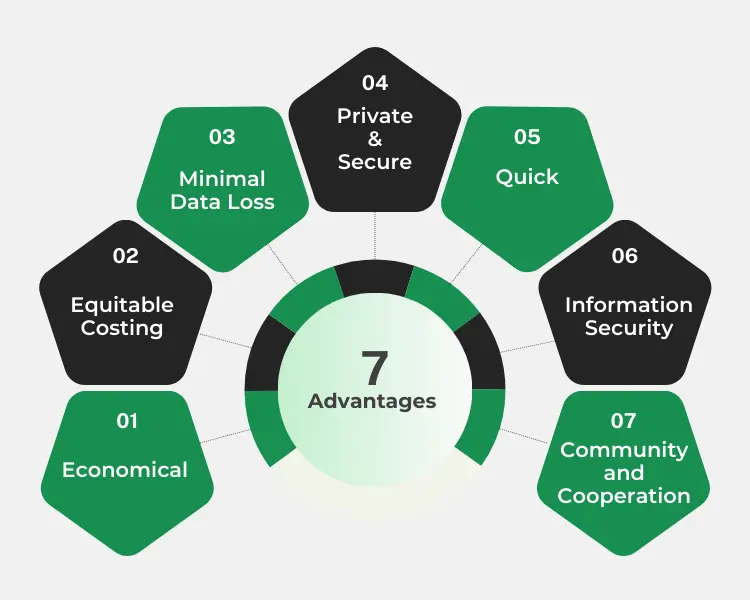
1. Economical
Decentralized storage networks are made up of millions of nodes willing to securely host your data, in contrast to centralized storage systems where your data is hosted by a limited number of data centers. This is a cost-effective solution because it not only offers a large quantity of storage bandwidth but also lowers the cost of storage.
2. Equitable Costing
Since only the most resilient nodes are often rewarded, there is always rivalry among storage nodes in Decentralized data storage networks. There is almost no chance of monopolies, unjust pricing, or anti-competitive behavior as a result of this kind of competition. As a result, you may anticipate reasonable pricing when you join this network.
3. Minimal Data Loss
Millions of nodes typically participate in decentralized storage systems and store your data. This assists in making several copies and guarantees that no data is lost in the event of any unanticipated events, like an area losing power, for example.
4. Private & Secure
The high levels of security and privacy that decentralized storage offers are a result of two reliable elements. The encryption of all the data is the first factor. The data is divided over millions of storage nodes after being encrypted, which is the second factor. This prevents any node on a decentralized network from being able to access or comprehend any data.
5. Quick
When using a centralized storage system, network bottlenecks are frequently seen since the servers may occasionally become overloaded with traffic. But in a decentralized network, different nodes keep different versions of the same data. Because you can now quickly and securely access your data from a large number of nodes, the likelihood of network bottlenecks is eliminated.
6. Information Security
Since data is usually encrypted before being shared across the network, decentralized storage increases data privacy. Without the right decryption keys, it is considerably more difficult for unauthorized parties to view or alter the data because it is fragmented and stored among several nodes.
7. Community and Cooperation
Decentralized data storage networks frequently promote a community-driven environment in which users pool their resources and work together to keep the network up to date and functional. Participation in the community can foster innovation, openness and consensus-building, which is advantageous to all parties.
What To Consider When Choosing A Decentralized Network Provider?
1. Mechanism of Persistence
To guarantee data is stored safely and securely in a decentralized network, a persistence mechanism or incentive structure is essential. For example, Ethereum has a persistence method called “Blockchain-based storage persistence.” Since Ethereum’s persistence method isn’t scalable for effectively storing massive volumes of data, every Decentralized data storage service has their own persistence mechanism and incentive structure. Another incentive structure that many Decentralized data storage services, including Filecoin and Storj, tend to adhere to is contract-based persistence. In this architecture, data is stored in a predetermined number of nodes for a predetermined amount of time thanks to the enforcement of contract agreements.
2. Enforcing Data Retention
A popular method to determine whether a node still retains data is to use cryptographic challenges as part of data retention enforcement, which is a way to guarantee data retention. Data retention enforcement can be seen in Arweave’s Proof-of-access mechanism, for example. Nodes must finish a challenge that determines whether data is available in the most current node as well as a randomly selected node from the past. Nodes incur penalties if they are unable to finish the challenge.
3. Dispersion
Although evaluating a storage provider’s level of decentralization cannot be done in a one-size-fits-all manner, it is generally a good idea to subscribe to services and software Blockchain cloud solutions that display some sort of KYC.
4. Consensus
To put it simply, consensus is the process by which every node in a blockchain or decentralized network comes to an understanding about the current state of the distributed ledger. Although each decentralized storage provider may have its own consensus process, the majority of other mechanisms are based on proof-of-stake (PoS) and proof-of-work (PoW), which are the two common mechanisms.
Conclusion
In summary, this revolutionary combination has the ability to completely transform data management and storage. This is made clear as we wrap up our extensive guide on “Decentralized Cloud storage security Using Blockchain.” Numerous issues raised by conventional centralized Peer-to-peer cloud storage Blockchain cloud solutions are resolved by blockchain’s intrinsic security, transparency and immutability. Users can now take ownership of their data through decentralized cloud storage, guaranteeing more privacy and a decrease in reliance on specific parties.
Though it faces a number of challenges, it is a shining star in the Flutter sky. It is up to you to choose the right star from among them. We Eiy sys will leverage this technology to advance a step ahead of others. Do you feel ready? Then buckle up and begin your journey with Eiy sys.
Frequently Asked Questions
Unlike typical centralized storage solutions run by a single company like Google or AWS, decentralized cloud storage distributes data among numerous nodes in a network.
Decentralized cloud storage disperses data among numerous computers, increasing security and resilience to outages, in contrast to centralized cloud storage, which stores data on the servers of a single business.
Data is dispersed among several nodes, reducing the possibility of centralized assaults or data breaches and enhancing security and privacy.
By removing dependency on other sources and enabling people to own and manage their own files, it gives consumers more control over their data.
