
The world of software Development practices may be intimidating. Numerous languages, Software testing frameworks and tools exist that one should be familiar with. There are other procedures to adhere to. Writing code isn’t always the hardest part of the job for a developer. The challenge is in figuring out what code to write, handling various scenarios and attempting to anticipate the demands of the user. By creating tests in advance, we can address this. By doing this, the developer has a set of standards to satisfy that can be verified as correct. The term “driven development” is a common component of the acronyms for TDD (test-driven development), BDD (behavior-driven development) and ATDD (acceptance-test-driven development).
These frameworks direct growth by forcing us to plan ahead and adhere to predetermined guidelines before beginning work. They share a focus on our spending time planning and creating tests before development. Having tests already in place sets clear expectations of what we need to build. And as developers, we labor through these criteria nonstop, determining that our job is complete when every test passes.
Everybody has a success story about why you should utilize their process choice when it comes to alternatives. I think you should experiment with the various procedures to see which one suits you and your group the best. In keeping with that, I’ll examine TDD, BDD and ATDD and discuss the benefits of doing so.
What is TDD, BDD & ATDD?
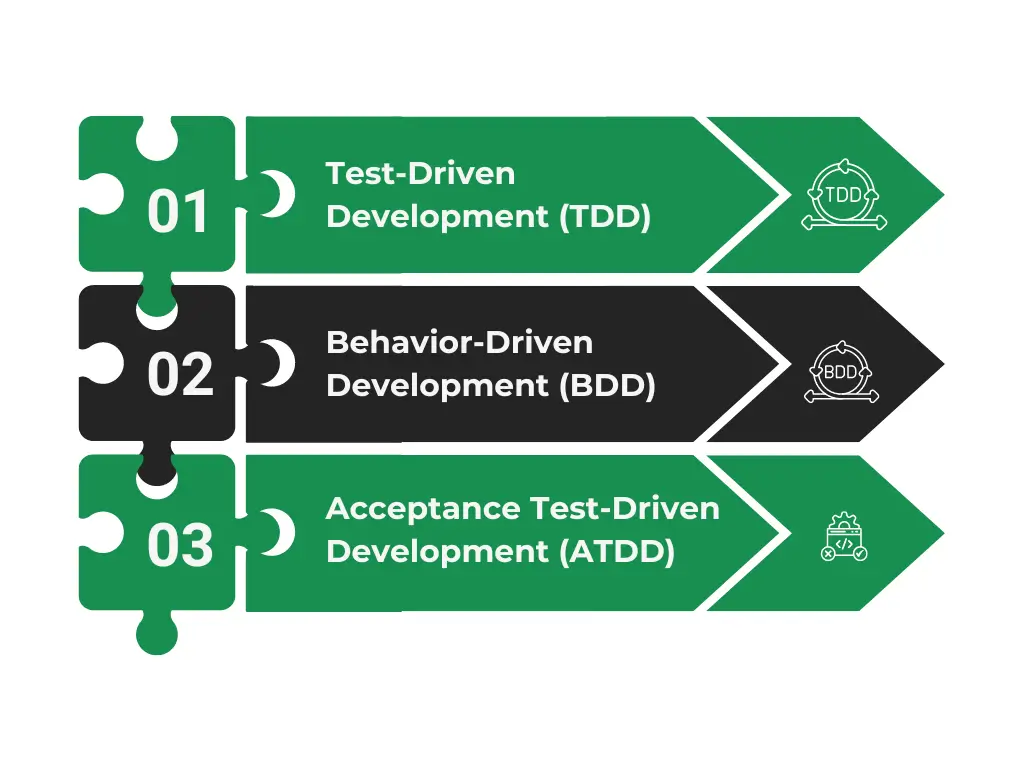
1. Test-Driven Development (TDD)
Test-Driven Development (TDD) is a process where test cases are created before developers begin coding. These test cases represent only a minor portion of the software’s requirements.
The method used in this case is a “red-green-refactor” loop that continuously tests the written code until it is fully prepared to be included in the scheme. TDD works best when there is a known set of inputs with predicted results. It assists in simplifying complicated reasoning, particularly when it comes to achieving those outputs. Developers can concentrate on one task at a time and divide complex challenges into smaller pieces.
i) TDD Methodology
The test-first Agile methodologies of TDD also help reduce significant bottlenecks that hinder software delivery and quality. The system is continuously updated with new features, problem patches, and feedback to ensure everything functions as intended. TDD improves communication with clients and among members of the development and QA teams. Teams also save time by not having to recreate lengthy test scripts because the tests are pre-written.
ii) Benefits of TDD
- Encourages efficient coding practices.
- Aids in better analysis and comprehension of customer requirements, allowing developers to ask for clarification when necessary.
- Later in the development process, adding software testing frameworks with new functions becomes easier.
- Test coverage is significantly higher with TDD than with traditional development approaches, due to its emphasis on developing tests for every feature from the start.
- Increases developer productivity and results in the creation of a flexible, manageable codebase.
2. Behavior-Driven Development (BDD)
Behavior-Driven Development (BDD) is an Agile methodology that involves constructing basic scenarios representing an application’s intended behavior from the perspective of its end users.
BDD focuses on verifying scenarios and behaviors rather than code implementation. However, it shares some parallels with TDD. For instance, to ensure high-quality code, both approaches adhere to similar procedures.
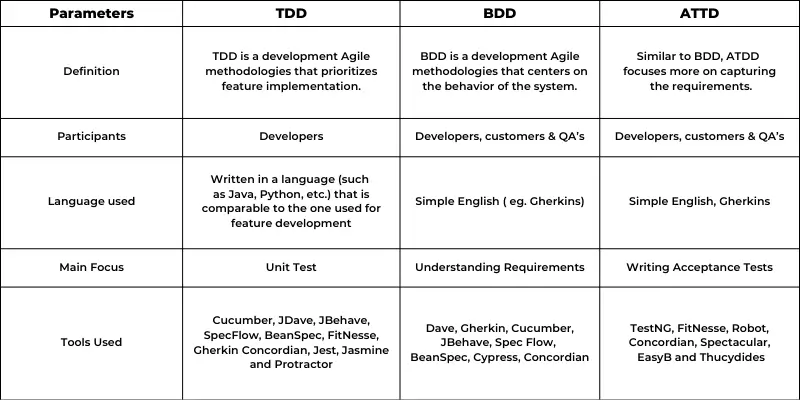
The primary difference between the two approaches lies in how test cases are written. In BDD, it’s not just developers who consider what to test; together with testers and product managers, they review each user narrative to ensure all requirements are satisfied. These instances are recorded in a language designed for behavior descriptions, such as Gherkin, which utilizes the Given, When, and Then keywords, making the specifications readable and understandable to everyone.
i) Benefits of BDD
- Good Cooperation: BDD fosters thorough understanding among all parties, facilitating communication and productive discussions. It enhances teamwork and simplifies interactions in the product development cycle.
- High Visibility: BDD provides high visibility into the project’s development by using a language understood by all stakeholders.
- Business Value in Software Design: BDD prioritizes business value and needs, allowing developers to deliver better results by collaborating with clients to prioritize features based on their value.
- Ubiquitous Language: The language used in BDD is easily understood by all team members, helping to eliminate misunderstandings and making it easier for new members to participate.
- Software Development Satisfies User Requirements: BDD emphasizes user behavior over implementation, aligning development efforts with user needs for higher satisfaction.
- Increased Developer Confidence: Teams using BDD often feel more confident that their code will be accurate and predictable.
- Reduced Expenses: Improving code quality reduces maintenance costs and project risks.
3. Acceptance Test-Driven Development (ATDD)
Acceptance Test-Driven Development (ATDD) is an approach that promotes collaboration among developers, testers, and business stakeholders. It is frequently linked to Agile methodologies and heavily relies on test automation.
Like TDD, ATDD is focused on automated tests. However, it prioritizes acceptance testing, ensuring that software meets business requirements. Teams implementing ATDD use automated test cases to guide the creation of production code.
i) Benefits of ATDD
- Improves clarity of requirements.
- Allows quicker resolution of issues and challenges.
- Enhances cross-team collaboration.
- Focuses more on client needs.
- Serves as a roadmap for the entire development process.
- Easier to manage.
Conclusion
Lastly, combining the three allows you to write tests from a perspective other than just the developer’s code-focused perspective. Recruit additional users, engage in dialogues and ensure that each user may provide their unique thoughts to improve the quality of the app. As a result, you improve the efficiency of your product Development practices cycle and your application satisfies its requirements. The code of your program has fewer faults as well. This frees up your QA team to work on manual test cases or more difficult assignments. All things considered, integrating TDD, BDD and ATDD can help everyone in your company use their time more effectively.
Platforms such as Eiy sys provide insightful information and services to anyone looking for the greatest IEO crypto prospects. With a focus on blockchain and cryptocurrency solutions, Eiy sys helps projects navigate successful IEOs and maintains industry standards compliance. Their knowledge aids initiatives in navigating the challenges posed by cryptocurrency initial public offerings. Making wise investing selections will depend on keeping up with the advantages and distinctions between ICOs and IEOs. As a dependable companion on this journey, Eiy sys provides knowledgeable direction and creative solutions for fruitful IEO offers.
Frequently Asked Questions
Writing tests before coding is emphasized by TDD as a way to make sure the program satisfies specified criteria while concentrating on the technical features of the code.
By defining requirements in plain language and concentrating on the behavior of the application from the viewpoint of the user, BDD makes the program more approachable for stakeholders who are not technical.
In order to ensure that everyone is in agreement on the intended outcomes before development starts, ATDD attempts to collaboratively define acceptance criteria among developers, testers and business stakeholders.
Within TDD, requirements serve as the basis for unit tests that developers create to ensure that each component functions as intended and to guide the coding process.