In our daily lives, we are surrounded by the bot technology in a way that we cannot deny the fact that we are surrounded by it. Machine learning, augmented reality, cognitive computing and software robotics. Every day, new technologies emerge and the latest entry in this tech stack is a Future of Bots. Bots are not a new term, but they have become increasingly relevant.
AI-powered bots are individuals who can chat with you over platforms like Facebook Messenger. In the present day, AI-powered bots are increasingly being used with more advanced features. In addition to being interactive, bots are programmed in such a way that they understand the question and respond as per the user’s request. By doing so, consumers are able to have a more seamless search experience. In order to change the way robotics are implemented in everyday life, top companies are competing with each other. Bot technology is making our lives more exciting.
How are Bots App Beneficial for Us?
The benefits of bots are numerous, but we have covered some useful features that can benefit your business as well.
- Using the bots is very easy, which is why it’s so popular. A bot will answer your question in a matter of seconds when you open a messenger app.
- When you need 24/7 support for your business, you can’t rely on a support agent. A bot can handle customer queries with automation trends responses if the customer requires a quick response.
- A bot can be built in a short period of time with a low development cost. Multiple platforms are easily compatible with the bots. If necessary, you can replace your customer support team with them.
- Booking orders and appointments can be automated with AI-powered bots to make the booking process easier for customers. Chatbots are preferred by around 45% of customers.
How will Bot Apps Shape the Future?
Apart from these benefits, many tech experts predict that artificial intelligence will become more prevalent across industries in the coming years. Machine learning will help automate routine and repetitive tasks. Leading companies are planning to automate app maintenance projects with AI. By reducing the requirements of routine software engineers, the company will be able to save millions of dollars.
Bot technology is also playing a significant role in transforming the Future of Bots in customer experiences. AI and robotics can completely replace white-collar jobs and redefine jobs. Additionally, bots are amplifying the power of artificial intelligence as automation trends disrupt the traditional healthcare system by amplifying the power of artificial intelligence.
Contrary to popular belief, bots are replacing tasks, not jobs. In the future, it will create new markets and jobs. We need to be ready for the robotic and dominated Future of Bots. Messaging apps are becoming very popular and more and more bots will be needed in the messaging app industry. Bots apps will become stronger with various advantages for common users. Businesses will also be able to drive sustainable growth with better bots in customer service.
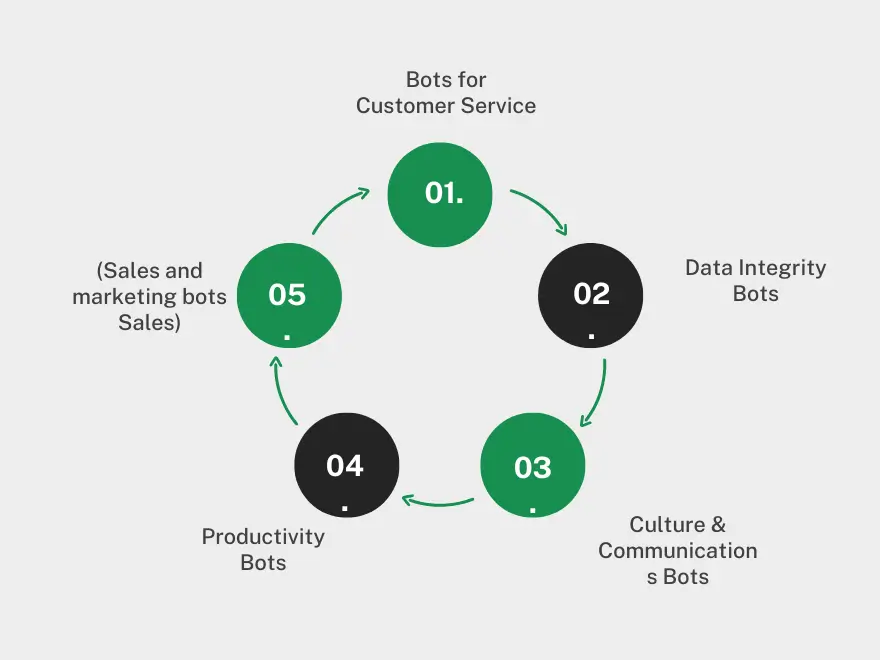
Which Types of Bots Are Available in the Market to Operate Businesses?
-
Bots for Customer Service
An improved bots in customer service experience leads to happier customers and more referrals, intuitively. In fact, new research reveals that the factors that contribute to a positive customer experience are not what you expect.
Ubisoft’s 2024 Mobile Messaging Report states:
- Customers prefer businesses that respond to their questions and queries 24 hours a day, 7 days a week.
- To get in touch with a business, 45 percent of consumers prefer messaging apps over email.
- It is more convenient for consumers to contact a business via messaging than by phone, according to 49.4 percent of consumers.
In essence, consumers want their companies to be able to contact them on their schedules and with as little effort as possible.
This is why chatbots have become so popular as bots in customer service tools. Bot technology can function as an interactive FAQ section on your website, answering customer questions quickly, while also escalating inquiries that require more complex assistance.
-
Sales and marketing bots
As with answering questions for customers, chatbots can also be used by business owners to provide information pertinent to leads that will enable them to overcome objections and convert into paying customers. Eric Devaney writes on the Drift blog that Tippit statistics show that sales teams with business development reps (BDRs) convert 40% of their leads while those without BDRs convert 5%.
As a result, Devaney argues that this critical BDR role does not necessarily need to be performed by humans, with all of their associated overhead costs and requirements. By using chatbots, BDRs could work more efficiently.
-
Data Integrity Bots
The integrity and cleanliness of data is vital to a CRM system’s success as any organization that manages prospect, lead, or customer data knows. Bots can facilitate these efforts, as it turns out. Tom Griffiths explains how Chinese fashion site Meici uses its chatbot to collect information about its users in a Medium post.
The chatbot can customize future interactions based on data stored by the app once it has recorded an initial interaction – one in which participants are asked to specify their gender. Meici’s CRM database will gain more segmentation information, allowing Future of Bots engagements to be tailored more effectively. This creates a better experience for Bot technology users.
-
Culture & Communications Bots
Chatbots have potential applications beyond customer interaction, including facilitating internal communication. Consider intranet systems. Intranets often end up serving as reference systems or centralized repositories instead of being interactive engagement tools.
In addition to diminishing the ROI of the project, failing to maximize the internet’s functionality risks leaving remote workers without the collaboration resources they need to be productive. Gallup’s State of the American Workplace report shared that “43 percent of Americans said they spent at least some time working remotely last year, up from 39 percent in 2023.”
-
Productivity Bots
The idea that Bot technology can search for you or perform other tasks for you illustrates the potential AI-powered bots have for personal and professional productivity. In some estimates, switching between tasks can take away more than 40% of your focus, so centralizing different search and reporting features within a single bot may minimize this loss of productivity. Take Reveal Bot, which automation trends and uploads Facebook Ads performance data to a user’s Slack channel.
Conclusion
Streamlining operations and enhancing bots in customer service are two of the benefits of chatbots in the modern business landscape. Businesses of all sizes benefit from their widespread adoption, efficiency and ability to meet customer expectations. For years to come, the Future of Bots will shape business-customer interactions. Particularly, voice and AI-powered bots and their impact across industries.
AI will become more deeply integrated across diverse industries as businesses evolve. Furthermore, chatbots are poised to transform communication and bots in customer service. Chatbots will also enhance our everyday lives. As a result, companies that embrace these burgeoning automation trends will have a significant competitive advantage. As a result, they will be able to deliver personalized services to their clients more efficiently.
Frequently Asked Questions
An automated bot app is a program that performs tasks or provides services via messaging platforms, using artificial intelligence to interact with users and fulfill requests.
By handling scheduling, managing personal assistants and providing instant information, bot apps will streamline daily tasks.
Bots can automate routine tasks and improve the user experience in industries such as customer service, healthcare, finance and retail.
Even though bot apps can automate certain tasks, they are likely to complement rather than completely replace human jobs, especially in areas that require complex decision-making.