


In today’s competitive digital market, software teams are in a tight spot to keep customers happy and content. And for this step towards agility, the integration of DevOps and cloud computing has emerged as a proven strategy. As a pair, they surpass every traditional development model in speed, control and efficiency.
Innovation is now less chaotic post this integration. It uses companies and businesses to scale higher on demand with no worries regarding conventional infrastructure. The two strong approaches of development and operations came together and are now ruling the software world.
In this blog, we will look at how this emerging trend ended up being a standard software industry practice and how this powerful duo is reshaping how modern applications are built, deployed, and maintained.
What Makes Cloud Computing and DevOps the Perfect Combination for Businesses?
Cloud computing and DevOps is all about creating a perfect balance between development and operations along with an on-demand infrastructure. This ensures constant improvement, speed, flexibility and on-demand infrastructure. They combine together to form a system where innovation is not hindered by any hardware limitations.
Additionally, cloud provides ideal working conditions for DevOps to carry out practices. Businesses and teams now have flexibility to scale resources up or down according to the demand, change testing environments in minutes and deploy updates worldwide with few taps. So, developers can now focus on real issues and building features.
Well, DevOps is functioning like some tech giant in cloud environments by accessing automation, monitoring and constant delivery pipelines. Similarly, when cloud is merged together with DevOps practices, there is an increase in efficiency and reliability.
Which Key Elements Make a DevOps and Cloud Strategy Successful?
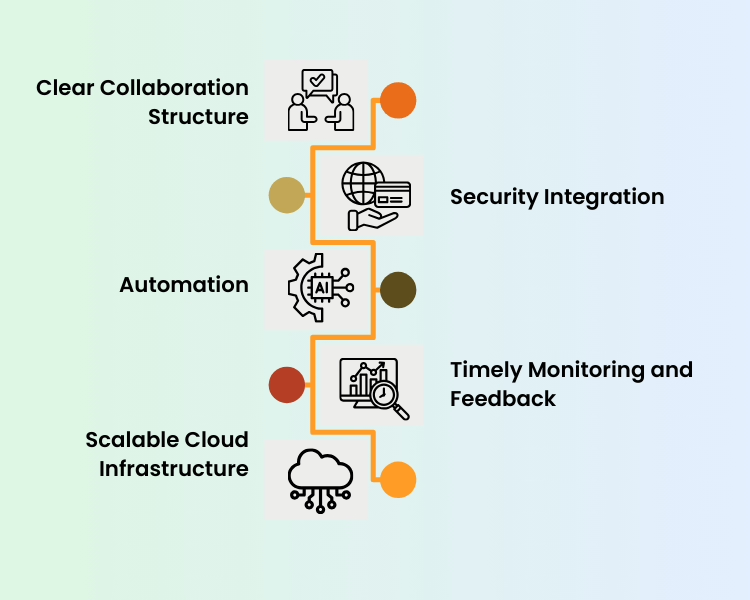
Building and developing cloud based DevOps is about aligning processes and technology along with picking up the right tools for a successful outcome. The key components for such successful strategy include:
1. Clear Collaboration Structure
There are open communication channels for transparent communication and sharing of goals altogether. This is also ensured that developers, operations, QA and security teams all work together like a community from day one.
2. Automation
Tasks such as Code testing, integration and monitoring, which are on loop and repetitions are mechanised or automated in order to avoid possible human error risks and to speed up the process of delivery.
3. Scalable Cloud Infrastructure
A cloud infrastructure can make or break the business environment. Using an infrastructure that can adapt to sudden traffic spikes is very important. Similarly, it should be able to scale down during low demands for cost optimization.
4. Security Integration (DevSecOps)
Security and privacy should be a major concern. Security Integration needs to be done directly into the development process, it’s called DevSecOps.
5. Timely Monitoring and Feedback
Constant monitoring of application performance is important to understand its working. Also, collecting user feedback from time to time also helps in making early improvements.
What Limitations Do People Face When Merging DevOps With Cloud Computing?
Cloud computing with DevOps offers several benefits but it has its own challenges. A major challenge is cultural acceptance and adaptability. It’s not easy for people to move from conventional processes to a collaborative DevOps model. It requires effective leadership, clear communication channels and commitment from every team member for such shifts.
Furthermore, managing this complexity is also an important task which poses a challenge. Handling multiple environments, automation pipelines and security protocols altogether is a difficult task. These limitations like failing to standardize processes and ignoring the learning curve for cloud tools can only be overcome by training and clear leadership.
Lastly, security and privacy are a major concern. Security Checks can be undermined sometimes during speedy processes. That’s why security Integration needs to be done directly into the development process, it’s called DevSecOps. This maintains both agility and safety together.
How Do Cloud and DevOps Shape the Future of Software Support ?
Cloud & DevOps together are revolutionizing the processes of software like building, testing and delivering. They provide everything from speed to flexibility which a business needs in order to innovate. Now, stability is ensured and improvements just take days or hours.
Furthermore, this duo is being equipped by technologies like AI-driven monitoring, serverless computing and edge deployments. These tools will back up the teams with early predictions of issues, automated scaling according to demands and better performance which makes it more user-centric.
Ultimately, cloud and DevOps are long-term solutions for this era of software development. Organizations and Businesses that go along with this approach will be able to adapt and innovate in a rapidly growing environment.
What Value Does Cloud-Based DevOps Bring to Organisations?
A strategic cloud computing with DevOps system brings about a lot of advantages and benefits that aid businesses with faster, smarter and high-quality software. Some more such advantages include:
- Faster Deployment – It just takes hours for the DevOps teams to test and integrate new features with available cloud resources.
- Scalability on Demand – Automated scaling ensures handling spikes in traffic effortlessly.
- Cost Efficiency – You just need to pay for the resources you utilise. There are no hidden charges included.
- Better Collaboration – Developers, operations and QA teams work altogether at a centralized platform with no interventions.
- Enhanced Reliability – system stability is ensured through constant automated monitoring and disaster recovery in the cloud.
Conclusion
This collaboration between DevOps and Cloud is the need of the hour. It’s necessary for the organizations and Businesses who aim to be a strong competitor in this fast paced digitalized world. They can now deliver software faster, smarter and reliable than ever before. With constantly growing customer expectations, this integration is a reliable solution.
We, at Eiy Sys provide strategic, innovative and customized solutions to your Cloud integrated DevOps processes. Do contact us for availing our team of experts for ensuring constant improvement, speed, flexibility and on-demand infrastructure for your businesses and organizations.
Frequently Asked Questions
Cloud Infrastructure supports DevOps which enables faster and safer development along with higher scalability.
Some important advantages of this approach are scalability on Demand, Cost Efficiency, Improved Collaboration, Enhanced Reliability, etc.
Yes, DevOps can be implemented without the cloud, but the results are often limited. They will be without the scalability, flexibility, and automation capabilities of cloud platforms.
Industries like e-commerce, fintech, healthcare tech, media streaming, gaming, and SaaS providers benefit the most from this adoption.
Common tools include Jenkins, GitLab CI/CD, and GitHub Actions for continuous integration; Docker and Kubernetes for containerization and orchestration; and cloud-specific services like AWS CodePipeline, Azure DevOps, or Google Cloud Build.

Jasleen Kaur
Hi, I’m Jasleen, a content writer and SEO enthusiast who loves turning ideas into engaging, reader-friendly content. I create blog posts, articles, and web copy that not only inform but also help websites rank higher on search engines. Combining st...read more