Blockchain in Travel has the potential to revolutionize the industry by improving security, transparency, and efficiency across key areas such as booking, payments, customer service, and supply chain management. With its decentralized and immutable nature, blockchain ensures that transactions and data are securely recorded, benefiting activities like flight and hotel bookings, as well as payment processing.
It simplifies international payments, reduces transaction fees, and enables quicker fund transfers. Blockchain also has the ability to overhaul loyalty programs by establishing a secure and transparent rewards system, which helps reduce fraud and manipulation. Additionally, Blockchain in Travel can support decentralized travel platforms, allowing customers to directly book flights, accommodations, or car rentals without intermediaries.
Smart contracts can automate and secure the booking process, ensuring payments are made once specific conditions are met. Blockchain technology can also streamline the identity verification process for travelers, reducing the risks of fraud and enhancing border control and check-in procedures. Furthermore, the travel industry’s supply chain can benefit from greater transparency, which improves accountability and builds customer trust.
What Are Travel Blockchain Solutions?
Travel blockchain solutions involve using blockchain technology to tackle common issues in the travel industry. These solutions take advantage of blockchain’s decentralized, secure, and transparent features to enhance various aspects like booking, payments, identity verification, loyalty programs, and supply chain management.
By implementing travel blockchain solutions, travel businesses can minimize fraud, cut out intermediaries, boost data security, and offer more efficient, cost-effective services. For example, blockchain can simplify booking processes, enabling travelers to directly book flights, hotels, and car rentals from service providers, while ensuring that transactions are safely recorded.
How Does Blockchain In Tourism Enhance Security and transparency?
Blockchain in tourism can improve security and transparency in several important ways:
- Blockchain in tourism has the potential to significantly improve security and transparency in the industry.
- Its decentralized structure ensures that data is safe from cyberattacks and accidental deletion, providing a more secure way to store critical information.
- Moreover, the responsibility for managing this data is distributed across the entire network, making it more dependable and easier to access.
- Blockchain also enables secure and efficient payment systems, especially for international transactions, which helps streamline financial processes.
- By creating unique and secure digital identities for travelers, blockchain simplifies and strengthens the identity verification process.
- The immutability of blockchain records further ensures data accuracy, as each block is securely linked to the previous one, preventing any tampering or alterations. <
- Lastly, blockchain in tourism facilitates direct communication between suppliers and customers, eliminating the need for intermediaries and booking fees, resulting in a more transparent and cost-effective experience.
What Are The Key Benefits Of Blockchain Technology?
- Distributed power and permissionless participation: One of the main blockchain benefits is its decentralized structure, which eliminates the need for intermediaries like banks to verify transactions. Instead, transactions are recorded and verified by participants within the peer-to-peer network, enhancing both security and transparency. This decentralized approach also makes blockchain more resilient to attacks and fraud.
- Network security: Blockchain is recognized as one of the most secure technologies because each block is encrypted and linked to the previous one via cryptographic hashes, making it nearly impossible to alter the data. Additionally, since the blockchain is spread across multiple nodes, it would require a tremendous amount of computational power to hack, adding an extra layer of protection.
- Transparency: All transactions are publicly recorded on the ledger, which allows anyone to verify their authenticity. This is particularly important in industries like finance, where transparency fosters trust and credibility.
- Privacy and confidentiality: Although blockchain operates on a public ledger, it still maintains privacy and confidentiality. For instance, blockchain ensures that the identities of the transacting parties remain separate from the transaction details, offering a level of pseudonymity while still maintaining the system’s transparency. As more data accumulates, privacy is further enhanced because accessing and connecting sensitive information becomes more difficult.
- Efficiency through trustless systems : Blockchain also promotes efficiency through trustless systems. By removing intermediaries, blockchain speeds up transactions and reduces the risk of manipulation. This makes it particularly useful for industries like finance and supply chain management, where quick and secure transactions are vital.
- Cost savings: blockchain eliminates the need for middlemen like banks, which often charge high transaction fees. By cutting out these intermediaries, blockchain reduces costs, making transactions more affordable and accessible for everyone.
- Traceability : The ability to ensure traceability is one of blockchain’s strong points, especially in supply chain management. Each product or shipment can be tracked at every stage, from origin to final destination, thanks to the unbreakable chain of blocks. This traceability helps quickly identify any issues, making supply chains more efficient and transparent.
- Immutability : Once a transaction is recorded, it cannot be modified or deleted, ensuring that the data remains accurate and secure. This is particularly crucial for industries such as healthcare, where maintaining data integrity is essential.
- Smart contracts : Blockchain also enables the use of smart contracts, which are self-executing agreements with their terms directly written into code. These contracts are automatically enforced, removing the need for intermediaries and reducing the potential for fraud. Smart contracts have applications in a variety of fields, including finance, real estate, and healthcare.
- Eliminating fraud : Blockchain also plays an important role in eliminating fraud. Since each transaction is verified and recorded on the public ledger, it’s impossible for fraudulent transactions to go unnoticed. The ability to trace each transaction back to its source helps maintain trust, particularly in finance.
- Settlement times blockchain reduces settlement times significantly. Without intermediaries, transactions can be processed quickly, often within minutes instead of the days or weeks it might take through traditional methods. This is especially beneficial in industries like finance, where timely transactions are crucial.
What Are The Benefits Of Using Blockchain In Travel For Cross-Border Transactions?
Blockchain in Travel allows for smoother cross-border payments by eliminating intermediaries. Here’s a simplified flow of how a consumer payment is made using blockchain:
- The merchant provides an option to pay with cryptocurrency.
- The customer picks the digital currency they wish to use, confirms the exchange rate, and transfers payment to the merchant’s public address.
- The transaction is checked by nodes, validated by miners, and then recorded on the blockchain.
Benefits of blockchain for payments:
- Decentralization: Blockchain operates globally without central authority control, reducing fees and barriers.
- Trust through Consensus: Instead of relying on a single authority, blockchain ensures security and integrity through the collective efforts of its users.
- Redundancy: Since data is stored across multiple nodes, blockchain continues to function smoothly even if some nodes go offline.
- Transparency & Security: Transactions are fully visible and encrypted, ensuring security and accountability.
Using Stablecoins in Cross-Border Payments: Many companies are using stablecoins for international transactions to avoid the risks of currency fluctuations. Stablecoins can be used in three ways:
- Local fiat > Settled in stablecoins.
- Fiat > Converted to stablecoins > Settled in other fiat currencies (USD, GBP, etc.).
- Stablecoins > Settled in fiat currencies.
For instance, an FX business might convert funds into stablecoins and transfer them internationally, making payments faster and more secure. Blockchain in Travel can transform how payments are handled for international travelers, lowering fees and simplifying the process.
What Are The Key Benefits Of Blockchain Adoption In Travel?
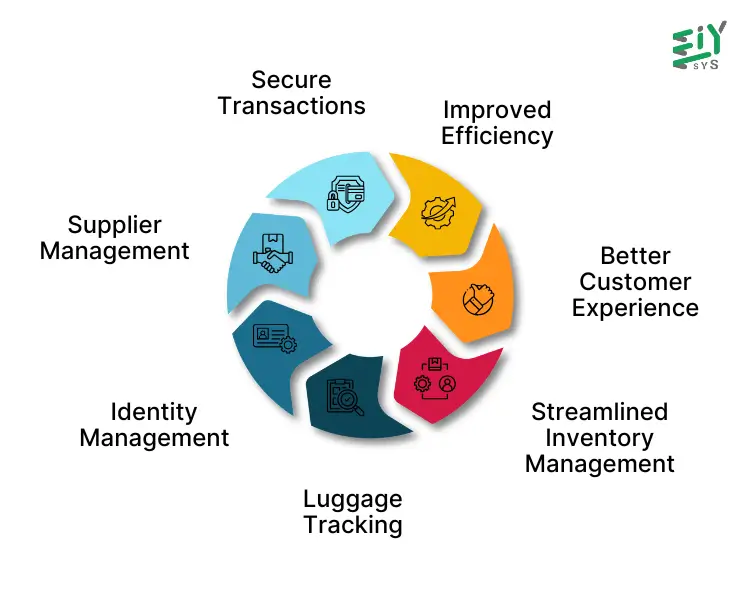
Blockchain adoption in travel offers numerous benefits for the industry, including:
- Secure Transactions: Blockchain ensures that transactions are safe and transparent by encrypting financial information, reducing the chances of fraud and mistakes, and helping build trust between customers and service providers.
- Improved Efficiency: By allowing direct transactions between customers and service providers, blockchain eliminates delays caused by intermediaries like banks or payment processors, making bookings and payments more efficient.
- Better Customer Experience: Blockchain helps deliver more personalized services by analyzing traveler preferences, enhancing the overall experience for travellers.
- Streamlined Inventory Management: Blockchain aids in managing inventory and shipments, making it easier for businesses to track goods and ensure accuracy.
- Luggage Tracking: Blockchain can be used to efficiently track luggage during international travel, reducing the chances of lost bags.
- Identity Management: Blockchain provides travelers with a unified global ID, giving them more control over their identity for various uses across platforms.
- Supplier Management: Blockchain speeds up the process of finding and onboarding new suppliers, while also minimizing risks involved in the process.
These are just a few examples of how blockchain adoption in travel can improve various aspects of the industry, making it more secure, efficient, and customer-friendly.
What Is The Travel Value Chain ?
- A travel value chain refers to the series of steps that bring tourism products and services from creation to the final consumer.
- This includes stages like development, promotion, sales, and distribution.
- Each segment of the travel value chain adds value, from designing travel experiences to delivering them to customers.
- It ensures that all parts of the travel journey are effectively managed, resulting in a seamless and satisfying experience for travelers.
Conclusion
EIY SYS understands the significant impact Blockchain in Travel can have, bringing substantial improvements in security, transparency, and operational efficiency. By leveraging travel blockchain solutions, the industry can optimize booking, payments, customer service, and supply chain management. The application of blockchain in tourism helps eliminate intermediaries, lower transaction fees, and streamline international payments, providing travelers with a smoother experience.
As travel industry transformation progresses, embracing blockchain offers various blockchain benefits. With blockchain adoption in travel gaining momentum, it enhances processes across travel value chains, contributing to a more secure and efficient travel ecosystem.
Frequently Asked Questions
Blockchain in Travel refers to the integration of blockchain technology into the travel sector to enhance security, transparency, and efficiency. This technology improves various aspects such as booking, payments, customer service, and supply chain management by ensuring secure transactions and reducing costs.
Travel blockchain solutions leverage the decentralized, secure, and transparent features of blockchain to solve common issues in the travel industry, such as booking, payments, and identity verification. These solutions help reduce fraud, eliminate intermediaries, and improve overall efficiency, resulting in safer and more cost-effective services for travelers.
Blockchain technology in travel offers several benefits, including decentralization (removing middlemen), improved security, transparency, and efficiency. It also ensures traceability, prevents fraud, and reduces transaction costs while enabling faster settlement times for payments.
Blockchain simplifies cross-border payments by eliminating intermediaries. It allows travelers to use cryptocurrency or stablecoins for transactions, reducing fees and processing times. Its transparent and secure nature ensures reliable and efficient international payments.
The travel value chain refers to the steps that bring tourism products and services from creation to consumption. Blockchain positively impacts the travel value chain by enhancing transaction security, improving customer service, and offering greater transparency in inventory and supply chain management, resulting in a smoother overall travel experience for consumers.
Blockchain enhances security in tourism by storing data on a decentralized network, reducing vulnerability to cyber threats. It also enables transparent payment systems, provides secure digital identities for travelers, and removes intermediaries, leading to a more trustworthy and efficient experience.