The distinction between PoC vs MVP vs Prototype revolves around their purpose and application shape . Product validation should be a committed initiative that follows a chronological order , i.e, PoC >Prototype>MVP . We can also skip creating a PoC if the idea has an existing validation in the market . Validating an idea in software development through a PoC (proof of concept) , Prototype , or MVP(minimum viable product ) , is important to prevent expensive errors .
A PoC checks the degree of a core idea with limited functionality, while a prototype vs MVP difference shows how the product would function with a basic interface and features. There is a very small difference between PoC , MVP and Prototype . A PoC is more complex than a prototype. These 3 are the important stages in the product development process.
A prototype is more complex than a PoC, and an MVP is more complex than a prototype.
PoC and prototype are considered pre-product stages that require minimal to medium investment. MVP is a more considerable product stage .
What Is Proof Of Concept ?
A Proof of Concept (PoC) is an early version or test of an idea to confirm its feasibility. It helps determine whether a concept can be developed into a functional product. When considering PoC vs MVP vs Prototype, the PoC focuses on demonstrating that an idea or technology works, but it is not yet a full product. This stage is critical for businesses to test the technical viability of a project before dedicating further resources. By proving that an idea is workable, a PoC can reduce risks and validate concepts, giving stakeholders confidence that the project has potential.
What Are The Benefits Of Creating Proof Of Concept (PoC)?
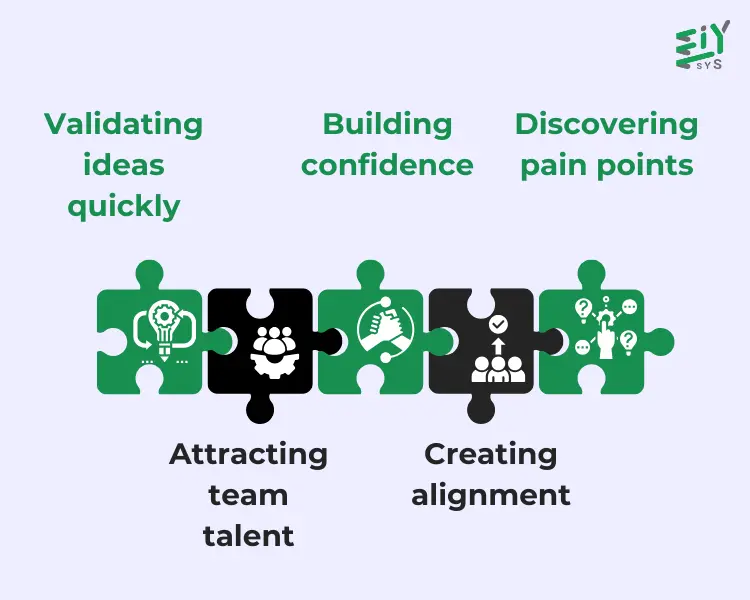
The main benefits of proof of concept is that it helps you to prove whether your idea is possible to do and viable. Other benefits of proof of concept are as follows :
- Validating ideas quickly : Validating your ideas in the early process helps you on the right track before investing too much time and money development .
- Building confidence: Once you’ve validated your idea and have shown that it’s feasible, investors and stakeholders will have the confidence to support the development of your product.
- Discovering pain points: Identify customer pain points so you can develop a product that solves their problems.
- Attracting team talent: Developing a solid product that generates a lot of interest from potential customers can help you attract top talent. And if your development teams are successful, it’s more likely that they’ll stay with your company.
- Creating alignment: A POC helps everyone align on the project’s long-term goals. This ensures that the project stays on track and increases its chance of success.
What Is Prototype ?
A prototype is an early version or representation of a product, system, or concept designed to test and improve its structure before it is finalised for production. In the framework of PoC vs MVP vs Prototype .The prototype acts as a functional model that shows how the product will appear and operate. It is commonly used in fields like engineering, design, and software development, where tangible or digital models are crucial for testing and validation. Prototyping helps businesses assess design ideas, detect issues early, and collect essential feedback before committing to full production.
What Are The Benefits Of Prototyping ?
- It is easier to discover possible design defects very early in the production process.
- It’s easier to design budgets and calendars.
- Similarly, selecting machinery and other production resources is simplified
- The expected durability of the product is known in advance thanks to the tests to which the prototype is subjected.
- You don’t go into production without feedback from the end customer. This allows companies to overcome a lot of purchase objections.
- Prototyping offers space to identify possible improvements.
- It makes it easier to attract investors.
The first benefit of prototyping is that it allows you to determine design and manufacturing problems. Early detection of them can prevent problems later in the production process, limiting the costs of waste and the production of defective parts. In addition, prototyping helps us estimate needs and materials, as well as manufacturing time and staffing requirements.
What Is MVP ?
A Minimum Viable Product (MVP) is the release of a new product that is used to validate customer needs and demands prior to developing a more fully featured product.Unlike prototypes or PoC vs MVP vs Prototype comparisons, an MVP includes only the core features required to address the primary customer problem and be deemed viable. To reduce development time and effort, an MVP includes only the minimum capabilities required to be a viable customer solution.
What Are The Benefits of MVP ?
Building an MVP comes with a whole host of benefits, making it an ideal option for many teams interested in introducing a new product idea to the market. Here are four of those benefits.
- Faster Time-to-Market:MVPs are quicker to build than full-fledged products since they’re much simpler.
- Gathering User Feedback: Customer feedback can help inform future releases, allowing you to focus on features that users truly value.
- Cost Efficiency: The MVP methodology tends to be more cost-effective than launching a full-fledged product because software development teams don’t spend countless hours or waste resources building useless features.
Risk Mitigation: By focusing on core features, MVPs reduce risk by validating an idea and allowing companies to cut their losses before pouring money into the final product.
What Is Product Market Fit Strategy ?
Your product marketing strategy is a roadmap for how you position, price, and promote your new product in the market. It’s what tells you where your biggest fans are and how to reach them.Your strategy should integrate with the product life cycle, informing how you market your product from development to growth. Its creation and implementation require input from product managers,product marketing managers, marketers, and sales teams. It should be based on strong buyer intelligence.
A Product – market fit strategy refers to how well a product meets the needs of a specific market . The product should solve at least one significant problem for customers .Product-market fit drives customer acquisition and retention, affecting a business’s growth and success. It can also make fundraising easier because investors are eager to work with businesses that have a proven product-market fit.
MVP vs Prototype: A Comparison
The MVP vs Prototype comparison highlights the key differences between these two stages of product development:
MVP :
- Market Validation : These are the core functionalities to be built in a viable manner .
- Cost -Effective :Needs a good budget , built for finding investors.
- Key – objectives : A working model with core personalities so it can be deployed and tested.
- Technical resources needed : It is needed for the development of the product.
- User Interaction : Full interaction with complete insights , into the main features .
- Target audience : Sizeable customer groups .
- Revenue Generation : From early adopters .
PROTOTYPE:
- Market Validation :This is how it is supposed to be and build .
- Cost -Effective : Least budget needed.
- Key – objectives : Gives you the first look and feel of the product for user feedback .
- Technical resources needed :Less technical resources needed as there is no development .
- User Interaction : It is used to test the user flow of the product.
- Target audience : Small audience usually stakeholders.
- Revenue Generation : No revenue generation
Proof Of Concept vs MVP - A Comparison
When comparing Proof of Concept vs MVP, the differences are clear in terms of their objectives, development time, and intended outcomes:
Proof Of Concept :
- Goal : Prove technical easily
- Development time : Days/Week
- Audience : Researchers , Developers
- Use Case : Test technical aspects
- Risk Evaluation :Reduces risk of technical problems
- Investment : Small budget
- Revenue : Not for sale
- Further Use : Technical prototype or MVP development .
Minimum Viable Product :
- Goal : Validate an idea and find a product -market fit based on real and end – user feedback
- Development time : Takes months
- Audience : Early adopters , investors
- Use Case : Look for a market fit by assessing user feedback , getting funding
- Risk Evaluation : Reduces risk of building a product with no market .
- Investment : Well – defined budget
- Revenue : Sells to early adopters , generates investments
- Further Use : Full specified product development
Why Are Product Validation Techniques Important ?
Product validation techniques are important because they help businesses reduce risk and make informed decisions about their products that serve real market needs .
- Determine market demand : Product validation helps you confirm that your product has market demand and is a viable solution for customers .
- Identify your ideal customer : You can learn how big your potential market is
- Improve your product : You can use prototype testing to gather insights and learn how to modify your product to meet the needs of users .
- Understand collaboration with users : You can collaborate with users , testers , and product managers to gather feedback and identify areas for improvement .
- Analyse competitors: You can analyse your competitors to learn what they are doing and how you can make your product stand out .
The product validation techniques also includes :
- Focus groups
- Prototype testing
- User testing
- Customer interviews
- Competitor analysis
What are the key steps in developing a product for a startup?
Product development plays a key role in the success of startups. By understanding market demands, improving customer satisfaction, and setting themselves apart from competitors, startups can secure a competitive advantage and accelerate growth. A well-executed product development process increases the likelihood of success, reduces time to market, boosts revenue potential, and helps startups stay adaptable in a changing market. Adopting approaches like lean startup principles, agile development, and a focus on user-centred design can help startups effectively manage the product development process and position themselves for sustained success in an ever-evolving business environment.
The stages of startup product development are vital for ensuring success and gaining a competitive edge.The stages are:
- Understand market demand: By identifying what customers need, startups can gain a competitive advantage.
- Improve customer satisfaction: Enhancing the customer experience helps drive growth and loyalty.
- Stand out from competitors: Offering innovative solutions allows startups to differentiate themselves in the market.
- Generate additional revenue: Expanding product offerings can open up new revenue opportunities.
- Stay flexible in a changing market: Effective product development helps startups adapt to shifting market conditions and maintain relevance.
Conclusion
At EIY Sys, we emphasise the importance of understanding the stages of PoC vs MVP vs Prototype in the product development process. By following the startup product development stages and utilising effective product validation techniques , startups can minimise risks and optimise their product’s success.
The product market fit strategy is essential for aligning the product with customer needs, while the MVP vs prototype comparison ensures that each stage contributes to refining the product. With a strategic approach, startups can confidently bring their ideas to market and scale effectively.
Frequently Asked Questions
A Proof of Concept is a small-scale demonstration used to validate the feasibility of an idea or technology. It answers the question, "Can this idea work in practice?" PoCs are typically used in the early stages of development to test technical viability before investing in full-scale development.
A prototype is a preliminary model or mock-up of a product designed to explore functionality, user experience, and design. Unlike a PoC, it focuses more on usability and visual aspects rather than proving technical feasibility.
A Minimum Viable Product is a functional version of a product with just enough features to satisfy early adopters and gather feedback for future development. It is used to test the market fit and gather insights on customer needs with minimal resources.
A PoC is about validating technical feasibility, often without considering design or user experience. A prototype, on the other hand, showcases how the product will look and function, focusing on user interaction and experience.
An MVP should be launched when you are ready to test your product in the market and collect feedback from real users. It’s best suited for understanding market needs and validating product-market fit with a live audience.