As web components have evolved, modern front-end solutions are becoming more encapsulated and reusable, making it easier to create front-end solutions. Scalability and maintainability of web applications are largely dependent on web design components. With them, developers can express themselves creatively while remaining consistent and performant.
Angular web components and Blazor web components have enabled it to be developed faster and easier. The frameworks help in the development of dynamic user interface websites.
Web Components have a profound impact on web development. By using them, developers can create modular, reusable elements that can be used across a variety of projects.
How are Blazor Web Components Effective at Improving User Interface Websites?
Blazor web components advance the UI of cutting-edge web applications incomprehensibly. Developers can effectively create astute and energetic web design elements. In contrast to JavaScript, Blazor is based on C# and .NET, which makes it possible for some engineers to make rich, client-side web applications.
By integrating web components into a project’s design, user interface websites will be highly responsive and energetic. These components function naturally within the existing HTML and CSS, giving the user an experience similar to that of a native application.
A hybrid approach to web development can be achieved through the use of Blazor web components in conjunction with other frameworks, such as Angular web components. Therefore, such flexibility will help developers choose the best tools for a particular task to ensure that the website’s user interface website is strong and flexible.
How do Angular Web Components help build scalable web solutions?

1. Modularity and Reusability
It is easy to create reusable, modular elements using Angular web components, which are self-contained and can be plugged into different parts of the application. Modularity means an organized, testable and maintainable codebase at scale based on the fact that each component is convenient to develop test and maintain independently.
2. High Performance
The performance optimization of these frameworks makes them an ultra-light, efficient way of developing web applications. Through the change detection and data binding mechanisms in Angular, it is possible to generate very responsive and scalable user interface websites that scale well under heavy interaction and dataset loads.
3. Smooth Integration
The interoperability features of Angular web components make them one of the most attractive web design components. Angular’s interoperability makes it suitable for use with existing applications that were built using different technologies or frameworks. The integration is done to make work seamless.
4. Maintainability
The separation of concerns makes Angular’s structure more robust, allowing web apps to be updated and maintained more easily. Components in Angular web framework leverage a clean and maintainable codebase, where each component only captures its functions. It greatly simplifies debugging, testing and subsequent refactoring.
5. Strong Communities and Ecosystems
A large community of developers creates extensive resources, libraries and tools besides using Angular web components. A developer can benefit from this diverse ecosystem by having access to latest practices, solutions to common challenges and continuous improvement of the development process.
What are the Benefits of Integrating Blazor and Angular Web Components in Front-End Solutions?
Collaboration and integration could be much easier with Blazor and Angular development at the presentation layer, enabling solutions that do not lose any of the improvements from both frameworks.
- Modular Development: Using Blazor and Angular, it is possible to create modular presentation layers which can be seamlessly integrated into and used across a variety of parts of a website or application.
- Code Reuse: Both Blazor and Angular libraries and components can be reused for a consistent user interface website design.
- 1. Fast-Development: There are developers already familiar with the languages, for example, existent Blazor developers and TypeScript developers for Angular developers. It makes them productive right away, without any learning curve.
- 2. Superior Performance: Both frameworks support implicit rendering and data binding, which significantly improves site performance.
A developer can use the flexibility and efficiency of the modern frameworks on both platforms with this implementation of Angular web components with Blazor.
What are the Ways in Which Web Components Improve User Interface Design and Functionality?
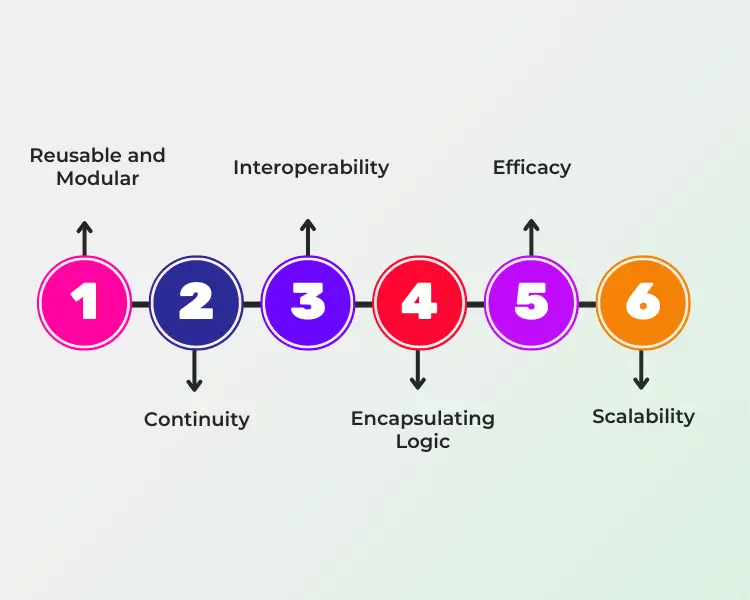
The following are some effective ways in which web components can enhance a user interface website’s design and functionality:
1. Reusable and Modular
By encapsulating HTML, CSS and JavaScript into reusable elements, web components provide clear modularity to websites.
2. Continuity
The use of web components to define custom elements will make it easier to ensure consistency throughout the user interface websites.
3. Interoperability
In the case of, for instance, Angular, React, or Vue.js, interoperability refers to developing web components to integrate easily with existing frameworks and libraries. As part of interoperability, web components can be integrated with diverse tech stacks without causing display conflicts.
4. Encapsulating Logic
It increases the reliability of a website by encapsulating the logic and behavior of each component, which reduces the likelihood of a conflict arising between them and other parts of a website.
5. Efficacy
A website’s performance can be improved by eliminating or reducing the overhead associated with complex JavaScript frameworks. In addition to abstracting browser-native features for rendering and execution, they are also a bit smoother in user interaction, allowing them to load quite quickly.
6. Scalability
By providing a structured way to build and manage UI elements, it provides a scalable solution for increasing website complexity and features. The most common way to do this is by creating new components and extending functionality.
Conclusion
It facilitates the modernization of web development by allowing HTML elements to be encapsulated and reusable, making them more scalable and maintainable. Combining Blazor and Angular WebComponents can enable dynamic high-performance user interface component development across parts of an application that is modular and uniform.
With Eiy sys, you can be assured of smoother user experiences across many platforms, faster development cycles and more maintainable code. Utilize the power of web components to drive innovation and superiority in your online applications by partnering with Eiy sys.
Frequently Asked Questions
Web components enable developers to create reusable, encapsulated components with their own HTML, CSS and JavaScript with the help of web platform APIs. Their modularity and reusability improves by allowing the creation of custom elements that can be used across a variety of web applications.
A Blazor application consists of reusable Blazor components. HTML markup, C# code, and CSS styling can be included in Razor syntax. To build complex user interfaces, components can be nested, parameterized and composed.
By providing consistent and predictable UI elements, reducing design inconsistencies and ensuring that components behave consistently across pages and applications, web design components improve user experience. Pre-built elements can also be reused to speed up development.
A web design component is typically part of a design system or library that uses HTML, CSS and JavaScript in order to style and function. The web components APIs enable the creation of encapsulated, reusable HTML elements (Custom Elements, Shadow DOM, HTML Templates). The components of web design can be implemented using web components or as part of a simpler design library.