As we move increasingly towards the digital era, SEO Trends 2025 are taking shape to redefine the way businesses and content creators navigate search engine visibility. Google’s algorithm keeps evolving, becoming more user-intuitive, intent-driven, experience-centric, and trustworthy. To remain in pace, marketers must keep up with these developments and choose the new SEO best practices that emphasise quality, relevance, and technical adequacy.
In 2025, search optimization is not just keywords and backlinks—it’s about knowing user behaviour. Advances such as AI-created content, voice search, and search generative experience (SGE) are shaping the way users interact with search engines. At the same time, Google’s growing focus on E-E-A-T (Experience, Expertise, Authoritativeness, and Trustworthiness) requires that content be credible and value-centric to rank.
Whether you operate an e-commerce website, blog, or SaaS platform, choosing these trends will be key to remain competitive. This guide will dissect the most influential SEO trends for 2025 and offer actionable tips to assist you in ranking higher and attracting more qualified traffic to your website.
How Is Google’s Algorithm Evolving This Year?
In 2025, Google’s algorithm is further moving toward understanding the intent of the user, the quality of content, and the experience of the site at a deeper level. The emphasis is not solely on keyword matching anymore but on providing content that actually meets the needs of the users. Semantic search, natural language processing, and contextual relevance are therefore playing an increasingly important role in ranking and presenting results. Also, google’s growing capacity to understand content in context has rendered conventional keyword stuffing and low-quality techniques all but irrelevant.
One of the most obvious trends this year is the merging of AI-based features like the Search Generative Experience (SGE), which provides synthesised answers right within the search interface. This is revolutionising the way users interact with content, often eliminating the need to click through to multiple pages. To remain seen, sites have to lead with distinctive insights, organised content, and full answers that address particular user demands, particularly in easily comprehensible forms for both users and AI systems.
Though there are well over a dozen signals at play, Google ranking factors in 2025 are more heavily weighted towards experience-based metrics. Core Web Vitals, mobile usability, originality of content, and topical relevance are some of the major elements that impact rankings. Furthermore, credibility indicators such as author knowledge and open sourcing are being included more heavily in the assessment.
What Are Important SEO Trends In 2025?
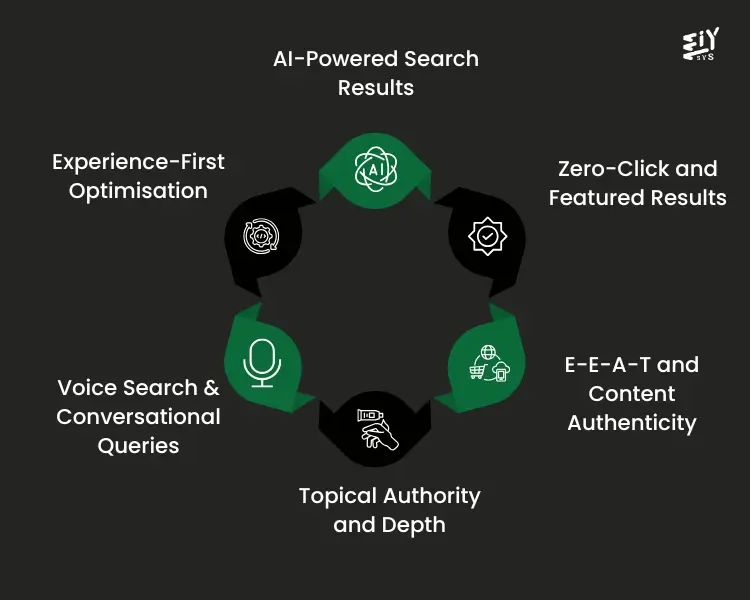
As the online world continues to grow, SEO Trends 2025 indicate a move towards personalisation, AI-powered results, and greater content relevance. Search engines are now prioritising quality over quantity, with sites that provide real value through valuable user experiences being favoured. To remain ahead of the game, it’s crucial to be aware of the most important trends influencing SEO this year and how they affect search visibility and engagement.
1. AI-Powered Search Results
As Google includes more AI-generated answers using the Search Generative Experience, content needs to be optimised around understandable, readable, and verifiable information. Authoritative content stands to win under this trend instead of typical answers.
2. Experience-First Optimisation
Indicators such as loading, interactivity, and visual stability within user experience now become essential to rankings. Websites that are offering smooth, mobile-first experiences are ranking well in search results.
3. Voice Search and Conversational Queries
As assistants and smart devices become more popular, content needs to be there for voice search optimisation. This means writing in natural language, responding to direct questions, and optimising long-tail conversational phrases.
4. E-E-A-T and Content Authenticity
Google’s focus on Experience, Expertise, Authoritativeness, and Trust continues to increase. Sourcing that is transparent, author bios that are genuine, and information supported by experts lead to increased credibility and rankings.
5. Topical Authority and Depth
Rather than distributing content, sites are concentrating on the creation of strong topic clusters. This creates subject-matter expertise and informs Google that the site is an authoritative source in its field.
6. Zero-Click and Featured Results
As more answers are displayed directly in search results, gaining featured snippets and structured data placements is central to success. This exposure drives traffic even without the usual clicks.
How Does AI-Generated Content Impact SEO Performance?
AI content has quickly changed how content is created, allowing marketers to write articles, product descriptions, and web copy in bulk. Though this brings great quickness and cost advantages, it poses concerns regarding content quality and uniqueness. Additionally, search engines such as Google are growing more effective at being able to spot AI-authored content through their algorithms and assessing whether the content delivers real value to users.
When used judiciously, e.g., assisting human writers with research, outlines, or data-driven recommendations, it can improve content relevance and production speed. But using AI solely for the creation of complete content without adequate editing or fact-checking can yield generic, superficial, or erroneous content, which can decrease rankings or even incur penalties.
In 2025, effective tactics in AI in SEO are centered around harmonizing automation with human experience. Also, content must be checked for factual correctness, adapted for the reader, and supplemented with creative thinking or experience. Depth, honesty, and value are what Google favours, so AI must be an aid, not a substitute, for quality content that meets these new expectations.
How Does Core Web Vitals Affect Rankings In SEO Trends 2025?
Core Web Vitals continue to be a major determinant of how Google evaluate website performance in 2025.The metrics include such as Largest Contentful Paint (LCP), First Input Delay (FID), and Cumulative Layout Shift (CLS), capture the loading time, interactivity, and visual stability of a site. Sites with good performances on these metrics provide a better user experience, which translates into greater engagement and improved search engine rankings.
As a part of Google’s larger initiative to reward user-centred design, Core Web Vitals are becoming more and more influential on competitive rankings for many industries. In reality, those websites that disregard these performance guidelines are regularly outranked by faster, more responsive alternatives, regardless of their comparable content quality.
This focus dovetails well with mobile-first indexing, when Google mainly uses the mobile iteration of a website for ranking and indexing. With mobile users coming to expect swift and smooth experiences, Core Web Vitals optimisation is necessary in order to continue seeing visibility. Performance in 2025 is no longer solely a technical issue—it’s an integral part of effective SEO planning.
What Are The New Standards For Content Freshness?
In 2025, content freshness is not merely about publishing dates, it’s about staying relevant, accurate, and in line with search intent. Additionally, Search engines assess how well content matches current information, user expectations, and continuous trends. With the advent of semantic search, Google now better understands context and meaning, rewarding content that remains current both factually and thematically.
- Evergreen Content – Periodic updating of top-performing pages using fresh data, examples, or rules keeps them fresh and competitive in search rankings.
- Current Industry Change and News- Featuring current developments, trends, or innovations serves to show that content is fresh and responsive to current user interests.
- Integrated Dynamic Content- Incorporating real-time features like feeds, widgets, or frequently updated statistics conveys active engagement and improves freshness scores.
- Freshened Metadata and Timestamps- Updating titles, descriptions, and publish dates where necessary aids in conveying relevance to users and search engines alike.
- Content Consolidation and Pruning- Retiring old or poorly ranked pages and clustering related topics can improve overall site quality and indicate active content maintenance.
User Engagement Signals- High engagement metrics, like comments, shares, and time on page, can signal that content remains valuable and up to date in the audience’s eyes.
Conclusion
In navigating the shifting terrain of SEO Trends 2025, it’s all about looking ahead while keeping the focus on user experience, technical optimisation, and content authenticity. From Core Web Vitals and mobile indexing to AI incorporation and semantic research, the game of SEO is becoming increasingly sophisticated and user-intent oriented. Choosing these changes is not merely a matter of remaining compliant—it’s about building digital experiences that are truly helpful, fast, and relevant.
As Google advances its algorithm and user expectations grow, these trends and applied intelligent, data-based tactics will remain strong in visibility. Eiy sys concentrates on high-quality content, contemporary optimisation strategies, and frequent updates to make sure websites ensure sustainable rankings and long-term search success.
Frequently Asked Questions
One of the most significant trends is the convergence of AI-powered search experiences, such as Google's Search Generative Experience (SGE). It's revolutionizing content discovery and consumption right within search results.
Hugely significant. Google favours content that shows E-E-A-T (experience, expertise, authoritativeness, and trust) and particularly this in competitive verticals.
Yes, it is a very important ranking factor. Google mostly indexes from the mobile view of a website, so responsiveness and quick mobile loading are necessary.
Yes, but keyword strategy is different now. It's less about exact-match keywords and more about knowing what users want and writing in a natural, contextual way.
There isn't a hard-and-fast rule, but checking and refreshing key pages every quarter is a good idea, particularly when new data, trends, or algorithm changes impact the subject.