


Turns Ideas Into Reality: Mobile App Development
People often ask what makes some applications succeed while other apps fail and vanish. The mobile app development lifecycle functions as the solution because it demonstrates how your concept evolves into an actual product. When you understand this journey, you can build an app that users actually enjoy.
Your app needs success throughout every development phase, which starts from planning and ends with launch. Understanding the lifecycle enables you to prevent errors while developing an improved user interface. The next stages will show you how to convert your concept into a successful application.
What Exactly Happens in Mobile App Development?
You should learn some of the modern tools and technologies that are trending widely among development processes. The current phase requires you to define the app’s solution and discover what users need. For instance, many startups study competitors before deciding how to make an app that stands out.
The process moves forward to its design and development phase. During this time, teams employ the mobile development life cycle to come up with wireframes and UI designs and build the final functional features. Testing is, in fact, the method most companies use to check user flows before creating their entire product. A formal mobile app development process ensures that all functionalities of an app work properly on various devices.
Testing is the last step for mobile application development before the app launch. Developers rely on customer feedback to identify bugs and upgrade the performance of the system during the development of different versions of the software. The app is safe and working well throughout its whole life with effective mobile app management.
Understanding the Main Causes of Mobile App Failure
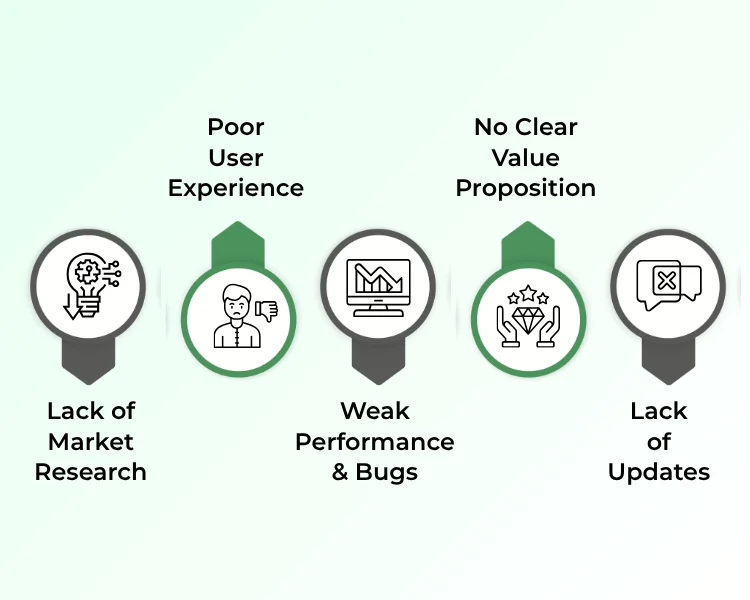 The mobile application development process needs to meet actual user needs for it to succeed. Some apps follow the mobile development life cycle carefully and keep improving through mobile app management. Others rush development and skip key stages of the life cycle of mobile application development, which leads to poor performance and low engagement.
1. Lack of Market Research
First of all, many apps fail because developers skip research in the mobile application development life cycle. For instance, a mobile app idea might be visually pleasing, but it is not solving the users’ real problems. CB Insights even reveals that most startups that fail are the ones whose market does not require their product.
2. Poor User Experience
If users experience a difficult or confusing navigation in your app, they will most probably uninstall it. Research from Google indicates that as many as 88% of users, after a bad experience, do not want to return to the app. A well-designed mobile development life cycle goes a long way in avoiding such problems.
3. Weak Performance & Bugs
The mobile application development process includes testing as an essential step of its development procedure. However, some apps launch without proper testing. Because of this, crashes and slow loading times frustrate users.
4. No Clear Value Proposition
Here’s the thing: users keep apps that provide clear benefits. People delete an app when it fails to provide them with any useful benefits. Mobile app development processes need to build solutions for specific problems because this approach results in higher user retention.
5. Lack of Updates
Apps need continuous improvements. To get social media sites ahead, they need new changes all the time. Updates and releases often help in retaining the users. Actually, routine updates build trust. The trend indicates that regular pushes are the most effective ones.
What Stages Are Important for Building a Successful Mobile App?
The project stage requires you to establish three elements, which are the problem description, the target audience, and essential project functions. Companies develop an app development roadmap as their first step to creating an application for the upcoming development phase.
Design and development work together as the next stage of the process. The mobile application development process takes the ideas and turns them into functional mobile app management components. Mobile developers use the life cycle of mobile development to build secure applications, which can attract a larger user base over time.
Statista states that the total worldwide income generated via mobile apps exceeded $935 billion in 2023. Testing and maintenance are the last phases of the mobile application development process that together close the development life cycle. The managers keep an eye on user data and receive feedback.
Mobile App Development Time Explained
Simple apps need only a few months for development, but complex platforms demand more time. The average time needed for mobile app management, according to industry reports, lasts from three to nine months.
Simple Apps (3–4 Months)
- Because these applications have reduced feature sets, their mobile development life cycle operates at a shorter duration.
- Developers are capable of designing basic calculator tools and note-taking applications even within a very short deadline.
- Designing the mobile application development process is very much about visual elements and core system features.
Complex Apps (6–9 Months or More)
- Advanced apps need detailed mobile app management and testing.
- The delivery of food and the delivery of financial technology applications both need secure payment systems to operate.
- The mobile application development process now demands additional development stages because of this requirement.
What Mistakes Should You Avoid During App Development?
The mobile application development life cycle needs to avoid common mistakes for successful execution at its endpoint. Many businesses rush through the mobile development life cycle without a proper strategy.
However, this causes them to face problems with user engagement and performance after their product launch.
- Skipping Market Research—The process of mobile app development gets disrupted when developers fail to identify their target audience.
- Ignoring User Experience—The lack of proper UI testing during mobile application development results in users experiencing difficulties when trying to navigate the app.
- Launching Without Testing—The application encounters problems after it gets launched, which results in negative impacts on its public image.
- No Long-Term Strategy—The absence of mobile app management leads to organizations missing critical updates and security patches.
- Overloading Features—The majority of enterprises write the initial version of their product and then keep making it better through continuous improvements.
Conclusion
It’s not enough to just have a great idea if you want to create a successful app. Detailed knowledge of the mobile app development process is very important because every step of the development is a determining factor in the functionality of the app, and it equally affects the manner in which users will use it. Having the right plan enables you to design an app that brings your customers the main advantages.
Your business needs the proper partner to transform your concept into an effective mobile application. Eiy Sys assists companies in creating, developing, and launching mobile applications that can expand according to their needs. Contact Eiysys today to initiate your path towards actual measurable growth because you should not miss any potential sales opportunities.
Frequently Asked Questions
Yes, they are. Because e-learning today is put together to enable you to support teams in different geographical areas, different time zones, and different types of devices.
Individualized educational software can help schools more easily manage information, enhance communication, monitor students' data, and provide more interactive teaching for teachers and students.
Of course, if we think about mobile learning, it goes around empowering the user to access courses, training modules, and other learning resources at any time to improve their skills along their learning process.
Yes, virtually all of today's popular training software will integrate seamlessly with your HR system, CRM communications application, and any other enterprise application needed for an integrated workflow.

Jasleen Kaur
Hi, I’m Jasleen, a content writer and SEO enthusiast who loves turning ideas into engaging, reader-friendly content. I create blog posts, articles, and web copy that not only inform but also help websites rank higher on search engines. Combining st...read more