Agile Estimation Techniques are essential in project management, enabling teams to evaluate the effort or time needed to complete tasks, features, or user stories. Scrum and Kanban focus on delivering value incrementally through short, iterative cycles (sprints) and adapting to evolving project requirements.
These techniques help teams effectively plan, prioritise, and manage stakeholder expectations, while providing the flexibility to respond to changing circumstances. Unlike traditional project management, where effort is measured in fixed units such as hours or days, Agile Estimation Techniques emphasise relative effort.
This approach is more suited to the dynamic and unpredictable nature of software development and the complexities of modern projects. By applying for the Agile Estimation Techniques, teams can better handle uncertainties and ensure continuous value delivery.
What are the key principles behind Agile Estimation Techniques?
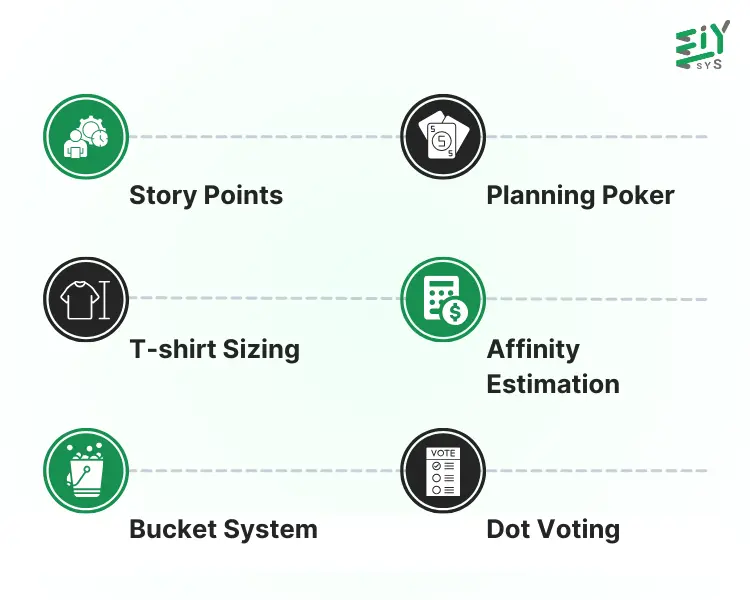
The most commonly used Agile Estimation Techniques include:
1. Story Points: Story points estimate the relative effort, complexity, or size of a user story. Teams assign story points based on the perceived difficulty of the task, often using a Fibonacci scale (e.g., 1, 2, 3, 5, 8, 13). This allows for estimating work in relative terms instead of specific hours or days.
2. Planning Poker : This consensus-driven technique involves team members using cards with story point values to estimate a user story’s complexity. After discussing the story, each participant selects a card with their estimate. Once everyone has chosen, the cards are revealed, and the team discusses any discrepancies to reach a consensus.
3. T-shirt Sizing: T-shirt sizing is a straightforward method where user stories are categorised into sizes such as “XS,” “S,” “M,” “L,” and “XL” based on their relative complexity or effort. This approach is often used early in a project when high-level estimates are needed quickly.
4. Affinity Estimation: In affinity estimation, user stories are grouped according to their relative size, then assigned a numerical value (typically story points). This technique is useful for estimating large backlogs quickly, helping the team to process a lot of user stories in a short period.
5. Bucket System: The bucket system is a technique for estimating many user stories at once. Stories are sorted into predefined “buckets” based on their complexity or size, with each bucket corresponding to a range of story points (e.g., 1, 2, 3, 5, 8). This helps teams quickly categorise work.
6. Dot Voting: In dot voting, each team member is given a set number of votes (dots), which they use to vote on the user stories they believe will require the most effort. The stories with the most votes are then further discussed and estimated in more detail.
These Agile Estimation Techniques allow teams to estimate tasks efficiently, ensuring better prioritisation and smoother sprint planning. By employing various Agile Estimation Techniques teams can focus on relative effort and complexity, making their planning processes more adaptable and collaborative.
What is Product Development?
Product development, also called new product management, is a series of steps that includes the conceptualization, design, development and marketing of newly created or rebranded goods and services. Product development includes a product’s entire journey, from the initial idea to its market release and later.
The objective of new product development (NPD) from a business standpoint is to satisfy consumer demand to cultivate, maintain and increase a company’s market share. From a customer standpoint, it’s to ensure a product’s value as a quality good or service.Not every product will appeal to every customer or client base, so defining the target market for a product is a critical step that must take place early in the product development process. Organisations should conduct quantitative market research at all phases of the design process, including before the product or service is conceived, while the product is being designed, and after the product has been launched.
What are the main frameworks within Agile Methodology?
An agile framework incorporates elements of continuous planning, testing, integration, and other forms of continuous development. Agile frameworks are lightweight compared to traditional development methods, meaning that rules and practices are kept to a minimum, allowing for greater flexibility and adaptability throughout the development process.
The main frameworks of Agile Methodology are as follows :
- Scrum: Scrum breaks down big projects into small tasks that can be completed in short development services.
- Crystal: The crystal framework is used for short-term projects involving teams located in the same workspace. No firm rule is followed with the firm approach.
- Kanban: Kanban is visual and incremental. Transparency into project statuses is key so that the tasks are laid out on the board and categorised in progress or done.
- Dynamic Systems Development Method: DSDM is a project management and product delivery method used by large organisations. DSDM follows disciplined processes for a strong governance formation.
- Feature- Driven Development: FDD is laser-focused on the development team. Like other frameworks, FDD also requires thorough documentation and strict organisation.
How do Estimation Methods help in determining project timelines ?
Time estimation is the process of forecasting how long a project will take to complete. While it’s not an exact science, it goes beyond mere guessing. Estimation methods utilise various project planning tools and techniques to assess the duration of individual tasks and, by extension, the entire project.
Project management software is instrumental in this process, helping to calculate project timelines. For instance, Project Manager, a highly rated project management tool, features robust Gantt charts that organise tasks, resources, and costs to establish the overall project duration. After creating a project schedule using these Gantt charts, project managers can identify the critical path, highlighting the key tasks that must be completed on time. They can also set a baseline to track progress, comparing the planned timeline against actual performance to ensure the project stays on schedule.
What is Agile Planning?
Agile planning is a project management method that is done step-by-step and progressively. Instead of beginning with a detailed plan that is typically product-related, Agile allows for required changes throughout the project and relies on regular feedback from end customers. The ultimate goal of Agile Planning is to have a clear image of the project vision, production roadmap with agility schedule, and business interests.
The following planning characteristics should be mentioned to understand what the agile planning process entails fully .
- The first step is the release. It is something the Agile team works on.
- The release plan is divided into sprints, each specifying a specific set of tasks to be accomplished.
- Such tasks are known as user stories.
- You then create a plan based on these user stories describing the end-user’s requirements.
- The team then collaborates to identify the best approach to address these user stories.
The sprint is the foundation of Agile planning. All the Agile sprints have the same duration and are repeated until a working feature gets rolled out for the end user. Because of the iterative nature of a sprint, a group will be able to determine effectively how long user stories will take over time.
How does Scrum Estimation help in planning a sprint?
- The goal of the Sprint is to deliver a completed increment of valuable, usable products.
- To achieve this, it is essential that higher-priority Product Backlog items are sized appropriately, ensuring they are small enough to be finished within a single Sprint.
- The purpose of Scrum Estimation is to determine the size of these high-priority Product Backlog items, making sure they can be completed during the Sprint.
Conclusion
At EIY SYS, we recognize the importance of Agile Estimation Techniquesin driving successful Product Development. By leveraging Agile Methodology and effective Estimation Methods, teams can plan and execute projects efficiently. Agile Planning ensures flexibility, while Scrum Estimation helps teams accurately gauge effort and prioritise tasks.
These practices allow for better project outcomes, continuous value delivery, and enhanced adaptability in a fast-paced environment, ensuring that customer needs are met with precision and agility.
Frequently Asked Questions
Agile estimation is a process used in Agile project management to predict the effort, time, and resources required to complete tasks or user stories in a sprint or project. It helps teams plan better and deliver products efficiently.
Estimation enables teams to set realistic goals, prioritize tasks, allocate resources effectively, and maintain a steady workflow. It ensures timely delivery of high-quality products and minimizes risks associated with under- or over-committing.
The most common Agile estimation techniques include Planning Poker, where team members assign story points to tasks collaboratively using cards to ensure consensus; T-shirt Sizing, which uses relative sizes like Small, Medium, or Large to estimate effort; Affinity Mapping, where tasks are grouped by similar levels of effort or complexity; Bucket System, a group-based technique where items are quickly sorted into effort "buckets"; and Story Points, which measure the relative complexity or effort of user stories.
Estimation is a collaborative process where the entire team participates, leveraging their diverse perspectives and expertise to achieve accurate and realistic estimates.
Agile estimation is iterative and flexible. Teams regularly reassess estimates during sprint planning or retrospectives, allowing adjustments as priorities or requirements evolve.