


Ethical SEO can be understood as the “do the right thing” approach to being found through Google search. It is not only about getting a better ranking and larger traffic; it is also about the way you approach. The very opposite of sneaky tricks, data hoarding, and manipulative tactics is what that good approach stands for; it stands for transparency, real value, and respect for people’s privacy.
Marketing automation tools today make it incredibly easy to create custom content, follow up with leads, and deliver hyper-relevant offers at exactly the right time. That’s right, but if the users are not aware of the situation behind the scenes, it might feel like an invasion of their privacy. The line separating “helpful and personalised” from “intrusive and stalker-ish” is more blurred than ever before, and this is precisely the place brands need to tread carefully.
The purpose of this blog is to elucidate the methods of striking a balance between intelligent marketing done through automation and showing your audience the utmost respect with regard to their privacy. We will explore what ethical practices truly involve in SEO and automation, how to avoid the most common pitfalls, and how to build trust while still achieving your growth objectives.
Why is Ethical SEO Essential in a Privacy-Focused Digital World?
In a world that prioritises privacy more than anything, users expect not only quickly responsive pages but also interesting and appealing headlines. They demand that brands be truthful about their data handling practices. Following transparency, relevance, and respect in your search strategy is the way to trust long-term instead of clicking short-term.
Moreover, search engines are now ranking higher those websites that prioritise user experience, accuracy, and security above everything else. Unethical methods, clickbait titles, and intrusive tracking can not only drive users away but also lead to penalties or reduced visibility over time. This is where best practices of marketing automation come into play, supporting your SEO with timely, relevant communication.
Trust and visibility are beyond the performance aspect of an ethical approach. When users feel safe and honoured, they are likely to stay on your site longer, visit more pages, and come back again. This results in better engagement metrics, higher-quality leads, and stronger conversion rates over time. In simpler terms, making the right choice for users is not only the moral thing to do but also a smart, sustainable growth strategy for your brand.
How Can Marketing Automation Deliver Personalisation Without Violating Privacy?
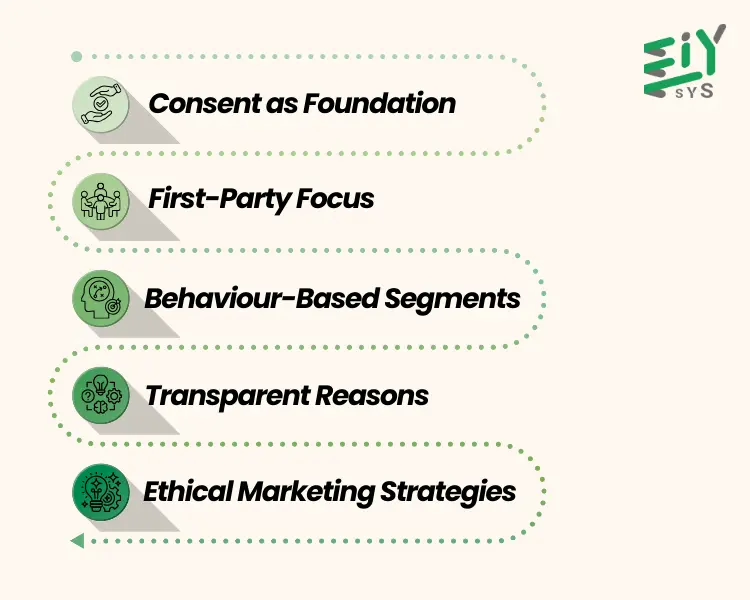
Marketing automation best practices can absolutely deliver smart, relevant experiences while staying respectful, as long as it’s guided by clear consent, transparency, and ethical marketing strategies rather than pure volume
1. Consent as Foundation
When users are clearly informed right from the beginning, each automated message becomes a welcome interaction rather than an unwelcome interruption.
2. First-Party Focus
This way, your journeys stay aligned with authentic interactions with your brand and do not rely on third-party tracking, which can feel intrusive and uncomfortable.
3. Behaviour-Based Segments
Distributing customers into groups according to their actions rather than making sensitive guesses is the right approach, using pages viewed, products browsed, or lifecycle stages as indicators.
4. Transparent Reasons
Simple notes in newsletters or preference centres make it easier for people to stay informed and empowered, rather than feeling silently controlled by the system.
5. Ethical Marketing Strategies
When your workflows and pages reflect ethical seo practices, you reinforce trust at every touchpoint, instead of chasing clicks at any cost.
What Ethical Search Engine Optimisation Practices Should Every Brand Follow in 2025?
In the year 2025, ethical SEO practices are simply based upon truthfulness. That is to say, your titles, meta descriptions, and content should not only reflect each other but also be very close to one another. Trust can be lost very quickly by users if their clicks are based on one thing and they get another. To the users, giving clear intent, authentic messaging, and accessible layouts will help them feel confident and understood.
Soon after, the search strategy must be oriented towards real user needs. Create content according to the real questions of your audience, not just high-volume keywords. Give preference to depth, clarity, and usefulness over word count. This methodology wins more users through engagement, shares, and links, thus, naturally, supporting the sustainable growth process.
To sum up, brands have to consider the issue of personalisation vs privacy very carefully when mapping out customers’ search paths. Upgrade relevance with the data you possess, but do it in a way that is never intrusive or confusing. When the reasons and methods of personalisation are disclosed, users are much more likely to trust and remain loyal to you.
How Do GDPR and Global Privacy Laws Impact SEO and Marketing Automation?
The global privacy laws have completely shifted the mindset of companies regarding the data they gather, the places where they keep it and the ways through which they utilise it. Consent banners, cookie options, along with clear privacy notices, are not considered optional anymore but are rather the standard. When these aspects are implemented correctly, they not only fulfil the legal requirements but also communicate to the users the message of being valued in their rights.
Limited tracking for SEO means that you might have a decreased amount of detailed behavioural data. Companies should not revolve their tactics around minute measures anymore, but rather concentrate on aspects such as content quality, website technical health, and overall user experience, which are going to be the main factors.
As far as the automation is concerned, the GDPR and SEO conditions met around consent, retention, and purpose are all the same. It should be the case that every automated journey can be traced back to a lawful basis and also to the customer’s consent. Designing campaigns that keep the data within safe limits from the start will not only lower the risk but also simplify the reputation.
Personalisation vs Privacy: How Do You Find the Right Balance for Users?
Achieving the right equilibrium implies constructing scenarios where the interplay of marketing automation and ethical SEO practices is not merely a support for your statistics but for users as well.
- Be clear from the very beginning: Describe to the users what they could and should expect with respect to content, the number of times they are sent it, and the way their data will be used.
- Gather only the essential information: Don’t ask for the personal details that you don’t need. Having less data is safer and more acceptable for the users.
- Allow the users to control the situation: Provide easy methods for them to manage their preferences, stop the emails, or unsubscribe. People appreciate being in charge.
- Do comfort testing, not conversion testing only: Look over the messages and flows and make sure they are not aggressive or too intimate. The goal is to be helpful and not hyper-intrusive.
- Get the different teams to converge on common values: Let marketing, product, and legal teams know the limits they can operate within. A consistent approach is the one that keeps your brand trustworthy.
Conclusion
In a digital world rapidly shifting to a privacy-first mindset, Ethical SEO is becoming the foundation of sustainable growth rather than just a tactical option. As regulations tighten and users grow more conscious of how their data is handled, brands that prioritise transparency, relevance, and respect in their optimisation and automation efforts will be the ones that earn lasting trust, better engagement, and more resilient performance.
At Eiy Sys, we focus on helping businesses turn these principles into practical, everyday reality. We work with teams to shape strategies where personalisation feels helpful instead of intrusive, where data is used responsibly, and where technology enhances human judgment rather than replacing it. By aligning content, data, and automation with user expectations, we help build marketing ecosystems that are compliant, well-organised, and genuinely user-first.
Frequently Asked Questions
To build long-term trust while improving visibility and performance.
Yes, it can be adapted to fit the scale, budget, and audience of any business.
At least every quarter, or whenever major platform or policy changes occur.
Yes, by making users feel respected, informed, and in control of their experience.

Jasleen Kaur
Hi, I’m Jasleen, a content writer and SEO enthusiast who loves turning ideas into engaging, reader-friendly content. I create blog posts, articles, and web copy that not only inform but also help websites rank higher on search engines. Combining st...read more