
The integration of data science in blockchain technology is becoming a game-changer for businesses, offering new ways to manage and utilize data. Blockchain’s decentralized and immutable nature enhances data security, while its validation methods ensure that new data is structured, documented, and unaltered, improving overall data quality.
Furthermore, data science in blockchain allows data scientists to establish a solid infrastructure, ensuring better data integrity. This combination also sparks innovation in fields like software development and finance, opening doors to new opportunities.
By leveraging the intersection of data science and blockchain, businesses can optimize security, efficiency, and data management, driving industry transformation. Data science focuses on extracting valuable insights from data through algorithms, and blockchain offers a transparent, secure, and decentralized way to record transactions, making their combination highly transformative for data usage.
What IsThe Role Of Data Science In Blockchain Technology ?
- The role of data science in blockchain technologyis essential in maintaining data integrity, security, and transparency.
- When these two technologies are integrated, they offer significant improvements in business processes.
- Data science aids organizations in making better decisions by analyzing patterns and trends in data.
- It also strengthens security by identifying unusual activities on blockchain networks, ensuring transactions remain secure and unaltered.
- Furthermore, data science helps build trust with customers by ensuring that data transactions are verifiable and transparent.
- Blockchain’s smart contracts automate data management tasks, which helps cut costs and boost efficiency.
- Therole of data science in blockchain technology is also critical in enhancing risk assessment, particularly in the financial sector, where it helps detect fraud and improve algorithmic trading.
- Data science, an interdisciplinary field that uses statistical methods and algorithms to extract meaningful insights from data, complements blockchain technology’s decentralized and transparent system to solve issues around data security, ownership, and auditability.
What Are Blockchain Analytics And Insights?
- Blockchain analytics is similar to investigative work in the digital world.
- It involves examining and making sense of the data stored on a blockchain.
- Each block in the chain contains a set of transactions, but this data can be complex and hard to understand at first glance.
- This is where Blockchain Analytics and Insights become essential.
- Blockchain Analytics and Insights help to analyze these blocks and provide a clearer understanding of how people are using the blockchain, what they are using it for, and who is involved in the transactions.
- This process uses specific tools and techniques to gather and interpret cryptocurrency data, revealing patterns and detecting suspicious activities such as fraud or money laundering.
How Can Big Data And Blockchain Integration Enhance Data Security?
- Combining Big Data and Blockchain Integration strengthens data security in several key ways.
- By utilizing blockchain’s decentralized storage, the risk of a single point of failure is reduced, making it harder for hackers to manipulate or access data.
- The consensus mechanism in blockchain creates a clear audit trail that enables transaction verification, regardless of asset ownership.
- Through Big Data and Blockchain Integration, financial institutions can monitor transactions in real time to detect and prevent fraud.
- Blockchain also simplifies data access for authorized users without requiring multiple checks.
- It ensures secure identity management without a central authority, which makes it more difficult for cybercriminals to steal information.
- Moreover, blockchain promotes transparency in data usage and helps maintain data integrity.
What Is The Role Of Predictive Analysis In Blockchain?
- The Predictive Analysis in Blockchain plays a significant role in improving decision-making, increasing efficiency, and enhancing security by leveraging historical data to anticipate future outcomes.
- It helps identify risks, detect fraud, and predict network issues before they arise.
- By utilizing Predictive Analysis in Blockchain, businesses can forecast transaction patterns, optimize mining operations, and predict user behavior.
- Analyzing large amounts of blockchain data with predictive models offers valuable insights, allowing companies to make smarter decisions, manage risks more effectively, and improve overall system performance.
How Does Data Science In Blockchain Help In Managing Large Datasets In Decentralised Networks?
- Blockchain technology and data science work together to handle large datasets within decentralized networks by enhancing data quality, conducting analyses, and addressing security challenges.
- By storing data in a structured and complete manner, blockchain improves data quality, enabling data scientists to make more precise predictions.
- Data science in blockchain helps analyze blockchain data to identify suspicious activities, categorize transactions, and predict future trends.
- The decentralized, transparent, and secure nature of blockchain contributes to resolving data security issues.
- Moreover, blockchain can integrate with other technologies, such as cloud computing, AI, and IoT, to facilitate predictive analysis.
- The interconnected chains of blockchain also help maintain data integrity by confirming its origin.
- Despite its advantages, blockchain’s distributed structure can create difficulties in data analysis, as accessing a block requires synchronization, validation, and retrieval by the network’s nodes, which can take time.
What Are The Benefits Of Blockchain Data Science?
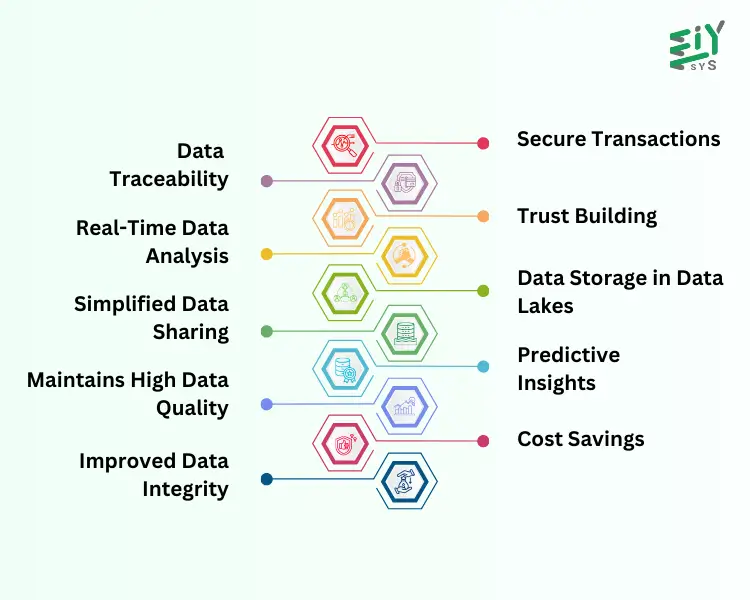
The key points about the benefits of Blockchain Data Science are as follows:
- Data Traceability: Blockchain offers a secure and unchangeable record of data, making it easy to trace its source and track its journey.
- Real-Time Data Analysis: Blockchain allows for immediate analysis of data as it flows through the system, enabling faster decision-making.
- Simplified Data Sharing: Blockchain ensures secure, tamper-proof sharing of information by storing it in immutable blocks.
- Maintains High Data Quality: Blockchain’s decentralized ledger system ensures data is accurate, up-to-date, and free from alterations.
- Improved Data Integrity: Data within blockchain is protected from unauthorized modifications, preserving its authenticity.
- Secure Transactions: Blockchain encrypts transactions, removing the need for third-party validation, ensuring security.
- Trust Building: Blockchain enhances trust by ensuring transparency and decentralization, reducing reliance on central authorities.
- Data Storage in Data Lakes: Blockchain enables secure storage in data lakes, improving data access and management.
- Predictive Insights: Blockchain data can be analyzed to uncover trends, which can help predict future behaviors and patterns.
- Cost Savings: By eliminating intermediaries and accelerating processes, blockchain reduces transaction costs and operational overhead.
Leveraging the benefits of Blockchain Data Science can significantly enhance data security, operational efficiency, and the ability to gain valuable insights, driving better decision-making for businesses.
Conclusion
At EIY SYS, we recognize the transformative potential of combining Data Science in Blockchain to enhance security, efficiency, and data management. The Role of Data Science in Blockchain Technology ensures accurate insights, while Blockchain Analytics and Insights help identify patterns and detect fraud.
Big Data and Blockchain Integrationstrengthens data security, and Predictive Analysis in Blockchain enables smarter forecasting. The Benefits of Blockchain Data Science improve decision-making, data traceability, and integrity, driving innovation and growth across industries.
Frequently Asked Questions
Data science enhances blockchain technology by ensuring data accuracy, security, and transparency. It helps businesses analyze data trends, improve decision-making, and safeguard the integrity of blockchain transactions, making them more trustworthy and verifiable.
When combined, data science and blockchain create a powerful synergy, where data analysis and secure transaction records complement each other. Data science identifies key patterns, strengthens security measures, and helps prevent fraud, while blockchain offers a transparent, unchangeable record of transactions, increasing efficiency and reducing costs.
Blockchain analytics is the process of analyzing blockchain data to understand transaction behaviors, spot potential fraudulent activities, and gain insights into how the blockchain is being used. Specialized tools interpret complex blockchain data, helping to detect issues like fraud or money laundering by uncovering hidden patterns.
The integration of big data with blockchain enhances security by decentralizing data storage, thus reducing the risk of a single point of failure. Blockchain’s consensus mechanism ensures that transactions are securely verified, and the combination of both technologies allows real-time fraud detection and ensures secure, transparent data handling.
Data science in blockchain improves the management of large datasets within decentralized networks by enhancing data quality and supporting detailed analysis. Blockchain’s structured approach to data storage allows for more accurate predictions and the ability to forecast trends, while its decentralized nature helps maintain data security and authenticity.
Blockchain data science offers several advantages, including the ability to trace data, analyze it in real-time, and share it securely. It helps maintain data quality and integrity, builds trust through transparency, and reduces costs by eliminating intermediaries. Additionally, it provides predictive insights that aid businesses in decision-making.