The Agile Manifesto values , published in February 2001, is a brief yet powerful document that outlines four core values and twelve principles aimed at improving software development. Created by 17 software development experts, the manifesto was a response to the growing demand for a more adaptable and efficient approach compared to the rigid, documentation-heavy methods that were prevalent at the time.
The developers, who called themselves the Agile Alliance, sought to challenge the traditional software development processes that they viewed as complex, slow, and overly focused on documentation. By emphasising the Agile Manifesto values , they aimed to create a more flexible and responsive methodology that balanced the best aspects of traditional approaches with new, innovative practices.
What Does Agile Manifesto Value Mean?
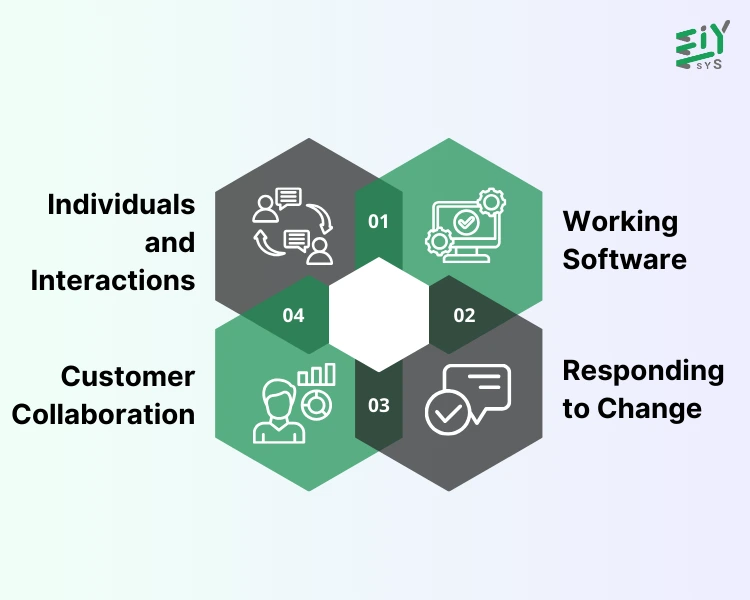
There are four types of agile manifesto values :
-
Value 1: Individuals and Interactions : In the past, software teams often focused on having the best tools and processes for development. However, the Agile Manifesto emphasises that while tools and processes are important, the people behind them are even more crucial. Success depends on having the right team members, as the best tools are useless if the team is not effective. What matters most is how team members communicate and collaborate, as these interactions are key to problem-solving and achieving success.
- Value 2: Working Software: In earlier practices, developers spent excessive time creating detailed documentation before even writing a single line of code. While documentation is still valuable, the Agile Manifesto stresses the importance of delivering working software to customers as a top priority. By releasing functional software early, teams can collect user feedback and continuously improve future versions.
- Value 3: Customer Collaboration : Traditionally, contracts were the foundation of software development, often leading to discrepancies between what was agreed upon and what the customer actually needed. The Agile Manifesto advocates for a shift toward ongoing customer collaboration rather than rigid contract agreements. This approach focuses on continuously engaging with customers to ensure that the product evolves in line with their needs and expectations.
- Value 4: Responding to Change : n the past, development teams would create fixed roadmaps that were rarely updated. However, in today’s fast-paced environment, such static roadmaps quickly become obsolete as requirements and priorities shift. The Agile Manifesto promotes flexibility, encouraging teams to adapt and modify their plans as needed. A dynamic roadmap allows teams to pivot quickly, responding to changes in real-time and keeping projects aligned with current goals and market demands.
Does your business follow the Agile principles in business by delivering working solutions over extensive documentation?
Yes, Agile businesses prioritise delivering working software over extensive documentation. The Agile Manifesto’s core value, “Working software over comprehensive documentation,” emphasises the need to provide a functional product to customers quickly. This approach helps streamline the development process and ensures that the product meets customer needs.
However, Agile doesn’t mean documentation is unnecessary. It simply means that documentation should be lean, simple, and aligned with the needs of stakeholders. Here are some strategies for balancing documentation and working software while applying Agile principles in business :
- Collaborate with developers: Work closely with the development team to create documentation that supports the software development lifecycle.
- Focus on essential documentation: Only document what is truly necessary, avoiding excessive documentation that serves little purpose.
- Use lean documentation practices: Keep documentation clear and concise, selecting formats that can easily be updated as needed.
- Promote knowledge sharing: Foster a culture of collaboration and open communication to ensure that knowledge is shared effectively across the team.
- Document decision-making processes: Record key decisions made during development so that valuable insights can be passed on to others.
- Automate documentation generation: Use tools and automation to help generate and maintain documentation more efficiently.
The Agile principles in business are also crucial to prioritise human-centred interactions over rigid processes, encourage close collaboration between development teams and customers, and remain flexible enough to adapt to changing requirements and circumstances.
What Are The Benefits of Agile Methodology ?
The benefits of Agile methodology are :
- Increased Employee Input : Traditional work structures often focus on high productivity with minimal employee involvement. However, Agile encourages empowering employees by giving them ownership of their work, moving away from the “assembly-line” mentality. Agile values autonomy over micromanagement, allowing people to perform at their best without unnecessary pressure.
- More Responsive to Customer Feedback : Agile teams prioritise direct communication with customers, shifting the focus from simply following orders to solving real customer problems. Instead of relying on long documentation or top-down plans, developers engage with customers continuously, enabling them to adapt and pivot quickly based on feedback. This approach enhances responsiveness and product relevance.
- Higher Job Satisfaction : Agile fosters a more humane management style by decentralising decision-making and giving team members control over how they build the product. This leads to greater job satisfaction, as teams have the autonomy to solve problems and deliver solutions in ways that directly meet customer needs, making their work feel more meaningful.
- Faster Fixes and Solutions : One of the key benefits of Agile methodology is the ability to quickly fix issues and deliver solutions to customers. Agile emphasises speed, so if a customer encounters a problem, teams can resolve it rapidly often within a day without waiting for lengthy approval processes.
- More Cross-Functional Collaboration : Agile promotes cross-functional teams where members from different disciplines collaborate throughout the project. This eliminates handoffs between departments and accelerates development, ensuring smoother workflows and faster delivery.
- Better Risk Management : In traditional environments, management tries to control risk through oversight, but Agile practices minimise risk by enabling teams to gather early feedback and make adjustments throughout the process. By avoiding long periods of uncertainty, Agile helps teams deliver products that meet customer needs with fewer surprises.
- Increased Room to Pivot and Experiment : Agile encourages continuous experimentation and adaptation . Teams remain flexible, adjusting direction as new information emerges. This adaptability is supported by a culture of psychological safety , where team members feel free to experiment, fail, and improve without fear of repercussions.
- Customised Company Solutions : Agile is highly adaptable, allowing companies to tailor practices to fit their unique needs. Whether in a small startup or a large corporation, Agile enables teams to create customised solutions that best suit their work environment and goals.
- Decentralised Communication : Agile empowers teams to self-organise and communicate directly across roles and departments. This decentralisation speeds up decision-making, eliminates barriers between teams, and fosters collaboration, allowing everyone to work toward a common goal.
- Bigger Focus on Relationships : Agile values relationships over rigid processes. While processes are important, Agile emphasises building strong relationships between team members and stakeholders. This ensures better communication and a more collaborative environment, where documentation becomes an artefact of ongoing conversations rather than a static requirement.
- Clearer Paths to Success : Agile is not a one-size-fits-all methodology but a flexible approach that adapts to each organisation’s needs. By focusing on feedback and continuous improvement , Agile allows companies to tailor their processes to be more effective, ultimately leading to better outcomes and clearer paths to success.
How can the Agile Manifesto for Startups improve team collaboration?
The Agile Manifesto for Startups can enhance team collaboration by :
- Fostering Cross-Functional Collaboration : Agile projects often involve teams with diverse skills and backgrounds, promoting better problem-solving and creativity.
- Encouraging Self-Organizing Teams : Agile empowers teams to take ownership of their work and make collective decisions, which boosts engagement and fosters creativity.
- Prioritising Communication : Agile practices, such as daily stand-ups, help ensure that team members share their progress, challenges, and next steps, creating a culture of accountability and support.
- Maintaining a Customer-Centric Approach : By focusing on customer feedback and collaboration throughout the development process, Agile teams ensure the final product meets user needs.
- Adapting to Change : Agile teams are encouraged to be flexible, responding to evolving requirements and market conditions to deliver the best possible product.
- Utilising Collaboration Tools : Agile project management tools enable teams to track project progress in real-time, making it easier to make data-driven decisions.
How Do The Values Of Agile In Software Development Prioritise Individuals And interactions?
1. Prioritising working software over detailed documentation : A fundamental value of agile in software development is to focus on delivering functional software that satisfies user needs, rather than spending excessive time on detailed documentation that may not directly contribute to the product’s success.
2. Collaborating with customers over contract negotiations : The values of agile in software development highlight the importance of ongoing communication with customers. This ensures that the product evolves based on real feedback, rather than being bound by the constraints of a contract or initial agreements.
3. Adapting to change over strictly following a plan : Agile values flexibility. Teams are encouraged to respond to changes in requirements or market conditions, rather than rigidly sticking to an original plan. This adaptability allows teams to better meet the evolving needs of their customers.
What is the business impact of agile values on product delivery and customer satisfaction?
The values of Agile in software development significantly influence business results by promoting adaptability, teamwork, and continuous progress. Here’s how these principles affect businesses:
- Faster Time-to-Market : Agile’s iterative process allows businesses to release working software in stages, enabling quicker delivery of products or features. This speed gives businesses a competitive advantage, particularly in industries where speed to market is critical.
- Enhanced Customer Satisfaction : Agile emphasises customer collaboration over contract negotiation, meaning businesses prioritise regular customer engagement. By consistently gathering feedback and adjusting products based on customer needs, businesses can deliver products that better meet expectations, leading to higher customer satisfaction.
- Greater Flexibility and Responsiveness : Agile’s focus on responding to change over sticking to a fixed plan enables businesses to quickly adapt to changing market conditions or customer demands. This ensures that companies can adjust their approach without wasting time on outdated plans or strategies.
- Improved Product Quality : By focusing on working software over extensive documentation Agile teams aim to deliver functional, tested products more quickly. This minimises the delays often caused by lengthy documentation or approval processes, allowing businesses to release high-quality features faster.
- Stronger Team Collaboration : Agile’s value of individuals and interactions over processes and tools encourages strong collaboration among team members. Cross-functional teams can work together more effectively, share ideas, solve problems creatively, and innovate, leading to better solutions and more engaged teams.
- Ongoing Improvement : The Agile principle of embracing change and continuous adaptation promotes a culture of learning. Teams regularly evaluate their performance, identify areas for improvement, and refine their processes, which enhances productivity and contributes to long-term business success.
Conclusion
In conclusion, the Agile Manifesto values drive businesses like EIY SYS to adopt more flexible, collaborative, and efficient workflows. By embracing these Agile principles in business , companies benefit from faster delivery, enhanced customer satisfaction, and improved product quality.
The business impact of Agile values is clear: startups can innovate rapidly, adapt to changes, and deliver products that truly meet customer needs. Ultimately, applying the values of Agile in software development leads to stronger, more responsive teams and better business outcomes.
Frequently Asked Questions
The Agile Manifesto is a set of foundational values and principles aimed at improving software development and project management. Created in 2001, it emphasizes collaboration, adaptability, customer satisfaction, and delivering value.
The Agile Manifesto emphasizes individuals and interactions over processes and tools, highlighting the importance of collaboration and communication; working software over comprehensive documentation, focusing on delivering functional results rather than excessive paperwork; customer collaboration over contract negotiation, promoting active engagement with clients to meet their evolving needs.
These values drive a customer-focused, adaptable, and innovative approach to product and service delivery, helping businesses remain competitive and responsive in dynamic markets.
It prioritizes the people involved in projects and their collaboration over reliance on rigid processes or tools. Strong teamwork and communication lead to better outcomes.
The principle highlights the importance of delivering functional, valuable results over spending excessive time on exhaustive documentation, which can slow down progress and reduce focus on end-user value.