Technology in healthcare is one that is extremely significant to individuals all around the world. Products and services for patient treatment are offered by this industry. In terms of employment and growth, it has grown to be one of the major industries in the globe. As a result, it serves a larger segment of the populace. patient data privacy is the largest problem facing Healthcare innovation in the industry.
The future of healthcare is being shaped by digital technology. The administration of patient data privacy in records and data is the most notable application of blockchain and other technologies. Our products and services might raise the standard, security and effectiveness of medical treatment. By offering our distinctive digital health solutions, we hope to strengthen the bond between patients and Healthcare innovation for professionals.
What are the impacts of technology on healthcare?
Throughout the centuries that people have been practicing medicine, many unique advancements in health technology have been produced, but few have had the same broad impact as digital technology. Significant advancements in computers and networking have not only increased the number of available medical treatments but also changed the work that physicians do on a daily basis.
Despite the fact that visionaries began debating the use of computers in medicine as early as the 1960s (link sits outside ibm.com), at first, medical practices were unable to rely on computers due to their high cost and unreliability. Policies and data standards (link lives outside ibm.com) were developed as technology advanced and costs decreased to encourage Healthcare innovation institutions to use new technologies for daily record keeping as well as medical equipment, such as diagnostic imaging devices. Electronic health records (EHRs), which make it simpler for health data like test results or diagnoses to be accessible conveniently and securely, have mostly replaced paper medical records that were computerized.
How is Technology Used in Healthcare?
Large diagnostic imaging scanners and small wearable sensors are only two examples of how technology is used in healthcare today. Technology has not only led to new medical advancements and therapies but also to several business process improvements in the Healthcare innovation industry. The advantages of online appointment booking, instant access to test results and data and texting or emailing queries to Healthcare innovation practitioners have become commonplace.
-
Diagnosing and Treating Diseases
Clinical professionals may be able to diagnose patients more accurately if AI in healthcare is used to interpret data, including medical imaging and create disease models. AI, for instance, may be used to identify and decipher patterns of brain activity in MRIs to monitor the course of neurodegenerative diseases like Huntington’s disease. This is demonstrated by recent work by IBM Research.
-
Imaging in Medicine
Because they can assist in translating images into statistics and identify patterns, computers and AI in healthcare models are very useful in the field of medical imaging. By highlighting abnormalities and highlighting high-value results, these technologies can assist radiologists and other physicians in managing the very huge amount of pictures they must evaluate.
-
Healthcare Administration
Building on the gains they’ve achieved with electronic medical records, many hospitals and healthcare systems are beginning to look for further methods to methodically enhance their operations. A few of the technologies that businesses are utilizing to enhance their digital infrastructure include mobile, cloud and analytics.
-
Clinical Investigation
Technology is being used by life sciences companies to revolutionize the way clinical trials are conducted. Decentralized trials are being supported by smart devices, telehealth visits and sensors, which increase participant convenience and efficiency in data collecting.
What are the Benefits of Technology in Healthcare?
-
Improving Patient Experiences and Care
Digital health solutions organizations can see their overall performance by using technology to measure and collect data across the patient data privacy care system. In order for companies to regularly examine their findings, identify problems that need to be corrected and find methods to improve treatment and the patient experience, technology also assists in automating that measurement.
-
Real-time Sharing of Information
A wide range of stakeholders, including payers, patients and physicians, require access to digital health solutions records for various purposes. Organizations have always been required to keep separate records for every group.
However, more businesses are integrating their data so that authorized individuals may access the documents they require whenever they require them thanks to new technology that makes it simpler for digital medical records to be standardized and securely kept.
-
Flexibility for Both Physicians and Patients
Finding time for appointments can be difficult for patients who have busy lives. There are additional options for patients to contact Healthcare innovation providers thanks to patient data privacy portals and telemedicine technologies. Similar to cardiac monitors, wearable technology offers medical professionals more means of assessing the health of their patients as well as other choices for documenting and assessing symptoms while the patients go about their daily lives.
What are the Advantages of Blockchain in Healthcare Technology?
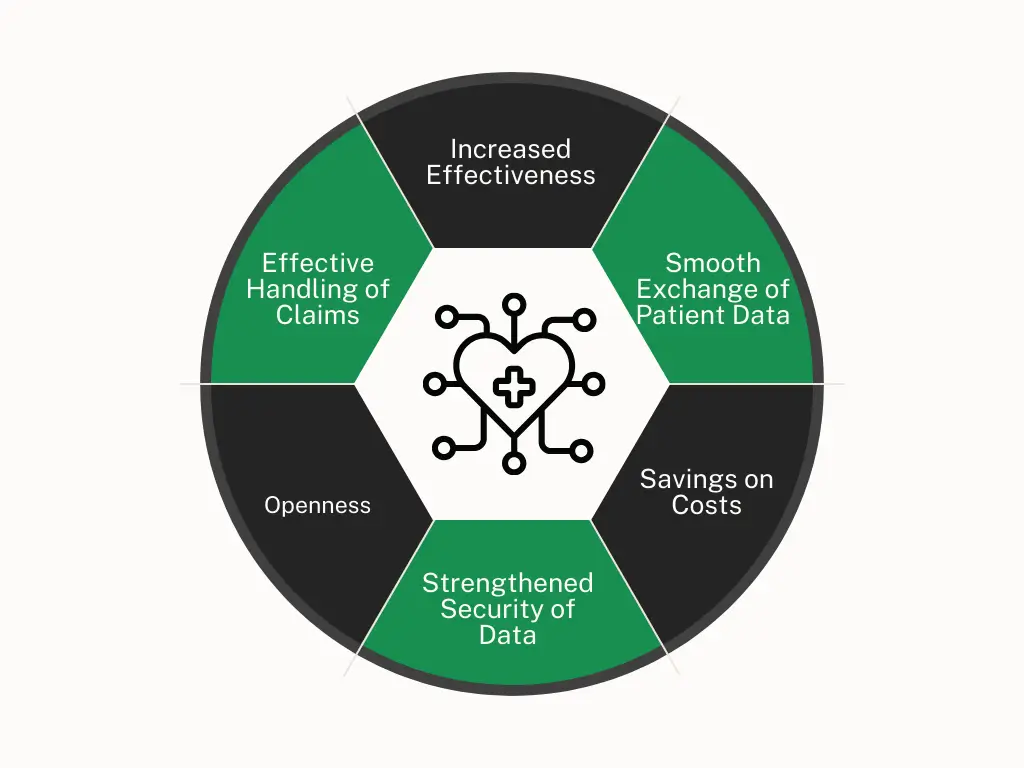
Blockchain provides several advantages to the healthcare sector, including enhanced data security, more transparency and more effective claims processing. Let’s examine the main advantages of blockchain in healthcare in more detail.
-
Savings on Costs
By improving interoperability, expediting data interchange and reducing administrative chores, the application of blockchain technology in the healthcare industry can drastically lower operating costs. By utilizing blockchain technology, healthcare providers may save costs by automating a number of labor-intensive, paper-based manual activities in the Healthcare innovation industry, such exchanging medical records, managing the medication supply chain and processing claims.
Furthermore, blockchain can offer real-time tracking of the movements of pharmaceuticals and medical supplies. By lowering the likelihood that fake goods may infiltrate the supply chain, this visibility improves efficiency and guards against losses brought on by fake goods.
-
Strengthened Security of Data
Breach of healthcare data affects millions of individuals worldwide and is a serious problem. Over 39 million people have been affected by healthcare data breaches in just the first half of 2023, according to a Health IT Security analysis. The need for a more secure healthcare system is demonstrated by this paper.
Blockchain technology can improve data security in the healthcare industry by offering a decentralized, safe platform for exchanging and storing patient information and payment details.Furthermore, the blockchain’s consensus process lowers the possibility of fraudulent entries by requiring network members to agree before making any changes or adding new data.
-
Smooth Exchange of Patient Data
Blockchain’s cryptography methods guarantee that, while being sent, patient data privacy is encrypted and impenetrable. The blockchain network’s decentralized data storage eliminates the need for a central authority to oversee and regulate access. This enables smooth transmission and gives patients and authorized stakeholders direct control to their data.
-
Openness
Blockchain technology can improve transparency in the healthcare sector by offering a distributed and decentralized ledger system that prevents changes to transactions or data once they are recorded. Blockchain in healthcare increases openness in the storage and sharing of patient data, medical records, information on the drug supply chain and other vital data in the Healthcare innovation sector. Additionally, blockchain ensures accountability and transparency by giving patients the authority to decide who may access their data.
-
Increased Effectiveness
Blockchain establishes a safe registry of medical records for patients, facilitating easy information exchange between various healthcare providers while preserving patient autonomy and consent. This improves the speed and efficiency of the healthcare system by removing the need for patients to regularly disclose their medical records. By tracking the flow of medications, medical supplies and other healthcare items along the supply chain, blockchain in healthcare integration for the healthcare sector also reduces the danger of counterfeit medication and improves supply chain management. Additionally, blockchain’s smart contract technology automated monitoring procedures, cutting down on paperwork and increasing productivity.
-
Effective Handling of Claims
Blockchain facilitates effective data sharing between the parties involved, which streamlines the processing of healthcare and medical insurance claims. Blockchain’s transparency reduces the possibility of mistakes and fraud. Furthermore, when requirements are satisfied, smart contracts handle claims automatically. These actions greatly increase efficiency and shorten the time it takes to process claims.
Conclusion
Blockchain in healthcare is expanding rapidly and blockchain technology will give Healthcare a Blockchain platform. AI in healthcare does, however, have certain benefits and drawbacks because it is a relatively new technology in healthcare. Our developers are committed to offering the best services for developing blockchain apps for healthcare. Our developers’ exceptional skill and dedication to their job are the primary factors behind each customer project’s success and their happiness.
One of the top software Healthcare innovation development firms with a focus on blockchain Technology is Eiy sys. Our company is already assisting numerous other clients with the requirements of their projects and has already supplied an abundance of digital health solutions. Being among the first to use this innovative technology, Eiy sys for healthcare development team is an ideal collaborating partner for your upcoming project.
Frequently Asked Questions
Remote consultations are made possible via telemedicine, which gives patients—especially those in underprivileged areas—more convenient access to treatment.
AI in healthcare improves overall efficiency and accuracy by streamlining administrative processes, forecasting patient outcomes and analyzing medical data for diagnostic purposes.
Electronic Health Records (EHRs) facilitate better patient data privacy management by making medical histories easily accessible, hence improving provider coordination.
Wearable technology enables proactive treatment and empowers patients to take charge of their health by tracking vital signs and health parameters in real-time.