Since Bitcoin was launched, blockchain technology has been adopted in a variety of industries and contexts. Inspire by the success and failures of cryptocurrencies and other decentralized finance (DeFi) projects, many central banks have experimented with converting fiat currencies into Central Bank Digital Currencies (CBDCs), while commercial banks have been exploring the possibility of tokenizing traditional assets on blockchains. The current trend is Asset Tokenization, which involves the adoption of Blockchain regulation at the organizational, industrial and national levels. Most research on the adoption of blockchain, however, is focused on the organizational perspective.
Few papers analyze monetary and Financial technology contexts from a national perspective. With a stock-flow model of an open economy, Temperini et al. (2024) examine the effectiveness of helicopter money, once theoretical but now feasible with CBDCs. The CBDC-related indices developed by Wang (2022) show a negative correlation with the MSCI World Banks Index. Currently, there is no comprehensive comparison of tokenization practices across countries.
What is Asset Tokenization?
When an asset is Tokenized economy, the rights to the asset are converted into Digital assets that can be traded, held and sold on a blockchain platform as a means of converting the rights to it into Digital assets. As a result of the Security tokens, a stake in the underlying asset is represented by a stake in ownership. As far as tokenization is concerned, it is theoretically possible to tokenize almost any asset, regardless of whether it is physical like real estate, or intangible like stock in a company. As soon as these assets are turned into digital Security tokens, they become more easily dilutable, allowing for fractional ownership and allowing for more people to invest, thereby making them more liquid as they become easier to divide and dilutable. Tokenization of assets could also enable direct peer-to-peer trading of traditional assets, removing the need for middlemen and increasing market transparency and Security tokens as well as eliminating the need for middlemen.
Which are the Top 3 Aspects from Tokenization in the Future?
1. Investing Barriers Reduced
First, the ability to break down expensive assets into smaller, more affordable units lowers Financial technology barriers. Investors can now access property, art and venture capital funds. It is possible, for instance, to get a share in a million-dollar property in a prime location for $100 or so.
- A Global Approach: With blockchain platforms, tokenization transcends geographical boundaries, enabling individuals worldwide to invest across borders.
- Improved Liquidity: Due to their divisibility into smaller, more manageable shares, Tokenized economy assets offer better liquidity than traditional investments. Investors can buy and sell portions of the asset, facilitating faster and more frequent transactions. People seeking to convert their investments into cash quickly find Tokenized economy assets more appealing.
- Optimal Diversification: Bain & Company estimates asset tokenization unlocks $400 billion in alternative investments. In addition to venture capital, real estate, commodities, cryptocurrencies and collectibles, Security tokens can diversify portfolios. Diversification spreads risk and potentially enhances returns.
2. Effective and Transparent Blockchain
- Decentralization: Blockchain eliminates centralized authority through a Decentralized finance network. By distributing data across network nodes, fraud and manipulation are significantly reduced.
- Immutability: Blockchain transactions are immutable – they cannot be altered or deleted. The inherent integrity of transaction records establishes blockchain as a reliable technology for transferring Tokenized economy assets and recording ownership.
- Openness: All transactions on a blockchain are transparent and visible, enabling participants to trace assets’ origins and verify their history cryptographically. As a result, transactions are more transparent and accountable.
- Smart Contracts: The blockchain facilitates the implementation of smart contracts – self-executing agreements. By automating and streamlining processes, these contracts reduce the need for intermediaries.
- Less Intermediaries: Peer-to-peer transactions are facilitated by blockchain technology without the need for intermediaries. Blockchain streamlines processes, resulting in faster and more direct transactions.
3. Investing globally
- Diverse Asset Access: Blockchains offer global scope, eliminating barriers for investors. On blockchain networks, Tokenized economy transactions eliminate the need for bank or broker accounts, making investment opportunities accessible to everyone. The democratization of access increases the liquidity of illiquid assets like real estate and art.
- Reduced Transaction Costs: Cross-border investing is simplified with tokenization, reducing fees and complexities. Tokenization reduces costs and streamlines processes with blockchain technology. According to Nasdaq, tokenization could reduce bond issuance costs by 80%. By 2030, Roland Berger estimates that tokenization could save approximately 4.6 billion Euros (equivalent to $4.83 billion USD).
- Transact Faster: Round-the-clock trading is enabled by tokenization. Using smart contracts, transactions are automated based on predefined criteria, expediting the settlement process. By accelerating trading, defaults and disruptions are minimized.
- Exchange and Compliance Simplified: With tokenization, assets are paired with cryptocurrencies or stablecoins for seamless and cost-effective exchanges. Investors have peace of mind through transparent and programmable smart contracts that ensure compliance with AML and KYC in Blockchain regulation.
What are the Current Trends in Asset Tokenization?
-
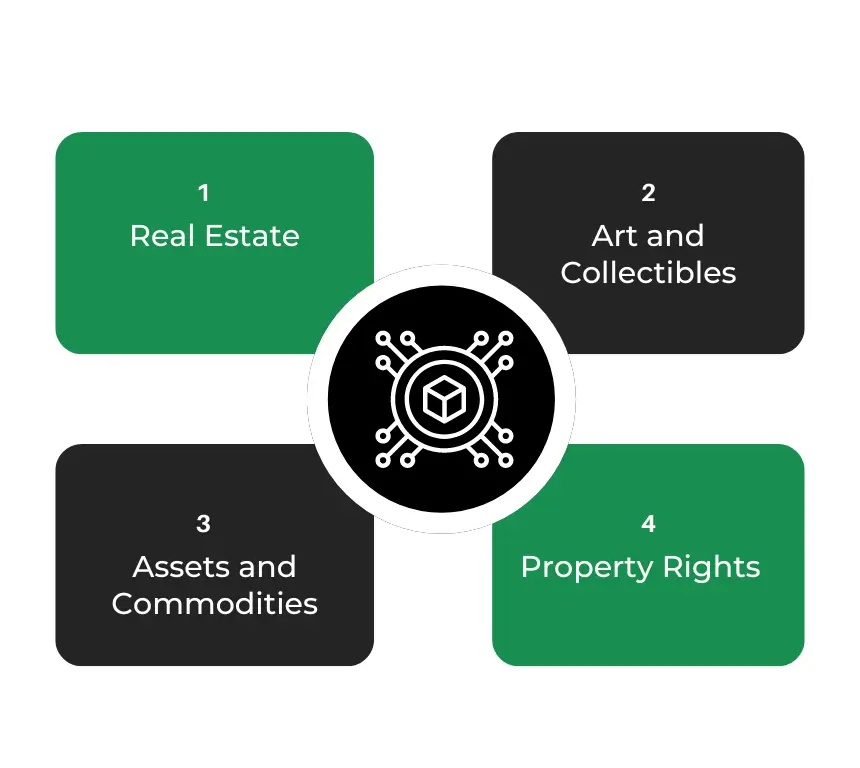
Real Estate
With technology and blockchain empowerment, real estate will grow so rapidly. Previously an exclusive and costly market, real estate is now undergoing a transformation thanks to blockchain and tokenization. Real estate is now accessible to a broader audience, regardless of their Financial technology resources or portfolio.
Property tokenization and fractional division are two examples of how tokenization is revolutionizing the real estate industry. Smaller investors can own one or more portions of the property without large initial investments. Additionally, blockchain facilitates real estate transactions. Global investors can invest anywhere. The world is opening up to investment opportunities.
-
Art and Collectibles
With Non-Fungible Tokens (NFTs), artists and creators can tokenize their digital art, collectibles and unique assets. Digital assets ownership and provenance are revolutionizing how digital assets are perceived and traded. Moreover, tokenization ensures enhanced authenticity and provenance, alleviating concerns about originality and ownership. Stocks, bonds and commodities are also undergoing tokenization, offering fractional ownership and broader investor access. The issuance and trading of Tokenized economy securities is becoming more efficient, transparent and secure thanks to blockchain technology.
-
Assets and Commodities
Investing in commodities through tokenization offers fractional ownership opportunities. By owning fractions of physical commodities, individuals get exposure to these assets without owning them physically. The tokenization of commodities facilitates efficient trading. By streamlining this process, traders are able to trade faster and more efficiently, potentially reducing transaction costs.
-
Property Rights
Tokenization is revolutionizing intellectual property management and trading. The innovative approach includes patents, copyrights, trademarks and Digital assets. By tokenizing intellectual property, creators and innovators can create new revenue streams and enhance value realization. Digitizing these assets into Security tokens opens up unprecedented opportunities for managing and trading intellectual property rights.
Conclusion
Overall, asset tokenization will be characterized by a dynamic interaction between decentralization and Blockchain regulation. With decentralization, assets will be managed and traded with greater transparency, fewer intermediaries and increased accessibility. Using blockchain technology, real-world assets can be represented by Digital assets, potentially transforming industries from real estate to Decentralized finance. Having assets easily accessible to a broader audience could result in a more inclusive Financial technology system.
In order to ensure asset tokenization is safe and compliant with existing laws, regulatory frameworks will be crucial. To address fraud, market manipulation and privacy concerns, Blockchain regulation will be needed. By leveraging Decentralized finance technologies and engaging with regulatory developments, Eiy Sys navigates this dual landscape. Eiy Sys can position itself as a leader in asset tokenization by integrating robust compliance measures and staying adaptable to regulatory changes.
Frequently Asked Questions
Tokenization converts real-world assets into digital tokens on a blockchain, allowing fractional ownership and easier asset transfer.
The decentralization of assets increases transparency, reduces reliance on intermediaries and facilitates peer-to-peer transactions, allowing individuals to trade and invest easier.
In order to create a safer environment for tokenized asset trading, regulation is crucial for ensuring compliance, protecting investors and mitigating risks such as fraud and market manipulation.
It is possible to achieve a balance between decentralized technologies and regulatory frameworks, which allows for innovation while maintaining investor protections.