


Keeping up with fast-moving modern business environments requires maximum productivity. With DevOps integrated services, development and operations can be seamlessly merged to achieve optimum performance.
Business can gain external competencies for robust, scalable solutions by embracing DevOps outsourcing. By doing so, businesses can focus on what they do best while experts handle development and deployment.
By integrating resources and processes, integrated workplace management systems enhance productivity even further. As a result, the business does not have a difference in how it operates and everything works out perfectly. The synergy of integrated services and DevOps services could bring about success without parallel if organizations continue to implement such strategies.
What is DevOps Services Integration?
A DevOps services integration allows collaboration, efficiency, and productivity during the development and deployment process through the merging of software development (Dev) and IT operations (Ops). Software development is based on continuous integration, delivery and automation of processes that enable safe and rapid software release.
In DevOps outsourcing integration, there are many different types of integrated services aimed at automating and optimizing processes. All of these aspects contribute to the overall efficiency of the development process, such as continuous integration, delivery, and automated testing.
An integrated workplace management system will also support DevOps outsourcing integration by providing the organization or company with a common platform for resources, processes and tools. An organization needs this system to ensure that all aspects are aligned in order to communicate and collaborate effectively.
By bundling services, businesses are able to produce high-quality products quickly and achieve greater organizational agility.
What are the Steps of a DevOps Services Implementation Plan?
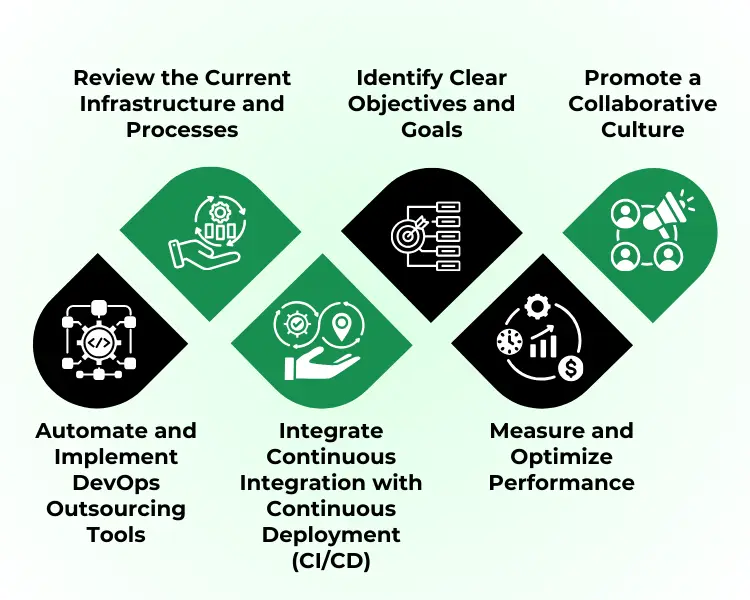
DevOps services are implemented in many critical steps for smooth integration and optimal performance. In order to develop a strong DevOps implementation plan, the following steps are essential:
1. Review the Current Infrastructure and Processes
The first step in DevOps services is to evaluate the existing development process and infrastructure. Assessment of the as-is process and infrastructure will reveal bottlenecks, inefficiencies and potential areas for improvement.
2. Identify Clear Objectives and Goals
Make sure your business objectives are measurable and align with your vision. During an assessment phase, targeted needs will be identified and a platform for integrating services will be established.
3. Promote a Collaborative Culture
In order for DevOps outsourcing to be successful, it must be implemented in a culture where Development and Integrated workplace Management systems can work together. When continuous integration and delivery, as DevOps advocates, need to be achieved, there must be a cultural shift.
4. Automate and Implement DevOps Outsourcing Tools
DevOps services integrated management systems rely heavily on automation in order to provide the best service possible. In particular, using the right tools will help to automate repetitive tasks and smooth workflows, which will increase efficiency and reduce errors by reducing human error.
5. Integrate Continuous Integration with Continuous Deployment (CI/CD)
In order to maintain a constant flow of updates, CI/CD practices are very useful. As a result of these practices, testing and integrated services are automated once changes are made to the code, so the time between the development and release of an application is reduced.
6. Measure and Optimize Performance
Monitoring and optimization are two major success factors for any DevOps implementation. A continuous measurement will allow one to identify areas where improvement can be made and areas that are weak. The improvement process also ensures that all goals and objectives defined at the beginning are met.
What is the Best Way to Measure DevOps Success?
There are several indicators that indicate the success of a DevOps initiative, such as efficiency, speed, and quality improvement. Among the metrics that are measured by DevOps integrated management system are the frequency of deployments, the change lead time, the mean time to recovery and the change failure rate.
Several Specific Integrated Services of DevOps Integration Increase the Realization Rate, such as:
- Outsourcing DevOps Cost savings, operational efficiency, and access to qualified specialized knowledge. In this regard, it is important to consider the impact.
- Integrated Management System: Check for improvements in workflow automation, compliance and governance.
- Integrated Workplace Management System: improved collaboration and facility management efficiency for optimal resource utilization.
- Deployment Frequency: A development process’s ability to be agile and responsive is reflected by the frequency at which code is deployed.
- Lead Time for Changes: A shorter lead time from code commit to deployment describes more rapid cycles of development and faster releases of features and fixes.
- Change Failure Rate: There are fewer deployments where failures occur in production, indicating better quality code and better testing practices.
- Mean Time to Recovery (MTTR): The ability to recover from failures with a shorter timeframe demonstrates enhanced incident response and system resilience.
- Automated Test Coverage: The more testing coverage achieved through automation, the more reliable and easily maintainable the code will be.
- Customer Satisfaction: Customers’ improved feedback indicates that value was delivered successfully and that the user experience was enhanced.
- Collaboration and Communication: Teamwork and knowledge sharing are enhanced because of improved collaboration measures, which include the use of shared tools and fewer silos.
Conclusion
Integrating DevOps with a wide range of integrated services acts as a panacea for businesses looking to maximize efficiency while retaining a competitive edge. DevOps outsourcing allows organizations to leverage highly specialized expertise that ensures robustness and scalability of solutions, allowing internal working teams to focus more on core competencies.
The goal of integrated workplace management systems is to facilitate seamless communication and collaboration across departments by providing a single platform to manage resources, processes, and tools.
Eiy sys understands the crucial role DevOps plays in maximizing productivity and ensuring success. By empowering your DevOps team and fostering collaboration, we can streamline operations, facilitate collaboration, and accelerate innovation. We can help you transform your business through our partnership with Eiy sys.
Frequently Asked Questions
Integrated DevOps services combine development, operations, and automation tools to streamline the software development lifecycle. As CI/CD, automated testing, and infrastructure management are integrated, DevOps increases productivity by accelerating development cycles, reducing manual effort, and improving team collaboration.
Continuous integration (CI) automates the process of merging code changes into a shared repository on a regular basis. The practice ensures continuous testing and validation of code, reducing integration issues and enabling developers to detect bugs earlier. As a result, the development process becomes more efficient and productivity is increased
Using continuous deployment (CD), new features and updates can be delivered more quickly to production environments. CD minimizes deployment time and speeds up the release cycle, allowing teams to respond quickly to market demands and increase productivity.
During the development process, automated testing allows for rapid and consistent execution of tests. It contributes to improved productivity by eliminating the need for manual testing and debugging, speeding up the release process, and ensuring higher quality code.
