


Most companies find the gap in their data security only after something has already gone wrong. A password gets reused, a vendor login gets compromised, and customer records end up somewhere they were never meant to sit. The systems holding that information were never designed to prove who changed what, or when.
Blockchain changes that arrangement. Records get distributed across multiple machines, signed, and time-stamped, so tampering leaves a visible mark instead of passing quietly. If your current setup depends on trusting one server and one administrator, it is worth seeing what the alternative actually offers.
Data Security: Why Centralized Systems Keep Letting Businesses Down
A traditional database keeps one authoritative copy of your data. That design is efficient and easy to manage, and it also means one set of stolen admin credentials can rewrite or delete anything. Attackers know this. They rarely break encryption; they log in.
Blockchain removes the single copy. Every participant on the network holds the same ledger, and no participant can quietly alter their version without the others rejecting it. Businesses moving toward blockchain integration services usually start here, because the change is structural rather than another layer of monitoring bolted on top.
The practical shift is from trusting people to verifying records. You stop asking whether your admin logs are accurate and start being able to check. For regulated industries, that difference shows up directly in audit preparation time.
How Does Blockchain Ensure Data Security?
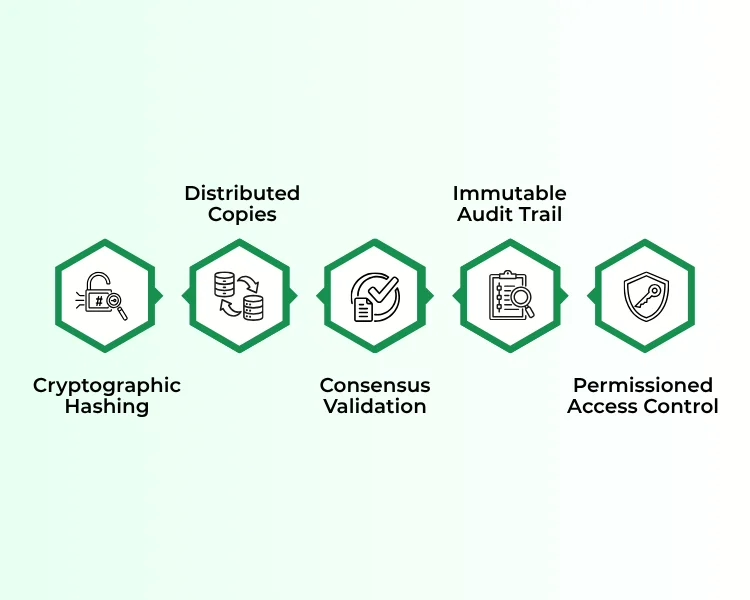
Blockchain security comes from five mechanisms working together, not from any single feature. Each one closes a gap that conventional storage leaves open, which is why blockchain in cyber security discussions tend to focus on the combination rather than the parts.
1. Cryptographic Hashing
Every block carries a hash of the block before it. Change one record and its hash changes, which breaks the link to every block that follows. The tampering does not stay hidden, because the chain itself stops adding up.
2. Distributed Copies
The ledger lives on many nodes at once. Taking down one machine, or one data center, does not take down the record. There is no single server whose compromise hands an attacker the whole dataset.
3. Consensus Validation
New entries only get written once the network agrees they are valid. A rogue participant cannot insert a fraudulent transaction on their own authority. Attacking the record means outvoting the network, which is expensive by design.
4. Immutable Audit Trail
Entries get appended, never overwritten. That gives you a permanent, ordered history of who touched what. Auditors get a source they can verify independently instead of a report someone assembled for them.
5. Permissioned Access Control
Enterprise blockchains restrict who can read and who can write, key by key. Access is enforced by cryptography rather than by an application setting somebody can change. Revoking a key removes access everywhere at once.
How Much Does Weak Data Security Actually Cost?
The number is larger than most mid-sized businesses assume. According to IBM’s Cost of a Data Breach Report 2025, the global average cost of a breach was USD 4.44 million, and organizations took an average of 241 days to identify and contain one.
Eight months of undetected access is the part that matters for this discussion. A tamper-evident ledger will not stop someone getting in, but it shortens the window where activity goes unnoticed, because unauthorized changes register immediately instead of hiding inside overwritten logs.
There is a second cost that rarely reaches the incident report. Teams spend weeks reconstructing what happened from fragmented systems. Businesses that have already moved toward automated, verifiable workflows find that reconstruction work mostly disappears, since the history was recorded correctly the first time.
Which Business Systems Gain the Most From Blockchain Cybersecurity?
Not every dataset belongs on a ledger. The strongest candidates are records that multiple parties need to trust and nobody should be able to quietly edit. Two categories cover most real deployments.
Records and Identity
- Customer consent and permission records, where proving what was agreed and when carries legal weight.
- Employee credential and certification data shared across contractors and clients.
- Medical and financial records that need an access history rather than just access limits.
Transactions and Supply Chain
- Cross-border payments where each party keeps separate books that never quite reconcile.
- Component provenance, so a recall can be traced to a batch instead of a whole production run.
- Contract milestones and payment triggers handled by smart contracts rather than email confirmations.
Is Your Business Ready to Move Sensitive Data On-Chain?
Readiness is less about technology than about knowing which records justify the change. Most projects that stall did so because the scope was set before anyone mapped the data. A short discovery phase with a blockchain development company will usually surface that faster than an internal debate, and the same applies whether you are considering a private network or building on an existing one for fintech and payment workflows.
- Map Your Sensitive Data- Identify which records carry regulatory, financial, or reputational weight. Everything else can stay where it is.
- Choose the Network Type- Public chains give maximum transparency; permissioned chains give control over participants. Business data almost always calls for the second.
- Keep Large Files Off-Chain- Store documents in encrypted storage and put only their hashes on the ledger. This keeps costs sane and keeps personal data out of an immutable record.
- Plan Key Management First- A lost private key means lost access with no recovery path. Decide on custody, backup, and rotation before you write a line of code.
- Check Your Compliance Position- Immutability sits awkwardly against the right to erasure under GDPR and similar rules. Hashes and off-chain storage are how most teams reconcile the two.
- Start With One Workflow- Pick a single process with a clear pain point and measurable outcome. Proving value on one workflow makes the next approval far easier.
Conclusion
Better data security is not really about adding more tools. It comes from changing how records prove themselves, so that verification replaces assumption and unauthorized changes become visible instead of invisible. Blockchain does that well for a specific class of data, and it is worth being honest about which data that is.
The team at EIY SYS works with businesses on exactly that assessment, from mapping which records belong on a ledger through to building and integrating the network itself. If you are weighing blockchain security solutions against another round of conventional tooling, a short conversation will tell you which one fits your situation.
Frequently Asked Questions
Blockchain data security uses a distributed, cryptographically linked ledger so that records cannot be altered without the change being detectable. It replaces trust in a single administrator with verification that any participant on the network can perform.
A normal database holds one authoritative copy that stolen admin credentials can rewrite, while a blockchain holds matching copies across many nodes that must agree before anything is written. Altering history means breaking every subsequent hash and outvoting the network at the same time.
No, and any provider claiming otherwise is overselling. Blockchain protects the integrity of stored records, but stolen credentials, phishing, and insecure applications remain real blockchain security risks that still need conventional controls.
It can, because GDPR grants a right to erasure while a blockchain is built not to erase. The standard fix is keeping personal data in encrypted off-chain storage and writing only its hash to the ledger, so the data can be deleted while the proof survives.
A single scoped workflow typically moves from discovery to a working pilot in a few months, depending on how clean the existing data is. Timelines and costs should be confirmed with the delivery team rather than estimated up front.

Jasleen Kaur
Hi, I’m Jasleen, a content writer and SEO enthusiast who loves turning ideas into engaging, reader-friendly content. I create blog posts, articles, and web copy that not only inform but also help websites rank higher on search engines. Combining st...read more