


You produce content on a regular basis, but its impact remains uncertain. Your content creation efforts become unfocused and exhausting because of the absence of a defined content strategy. The process of creating a brand with intention enables you to identify your ideal customers without needing to make random attempts.
Your content begins to generate value for you when you achieve this critical milestone. Your business will grow at a steady pace when your message matches your audience’s actual requirements. The present moment requires you to start building better systems because your ideas need to become tangible results.
Why isn’t Your Content Strategy Driving Results?
Your content does not fulfill search intent requirements. Your message shows that you prefer to write content that your audience will not find interesting. Most sites never appear in Google searches, research finds. When what you offer misses what people actually look for, fewer will see it. That gap makes clicks fade away, pulling engagement down with them.
Your performance receives hidden damage from weak topic relevance. Search engines need niche content to understand its value to users. A fitness brand that shares unrelated productivity tips creates confusion for its audience. The result leads to a decline in both trust and authority over time.
The practice of neglecting content freshness results in negative effects on ranking duration. Search engines prioritize websites that provide the most recent information. HubSpot demonstrates this concept through its practice of updating existing blog posts, which results in higher website traffic. Your search rankings will decline when you do not update your content and create strong, long-form articles in competitive markets.
Are You Posting Consistently But Seeing No Growth?
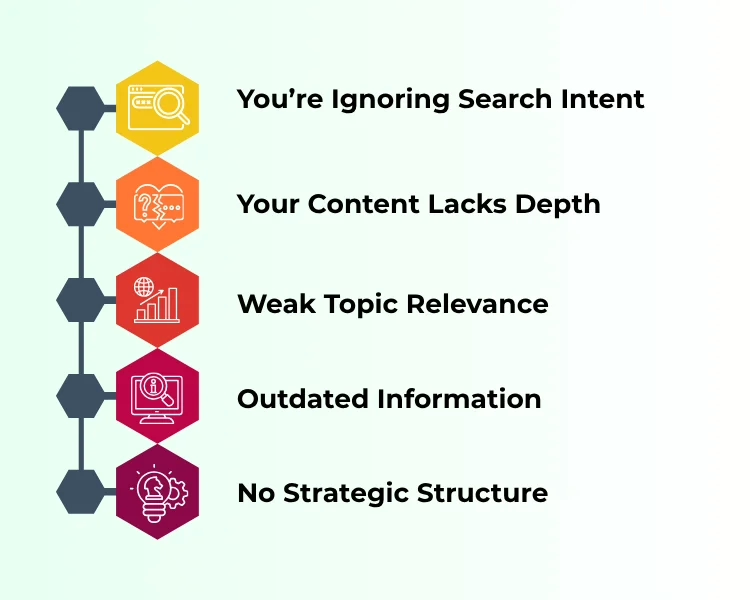
Here, consistency alone does not guarantee results. In fact, there are companies that prioritize blogging, which are 13 times more likely to see positive ROI, yet many of them still struggle because of poor search intent.
1. You’re Ignoring Search Intent
If your article answers the wrong question, readers leave quickly. For instance, someone searching for “best CRM” does not want a history lesson. Due to this gap in search intent, bounce rates increase, which leads to lower visibility.
2. Your Content Lacks Depth
Short posts rarely build authority, and long-form content tends to earn more backlinks and shares. Similarly, detailed guides hold attention longer. This improves ranking longevity.
3. Weak Topic Relevance
When posts jump between unrelated ideas, clarity suffers. Search engines tend to use topic relevance to determine a person’s expertise. The absence of this element leads to a decrease in trustworthiness. Over time, rankings drop.
4. Outdated Information
Statistics and trends change fast. Without content freshness, your blog feels old. In contrast, updated posts often regain traffic. This is why regular audits matter.
5. No Strategic Structure
Random headlines confuse readers. A clear strategy supports long-form content and improves flow. As a result, engagement increases naturally.
What Separates Strategy From Random Content?
A real strategy begins with understanding search intent. Random content focuses on quantity. Strategy focuses on purpose. For instance, brands that have established a content mapping as per the user’s journey could have shown 73% higher conversion rates. In this way, at least the planning could change everything.
Moreover, strategy protects topic relevance. Every article supports a central theme. Similarly, it also strengthens authority in one area instead of scattering efforts, and because of this focus, the search engines reward consistency.
Most importantly, the strategy prioritizes content freshness and ranking longevity. Posts are reviewed, then expanded and improved over time. In contrast, random content gets published and forgotten. Over time, strategic updates build compounding growth.
How Can Your Content Generate Real Leads?
The real question is how to turn readers into prospects. On a practical level, it requires clarity, depth, and trust. Especially when supported by long-form content, results improve significantly.
1. Align with Search Intent
- Write answers people actively search for.
- For example, create guides addressing buyer questions.
- This practice establishes trust, which helps websites maintain their search ranking over time.
2. Build Authority Through Relevance
- Maintain strong topic relevance in every piece.
- The website requires content updates, which need to occur at regular intervals.
- As a result, readers see you as a reliable source.
What Small Changes Can Boost Your Impact Fast?
Small improvements at this time lead to major changes in business operations. The method, which needs to be applied constantly, produces better results in both visibility and user interaction.
- Refresh old posts regularly- Keep updating statistics and examples for better content freshness. Thus, protects ranking longevity.
- Match every blog to search intent- Clearly define what the reader wants. Because of this clarity, engagement improves.
- Create deeper, long-form guides- Start investing in long-form content that solves real problems. In fact, longer guides often rank higher.
- Stay focused on one niche- Maintain a record of strong topic relevance across posts, and that’s how authority builds.
- Improve internal linking- Do connect related articles naturally. This supports ranking longevity and improves user flow.
Conclusion
The organization needs to establish a content strategy that focuses on search intent and provides consistent value to customers. The continuous delivery of relevant and up-to-date content results in positive outcomes for your business.
At Eiy Sys, we transform your ideas into organized content that performs well in search engines and generates customer conversions. Our team creates strategies that will produce results for our clients throughout their business operations. Connect with Eiysys today to create content that will help your business achieve specific growth targets.
Frequently Asked Questions
A content strategy is a structured plan that aligns your content with business goals and search intent. It ensures every piece you create drives measurable results instead of random traffic.
Long-form content provides depth, answers multiple user queries, and increases time on page. As a result, it improves ranking longevity and builds stronger authority.
You should review and update important posts every 3–6 months. Regular updates improve content freshness and maintain topic relevance.
Search intent ensures your content matches what users are actually looking for. When intent aligns, engagement increases and bounce rates decrease.
Yes, if it aligns with search intent, maintains topic relevance, and includes clear calls to action. Strategic content attracts qualified traffic that converts.
Typically, noticeable improvements take 3–6 months. However, with consistent optimization and content freshness, results compound over time.

Jasleen Kaur
Hi, I’m Jasleen, a content writer and SEO enthusiast who loves turning ideas into engaging, reader-friendly content. I create blog posts, articles, and web copy that not only inform but also help websites rank higher on search engines. Combining st...read more