


If you want your content to rank and genuinely establish trust, you really cannot disregard EEAT any longer. It is not just a buzzword in SEO; it is what determines if your brand will be noticed or will be buried.
The core question is quite simple: Is your content able to make people trust you and thus choose you? You need to create new content when the existing content fails to attract visitors, establish your authority, and generate measurable results.
What is EEAT?
SEO represents Experience, Expertise, Authoritativeness, and Trust. There is, indeed, proof of this as studies reveal that the first page of Google attracts more than 91% of the overall search traffic, which indicates that credibility has a direct impact on visibility.
However, here is the point. Google keeps refining its systems through regular Google algorithm updates. For example, a few niche sites shared their experiences during recent core updates, where they lost 30-50% of their traffic because of weak authority signals.
Matters of user trust cannot be emphasised enough when it comes to EEAT. One study, for example, showed that 75% of consumers determine the reliability of a business based on the quality of its website content. This is the way strong seo contributes to improved, stable rankings in the search engines over time.
How Can You Improve EEAT on Your Website?
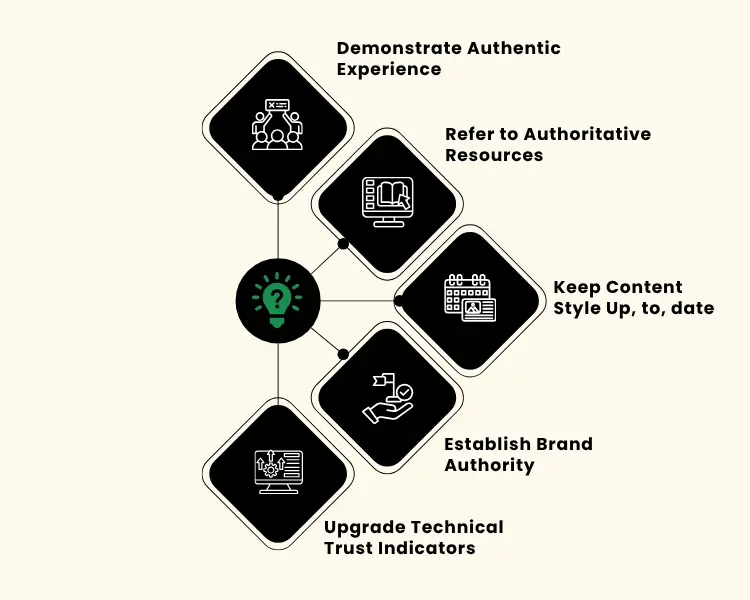
Improving EEAT in SEO is a work that needs to be carried out regularly. Basically, you need to focus your content on the main EEAT principles and be aware of the changes in the Google algorithm.
1. Demonstrate Authentic Experience
Firstly, make it a point to show the author’s credentials transparently. Besides that, add the case studies and the outcomes of the situations. For instance, the companies that publish data-driven case studies have up to 55% higher engagement rates. This is a direct advantage for the practical EEAT meaning.
2. Refer to Authoritative Resources
Besides this, verify your statements with reliable scientific sources. Actually, content including relevant statistics gets 37% more backlinks on average. One fine example of this is referencing an industry survey or government statistics. This perfectly corresponds to the EEAT principles.
3. Keep Content Style Up, to, date
Because of the frequent Google algorithm changes, outdated pages tend to lose their ranking. Refreshing old posts according to SEO metrics may bring a 106% rise in organic traffic. So, updated content naturally leads to better search engine rankings.
4. Establish Brand Authority
Besides that, get recognised by reliable sources and mention them. Likewise, guest posting works as a trust-building factor. Brands with powerful backlink profiles typically lead the pack regarding search rankings, especially after significant updates.
5. Upgrade Technical Trust Indicators
First of all, make your site HTTPS and have clear policies. Studies indicate that 84% of users quit a purchase if a website is not secure. Such technical trust elements effectively back up the core EEAT concept.
Does EEAT Directly Influence Google Rankings?
Here’s the thing. Google does not identify EEAT as one of the ranking factors directly. Still, it has a very strong impact on how the quality is evaluated. Due to that, websites that are in line with the EEAT criteria usually rank higher on search engines.
Take the example of affiliate sites with thin content that lost a lot of traffic due to recent Google algorithm changes. Some industry case studies revealed a drop in visibility of over 40%. That is why putting money into EEAT in SEO is being ahead of the competition.
Actually, Google’s quality raters are mostly guided to check the trustworthiness of information and EEAT guidelines, especially when it comes to finance and health topics. Pages having high trust signals generally see their click-through rates increase by 2030%, gradually resulting in higher rankings on search engines.
What Mistakes are Affecting Your EEAT?
Several companies have a misconception about the exact EEAT meaning. They solely concentrate on keywords and overlook the aspect of credibility. Because of the continual Google algorithm changes, such loopholes become quite dangerous. Most significantly, your search engine rankings might be compromised if you disregard the structured EEAT guidelines.
1. Anonymous or Weak Authorship
- No author bio or credentials, which reduces trust instantly.
- Generic admin posts without proof of expertise.
- No professional links or verification, which weakens EEAT in seo signals.
2. Thin or Unverified Content
- No data or references to support claims.
- Outdated information after major updates.
How Can You Measure and Strengthen EEAT?
The assessment of search engine optimization results consists of three main elements which are authority, trust, and performance assessment. The brand perception, together with user engagement, serves as a credibility indicator for the website.
The EEAT framework requires you to understand analytics and monitor Google algorithm updates to maintain your search engine rankings.
- Organic Traffic Trends- It can be an indication of weak authority if there are sudden drops after the updates. Whereas, if the traffic is stable or increasing, it indicates that there are stronger trust signals.
- Top-Notch Backlinks- Generally, web pages in the first 3 spots have quite a few more powerful backlink authorities. This, hence, helps to rank higher in the search engines.
- Engagement Metrics- If a page has a lower bounce rate, it usually means that the visitors consider it credible. Thus, the practical EEAT meaning concept is further strengthened.
- Content Audit Frequency- Refurbishing old materials may lead to more than a double increase in web traffic, especially after the changes in the algorithm.
- Author’s Reliability- Displaying achievements and certifications prominently is one way to do this. This, in turn, helps to SEO with EEAT and makes more people trust the brand over time.
Conclusion
In fact, establishing an online authority vehicle of your choice should first be a priority, not an option. The term EEAT mainly determines if your content gets trusted or simply ignored. As soon as you bring your strategy in line with the aspects of credibility, expertise, and user value, your brand will not only get higher rankings but will also have long-term influence.
At Eiy Sys, we aid businesses in transforming their strategies into tangible growth. Our team not only helps you boost your content authority but also collaborates with changes in search engine criteria, ensuring your digital presence is always one step ahead. Reach out to Eiysys today, and let’s craft something that will take your brand ahead with certainty.
Frequently Asked Questions
EEAT helps Google evaluate the credibility and quality of your content. Strong experience and authority signals increase trust, which improves long-term search visibility and stability.
Yes, but it is especially critical for health, finance, legal, and e-commerce websites. These niches require higher trust standards because inaccurate information can directly impact users.
Improvements are gradual. You may start noticing positive shifts after a core update or within a few months, depending on competition and content quality.
Absolutely. Clear author bios, authentic case studies, updated content, and transparent policies can significantly strengthen credibility without heavy investment.

Jasleen Kaur
Hi, I’m Jasleen, a content writer and SEO enthusiast who loves turning ideas into engaging, reader-friendly content. I create blog posts, articles, and web copy that not only inform but also help websites rank higher on search engines. Combining st...read more