


The search tool has changed its behaviour from how it used to be, and you probably have already seen it. One day, your content is on top of the ranking list, and the next day, there is an unexplained drop in traffic. AI SEO comes into the picture then. Nowadays, search engines take into account much more than just keywords; their main focus is intent, behaviour, and experience. Aligning your content with the modern way of search is no longer a matter of convenience; it’s a dire need if you want your content always to be seen, to remain relevant, and to be clicked on.
Reflect on your search behaviour around the engine. You phrase inquiries in complete sentences, are desperate for answers very quickly, and are only concerned with the first few results. They track clicks on links by users, the duration of users’ stays on the site, and the actual fulfilment of users’ needs by the content. If your approach is in line with this transformation, your content will not only rank but also be trusted. Trust, in this instance, is what changes visitors into leads and readers into loyal customers.
This is your chance to be ahead of the game, not to be in the process of catching up. If you switch to the new method today, the audience will find your brand exactly where they expect it to be. The longer you rely on it, the tougher it will get for you to be different. If you are determined to get more, be seen and have lasting results, then it is really necessary to take your SEO strategy through a re-evaluation process and start optimising for the future and not for the past.
How Will SEO Using AI Change the Search Patterns in 2026?
Word matching is not the most important factor in the search anymore. The main thing now is to understand the searcher’s intention. By 2026, AI in digital marketing will be able to reflect users’ actions, the context of the search, and understand patterns to predict what will be shown to that user. Some industry reports even say that more than 65% of searches now produce results based on intent rather than the matching of keywords. This is how search has evolved to be more human-like.
Thus, it is becoming a common practice that the content of the question can create a strong bond with the searcher. Taking for instance, brands that are optimising for conversational queries are experiencing up to 30% more interaction than before. Not only this, but also the search engines have started giving preference to clarity, structure, and usefulness. That’s the reason why the keyword-stuffed and long pages are getting obsolete gradually.
Ultimately, the most important factor is content is relevant. If your content corresponds with the way people search, you will automatically be ranked higher. Thus, the display of results becomes stable as there may be fewer algorithm updates in a given duration.
What are the Top Challenges That Come Up When Adapting to AI Search Optimisation?
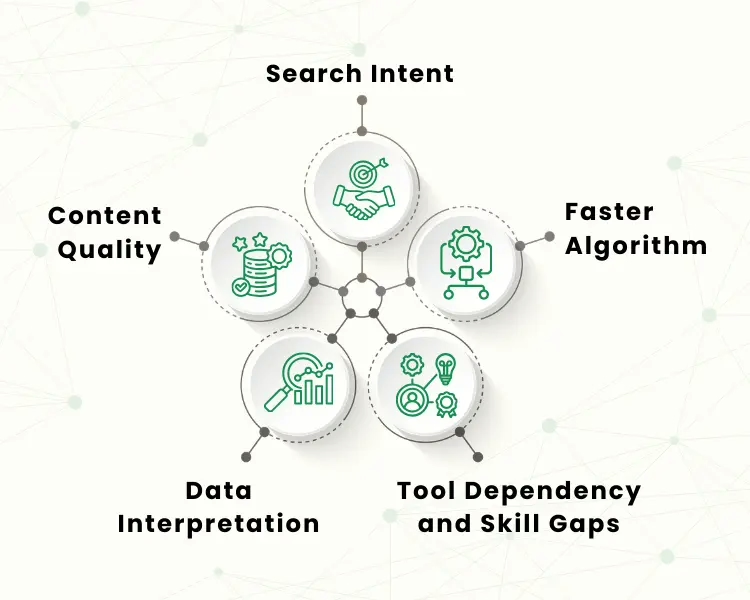
Accepting transformed search will open a new book of opportunities with a new set of challenges to overcome. The problem mostly lies in the fact that companies are not aware that the practice of AI SEO is such a different one that it will not only require some technical changes but also a complete shift in their thinking.
1. Search Intent
Presently, search engines give priority to intent rather than to keywords. If your content does not answer the real question of the user, its position drops. For example, pages written only for traffic usually fail to convert, as they do not address any issue.
2. Content Quality
Very little content is no longer to be found on the web. According to Google, content that is helpful and that comes from a person’s own experience has better retention.
3. Faster Algorithm
AI models are getting better all the time. That is why the ranking signals fluctuate at a quicker pace than ever. Brands that do not keep an eye on their performance closely may soon lose their visibility.
4. Data Interpretation
SEO data today is not just about the number of impressions and clicks. Behavioural signals are becoming the most important factor. That is why the analysis is powerful as well as hard.
5. Tool Dependency and Skill Gaps
The majority of the teams are using AI SEO tools without knowing them well. Even though the tools are more in control of these matters, a lot of the decision-making is of human nature.
How Does SEO Improve the Traffic, Leads, And Conversions of the Search?
AI-powered search is concerned with behaviour and not with assumptions. Brands that adopt ai driven search strategies experience up to 35% qualified traffic growth in just six months. This is due tothe content being more in line with user requirements.
For instance, online shopping websites that implement predictive content suggestions witness more time spent on the site. Not to mention, personalised search results boost conversion rates. AI-assisted methods bring in users who are almost ready to buy, as opposed to traditional SEO methods.
Aside from that, the quality of leads increases as well. When the search results align with the intent, bounce rates go down. Thus, while the number of visitors is shrinking on one side, the results are more probably the good ones on the other side.
In What Ways do AI SEO Affect Search Content Ranking?
The evaluation now revolves around the user experience and AI impact on SEO. Through user behavior and Artificial Intelligence developments, SEO metrics have evolved. This, in turn, is altering the design and ranking criteria of search engines. According to Google, the more engaging the content, the higher the chance of being on the first page, with a likelihood of 40%.
To illustrate, there are two articles with the same focus. One gives a straightforward answer, and the other one does not. Actually, every modern search engine audits and assigns SEO page indexes to rate them on diverse key metrics like referrals.
To begin with, everything must be consistent. The more a page performs its role, the more it gains power in the aspect of authority. The rankings did not change at all. The rankings of the last two computations stayed the same.
The Right SEO Strategy Businesses Should Adopt for the Future
The very first part of the game already gives you a better chance. Understanding how AI will impact SEO will allow you to build up long-term strategies instead of short-term tactics that are soon gone. To start with:
- Concentrate on real user questions- First of all, see what the users are really asking. Trust is built up eventually when content centred around intent does well.
- Make content clearer and deeper- When the content is well-structured, it will take longer for the users to lose interest. This is how the search engines detect high quality.
- Keep a close watch on behavioural metrics- From a practical perspective, track the time spent on the page and engagement. These signals have a direct impact on the rankings.
- Utilise AI tools sensibly, not automatically- The tools provide support for the decisions, but the strategy still needs the input of a human. Find a middle ground between automation and the use of discretion.
- Content should be updated regularly- The content that is updated with new information will remain relevant in the long run. This will result in better visibility and continuous growth.
Conclusion
The future of search is no longer a riddle but has more or less come out of the shell. AI SEO has made it clear how brands keep their positioning, relevance, and rivalry in an experience and intention-dominated environment. The first question to ask is whether your content is helpful to the real users and not if you are resorting to old techniques. Coming in early means not only retaining your positions but also getting, in the long run, growth, engagement, and impact that can be measured in your business.
Eiy Sys is there to help businesses interpret the changing search behaviour into performance-driven outcomes. If you want to secure your digital presence for the future and be the first one to adapt to the constant algorithm changes, then the time to take action is now. Let’s design a search strategy that is in tune with where search is going, rather than with where it’s been. Get in touch today and let your visibility be transformed into real growth.
Frequently Asked Questions
Yes, absolutely. AI-driven optimisation helps businesses of all sizes understand user intent better and compete more effectively. In fact, small brands using AI-led strategies often see faster improvements in engagement and lead quality compared to traditional methods.
Not entirely. Core SEO fundamentals still matter, but AI enhances them. It improves how content is analysed, ranked, and personalised, making traditional practices more effective rather than irrelevant.
Results vary, but many businesses notice improvements in engagement and visibility within three to six months. Because AI focuses on behaviour and intent, the growth tends to be more stable over time.
Not necessarily. While understanding the basics helps, working with experienced professionals makes the process smoother. With the right guidance, businesses can adopt AI-driven SEO without managing complex technical details themselves.

Jasleen Kaur
Hi, I’m Jasleen, a content writer and SEO enthusiast who loves turning ideas into engaging, reader-friendly content. I create blog posts, articles, and web copy that not only inform but also help websites rank higher on search engines. Combining st...read more