



The very first thing that comes to mind when it comes to websites is that they should provide the information instantly. However, that might not always be the case, where people see nothing but a blank screen and are left waiting. It can definitely be very annoying! Well, that exact moment is what the Core Web Vitals are trying to capture. They measure the user experience through the website’s real users rather than by the speed it claims. Experience is no longer an option in today’s search environment; it has become the first impression.
In fact, it is only a matter of seconds for the visitors to decide if your website is going to be their place or not. On the other hand, if the pages are loading without any issues and the users are having a smooth experience, then they are likely to stick around longer, check out more areas, and even have a positive image of the brand. The latter is also the time when search engines grant you a better position. In fact, performance optimisation is not about targeting technical scores; it is about being the user-friendly digital business partner that the users want and keeping their engagement from the very first click.
If a user wants the website to be perceived as fast, stable, and trustworthy regardless of the device or connection, then the time to act is now. The performance expectations are becoming more stringent, while waiting only puts one further behind. Start off with the focus on the true user experience, plus you’ll not only get a better ranking but also a website that helps your business more.
Why are Core Web Vitals Becoming More Critical for Rankings in 2026?
Search engines have certainly raised their standards and are no longer happy with just pretty pages. What they do now is measure the actual behavior of your site when real users interact with it. core web vitals seo has become the main reason why Google is rewarding sites that are fast, stable, and responsive. In the eyes of a user, a site that is quick to load is a trustworthy one, and a slow site, on the other hand, is a suspect one.
This change of perception has caused a shift in the rankings, which now heavily rely on user behavior signals. For instance, Google’s research indicates that pages that load within 2.5 seconds have bounce rates up to 24% lower than those that are slower. In other words, increased engagement equals higher rankings. In fact, performance is no longer purely just a technical thing-it has emerged as an explicit cause for concern in all ranking factors.
In the case of performance, it is no longer a question of the already dense market but rather a distinct selling point. The early bird catches the worm: the first portal that puts money into speed will be assured to occupy a top place, while the others are just left waiting. That is the reason why these actions are going to be, in 2026, even more paramount than they are now.
What New Performance Metrics are Replacing Traditional Core Web Vitals?
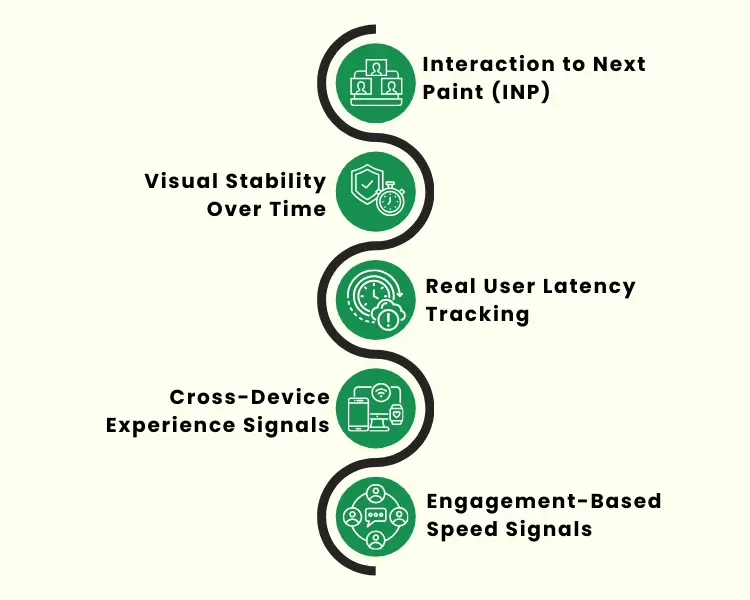
At the beginning stage, Google is not going to get rid of the experience factor, but gradually, it is going to refine the way it evaluates. Core Web Vitals are still very much at the heart of it, but newer signals are relating more to interaction quality, diversity of devices, and perceived speed. What is really fundamental is not only the speed of your site as measured, but also how fast it feels.
1. Interaction to Next Paint (INP)
INP is the measurement of a site’s response speed after a user clicks or taps. For example, an eCommerce “Add to Cart” button needs to respond without any delay. Industry studies suggest that a delay of over 200 milliseconds can result in a decrease in conversion rates of as much as 7%.
2. Visual Stability Over Time
It assesses the performance stability during long sessions, in contrast to one-time layout checks. This is especially true for news websites where ads come in later. Sudden shifts in position give rise to frustrations among readers and loss of trust.
3. Real User Latency Tracking
This is the real-world viewpoint. Users who have network connections with low speed see delays that are not detected by lab tests. Hence, Google considers field data more important than simulations.
4. Cross-Device Experience Signals
Performance is currently dependent on the device. Mobile users are exposed to slower CPUs, unlike desktop-first websites. The measurement of this difference helps keep the rankings just.
5. Engagement-Based Speed Signals
Additionally, the duration of interaction is vital. If users are scrolling and clicking smoothly, that’s a positive signal. This is the combination of employee engagement and performance.
How do Core Web Vitals Directly Influence User Experience and Conversions?
The principal argument is that the pace of the website is a vital element in the user’s emotional response. If the website’s pages get instant loading, then the users will feel that they have control over the site. The Google Core Web Vitals are an important part of the process, as they set the perception up by their criteria of loading, providing responsiveness, and being stable. There is no doubt that the smoother the flow, the more users the site will have, particularly during checkout or sign-up, when users are more easily put off.
To illustrate this point, Amazon has once revealed that sales dropped by 1% for every 100ms delay. A slow-loading product page, for example, can easily be the reason why thousands of dollars are lost in sales. On the other hand, a form that is not responding after the user clicks “Submit” creates doubt and leads to user abandonment.
These little delays add up over time. Moreover, the users will keep their frustrations in mind forever, and not the design of the site. Hence, the performance optimization brings about increased conversions, improved retention, and greater trust in the brand.
How SEO Value of a Site Gets Affected With Failed Core Web Vitals Benchmarks?
It remains that the most important thing is the fact that not passing the benchmarks does not automatically lead to penalties, but it definitely makes the position less competitive. Your pages could slip down the rankings in relation to the more rapid rivals, especially in searches with high intent, hence the experience is now playing the role of a tie-breaker in the ranking.
Google’s research is a good example, as it states that 53% of mobile users will quit the site if it takes more than 3 seconds to load. Search engines categorize slow sites as less helpful because of such user behavior, and this, in turn, results in a gradual loss of visibility.
After a while, it becomes quite difficult to bounce back. Conversely, sites that do not have performance dips keep on getting the same amount of traffic. If one chooses to disregard the signals, then it is literally losing cork by piece, overnight.
Optimisation: Core Web Vitals for Your Site
Optimisation on a practical level does not mean starting from scratch. Improvements made to seo core web vitals are usually the result of minor changes, which are occasionally done with the aim of a quick win.
- Compress and optimise images- Images with large sizes considerably slow down pages. For instance, the new formats like WebP can cut image size by 30-40% and thus faster loading will follow.
- Reduce unused JavaScript- Extra scripts are the cause of delayed interactions. Deleting the unused code causes responsiveness to improve, more so on mobile devices.
- Improve server response times- A quicker hosting setup is a way to eliminate the delays at the beginning. That’s how you increase the perceived speed instantly.
- Stabilise layout elements- Mark the space where the ads and the media will be. This ensures that no sudden shifts that are annoying for users will occur.
- Prioritise above-the-fold content- Initially, load the content that is visible. This gives the impression of speed, even if the loading of background assets is done later.
- Monitor real user data regularly- Search Console is one of the tools that can help you see the real-life issues. Intervening at the right time will avoid ranking drops later.
Conclusion
In the end, the Core Web Vitals have turned into the indicators of the user experience on your website at all the moments that they come in contact with it. If your website gives a fast, responsive, and smooth navigation feeling to the users, they will not only stay for a longer time but also get more involved. Gradually, the trust and loyalty that the users will have towards your brand will be due to the consistent experience. It is very evident that the performance factor has silently become the key factor that distinguishes the winning brands from their rivals.
At Eiy Sys, we assist companies in converting their performance into quantifiable growth through intelligent, user-centered optimization. If you want your website to not only load faster and rank higher but also forge a deep connection with your audience, then the time is right to act. Contact our team today and commence the building of a digital experience that your users will not forget.
Frequently Asked Questions
Core Web Vitals are a set of performance metrics introduced by Google to measure how users experience a website. They focus on loading speed, interactivity, and visual stability. Simply put, they help you understand whether your site feels fast and smooth to real visitors.
These metrics influence how search engines rank pages with similar relevance. When your site delivers a better experience, users stay longer and engage more. As a result, search engines see your content as more valuable and trustworthy.
You can improve them by optimising images, reducing unnecessary scripts, and improving server response times. Small changes like stabilising layouts and prioritising visible content often lead to noticeable improvements. Over time, consistent monitoring helps maintain performance.
Start with user-focused fixes rather than deep code changes. Tools like Google Search Console highlight key issues clearly. On a practical level, fixing what users see and feel first delivers faster results with less effort.

Jasleen Kaur
Hi, I’m Jasleen, a content writer and SEO enthusiast who loves turning ideas into engaging, reader-friendly content. I create blog posts, articles, and web copy that not only inform but also help websites rank higher on search engines. Combining st...read more