


The majority of companies apply the keyword method, but the real battle has moved to a different front. Nowadays, the start of online visibility through search engine rankings lies in the power of Search Intent Optimisation. The users are not only putting questions in the search box – they are in search of particular answers, results, and even experiences. If your material is up to that standard, you will get higher positions as well as more trust.
Just reflect on your searching habits for a moment. At times you just need a quick fact, at other times a complete manual, and sometimes you would like to do a comparison before you buy. Your audience is the same, and they give their rewards to those pages that are the quickest in helping them, not to the keyword-oriented ones.
That’s the reason why modern SEO is not about estimating what people want. It’s all about understanding the searchers’ intentions and making the content feel helpful right from the first line. When your blog, landing page, or product description corresponds to what users hope to see, you will effortlessly be ahead, no matter how fierce the competition is in the market.
What Makes Search Intent the Real Driver of Today’s SEO Results?
Search behaviour has changed, and algorithms are now more focused on understanding the user’s needs rather than just on the words they use. The transformation has made intent-based search optimisation the reason behind the search the main aspect in deciding which pages would be visible. The content that is in line with the expectations gets longer engagement, higher relevance, and more trust signals.
In addition, search engines also look at how a page fits a need in a very good way. In this regard, the quality, design, and how soon the answer appears on the monitor are taken into consideration. When the content is in accordance with the user’s intention, it will eventually take over the keyword or the old ranking methods’ reliant pages.
With the competition becoming tougher, the intent is the factor that will either put a page in the ranking list or ignore it. Companies that do user analysis in terms of the goals, difficulties, and motivations are the ones that provide the most useful experiences. This generates a pattern of positive interactions that is consistent and helps to build the brand’s authority and maintain its organic performance in the long run.
How Does Intent Alignment Strengthen Content Performance Across Segments?
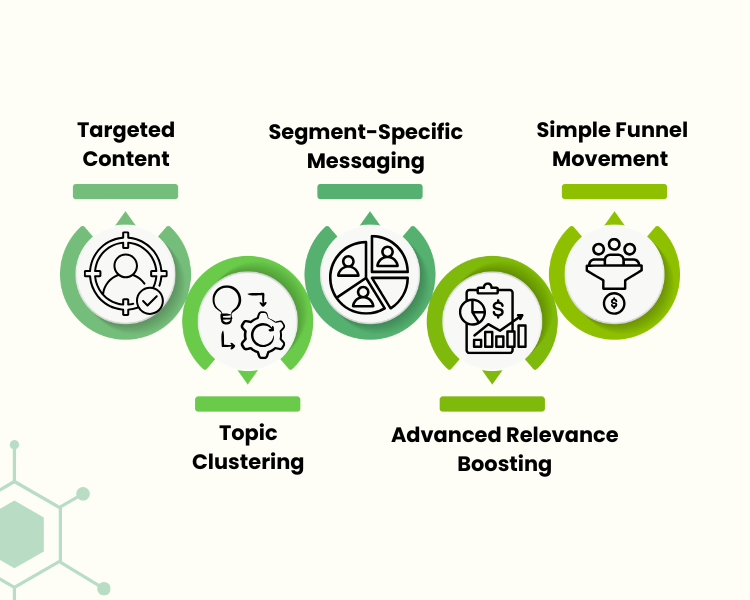
Whenever user motivations are clear, they will get quicker answers, longer engagement, and smoother conversion. The process of Search Intent Optimisation helps the teams to see the expectations of the audiences at all levels, and it also helps in forming the messages that directly speak to those expectations.
1. Targeted Content
The content gets a better response when it is created based on the real problems of the users. This transparency keeps the messages focused and relevant even in different industries. It also promotes the use of a structure that facilitates quick reading and easy navigation.
2. Topic Clustering
Intent alignment helps in creating the clusters that cover wide themes, but at the same time, they do not lose their depth. Each of the supporting pages adds to the main topic, thereby upgrading the authority of the topic. This results in a natural flow of the pages, which is beneficial for both discovery and retention.
3. Segment-Specific Messaging
Different audience segments very often expect different answers. Intent-driven alignment helps in changing the tone, depth, and examples for each segment. Thus, the personalisation of experiences is achieved without making the production complicated.
4. Simple Funnel Movement
When content is prepared for questions at every stage, the users pass through the funnel with less resistance. This leads to a decrease in drop-offs and helps to maintain a stronger engagement. The method also allows for the creation of CTAs that are not imposed but rather feel like an integral part of the process.
5. Advanced Relevance Boosting
Segmentation gets more precise as behaviour signals dictate the planning process. The pages are aligned with the actual user journeys, not the assumptions. This, in turn, lays the groundwork for the development that is scaling up the search optimisation by intent-based means.
Why is User Motivation Essential for Modern Ranking Success?
The successful implementation of Modern SEO techniques relies on identifying the purpose of a search. Users want the page to be clear, quick, and pertinent from the first line, and therefore, the page that gives this kind of experience will surely be among those that users have turned to. With the help of tools like AI search optimisation intent analysis systems, it becomes possible to easily uncover those motivations and apply them at a large scale.
In addition to that, the knowledge of user motivation also affects the way content is arranged. Teams that understand the users’ wants will not only get rid of unnecessary details but also concentrate on the insights that have the most immediate impact. This results in pages becoming shorter, more informative, and in line with what users really expect.
In the end, content driven by motivation lasts longer in the performance fight. Users always go back to the sources that are, in reality, familiar with their problems. This gradually builds authority, and in return, the website gets the chance to remain visible even when the algorithms change and competition becomes tougher.
What Factors Turn Intent-Focused Content Into High-Conversion Assets?
High conversion content is all about clarity at first. The pages that quickly prove their worth are usually the ones that have the strongest impact on people’s choices. Therefore, comprehending the Role of Search Intent in Content Optimisation USA has become crucial for teams in fierce competition.
Moreover, when content is aligned with the user’s journey stage, conversion rates go up. Users asking for educational help will be given simple explanations, while users making inquiries about the purchase will be offered solutions, comparisons, and assistance. This well-planned structure creates an impression of a smooth transition and minimises the resistance.
Content based on intent is also more successful since it fosters trust. Users feel that they are cared for when the page guesses their worries or answers their questions even before they come up. This emotional connection is very often a decisive factor in determining the final actions.
What Powers an Effective, Future-Ready SEO Framework in 2025?
The roadmap leading to a strong framework for 2025 is indeed laid down by user motives grasping, turning them into distinct formats of content and the customers receiving value at every stage of the process.
Such a technique not only keeps the companies aligned with the changing needs of the customers but also gives a practical application of the Keywords search intent optimisation during the entire process.
- Clear classification of search behaviours- Categorising the queries into informational, navigational, commercial, and transactional helps to see the content planning very precisely. It also brings more accuracy to the content of different pages.
- User-journey mapping for better structure- If the content is designed according to the different steps of the decision-making process, it will be easier for the user to navigate through it. This will keep the user engaged and also lower the bounce rate.
- Insight-driven content refinement- The updates are backed by the behaviour data, and therefore, they are aligned with the real user actions. This ensures that the framework remains relevant even when there are changes in the trends.
- Consistent evaluation of content gaps- Taking inventory of what people are still searching for is a way to suggest new sections or pages more easily. This, in turn, leads to a more solidified topic authority.
Conclusion
As search habits change, matching content to the actual user motives is already, and still will be, the core of effective SEO. Search Intent Optimisation guarantees that every page responds to the correct question, provides useful value, and the user is assisted at precisely the moment that he or she needs it. When the content shows up with unarguable intent, it, in turn, acquires stronger visibility, better engagement, and more conversions at all digital touchpoints.
At Eiy Sys, we integrate strategic insight, data-driven thinking, and practical execution to support brands in the development of an SEO ecosystem that will always be in line with users. expectations. Our main objective is to create content frameworks that are unambiguous, scalable, with the actual search trends, thus enabling each project to guarantee measurable results and long-lasting organic growth.
Frequently Asked Questions
The goal is to ensure that every piece of content matches what the audience expects to find. When information is relevant and helpful, it leads to higher engagement and stronger trust.
It improves navigation, increases time spent on pages, and reduces bounce rates. Content becomes easier to explore, making users more likely to move deeper into the site.
Positive signals include longer reading sessions, lower exit rates, and higher completion of desired actions. These behaviours show that the content is answering the right questions.
Behaviour patterns reveal what the audience values most. This insight helps refine existing pages, create better structures, and guide future content decisions for sustained growth.

Jasleen Kaur
Hi, I’m Jasleen, a content writer and SEO enthusiast who loves turning ideas into engaging, reader-friendly content. I create blog posts, articles, and web copy that not only inform but also help websites rank higher on search engines. Combining st...read more