


The evolution of search engines and their corresponding business content optimisation strategies has been drastic over the past few years. The need for trust and visibility is no longer met solely by means of traditional keyword strategies. In other words, entity-based SEO has come forward to rescue the brands from getting lost and to give them the clarity of context and authority in a digital space that is already crowded.
To put it simply, Google nowadays is not merely matching the words of your pages. It is rather attempting to grasp the very meaning of your content, how it relates to the already known ideas, and whether it can safely refer to your page as the correct answer. This transition has significant implications, such as putting increased importance on relationships, consistency, and clearly defined information.
For your content to be in the ranking of the year 2026 and the years to come, the keyword mindset is not sufficient anymore. You have to think of how the search engines view your brand, how they interpret your topics, and how they credit your expertise. The change of mindset will not only result in better rankings but also help in building long-term credibility with the search algorithms and the human audience alike.
What Builds a Strong and Recognizable Entity Presence in Search Ecosystem?
The search engines are no longer dependent solely on query and keyword matches. They have made a big leap and now attempt to get the meaning, the context, and the relationships that exist among the topics. This change compels marketers to prioritise the concepts of clarity, consistency, and relevance as opposed to content that bears the same phrases throughout. Thus, contemporary strategies are now requiring the deepest possible alignment between information and intent.
The transition is mainly centred around the entity-based SEO, which helps search engines to identify the subjects with more accuracy. When the content clearly identifies and links the entities, then the algorithms find it easier to deduce the topic and the intent. This methodical drawing supports improved visibility because it is in line with the way that real knowledge is organised.
Furthermore, the semantic understanding not only identifies the brands that are selling fact-based content but also identifies the brands that are producing such content. The reliance of the content on keywords gradually declines, and reliance on the demonstration of expertise and contextual depth increases. This results in a more trustworthy digital footprint being created, which is beneficial for both search engines and readers alike.
The Core Elements That Build a Recognizable and Trusted Entity Online
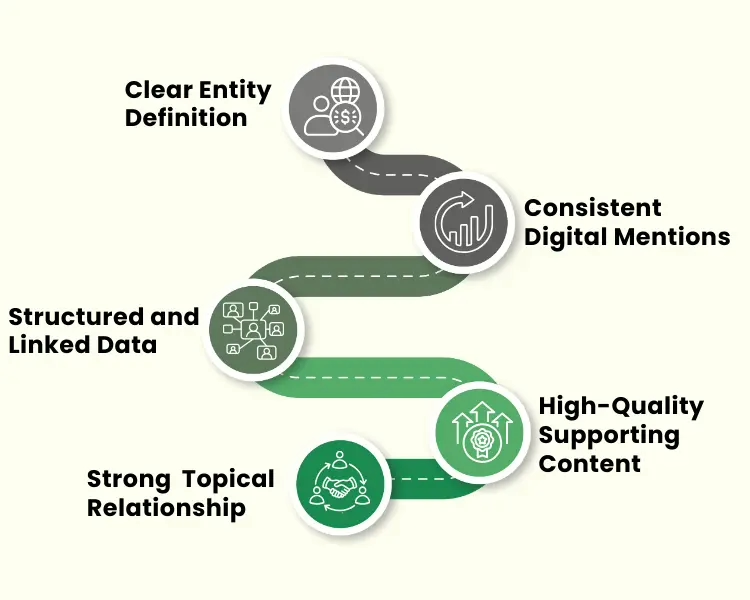
The presence of a strong entity begins with a well-defined entity. It includes the truthfulness of the data, the uniformity of the references, and the context that is synchronized across all media.
After this foundation is set, search engines can straightforwardly understand what is entity-based SEO and use the same logic for other entities. This, in effect, results in a stronger and more trusted position in the SERPs.
1. Clear Entity Definition
A clear and confirmable definition facilitates the understanding of the entity’s nature and purpose by the search engines. This covers precise descriptions, categories, and characteristics that correspond to the way the topic is identified throughout the Internet.
2. Consistent Digital Mentions
The strength of an entity is increased when it is uniformly represented on different websites, listings, and knowledge sources. These mentions not only support the credibility of the entity but also link it to the broader semantic networks that are used by search engines.
3. Structured and Linked Data
Schema markup is a critical factor in allowing algorithms to read and classify information accurately. It structures the content, sets the connections straight, and ties the people and things involved to the right data in the search world.
4. High-Quality Supporting Content
The content that provides information, expands, and connects the entity with other concepts is strengthening the topical authority deeper. This indicates the significance of the entity and thereby facilitates its mapping in knowledge graphs.
5. Strong Topical Relationships
Entity-based SEO with clear internal and external relationships is considered more relevant. If the relationships are backed up by trustworthy content, search engines will be able to place the entity in the correct position within the larger conversations with certainty.
In What Ways Do Strong Entities Give Brands a Competitive Edge in Search?
When the content is consistent with the concepts, categories, and relationships acknowledged by the search engines, the topical authority gets a boost. Entities serve as a bridge that reveals the connections between the subjects. Also, they introduce a format of the information that is extremely clear to the algorithms interpreting it, especially in the case of the competitive areas, where clarity is vital.
Entities in the content help to make a distinction between surface-level information and deep expertise. When the content frequently refers to and elaborates on the acknowledged entities, it means that the author has a better understanding of the topic. This not only improves trust signals but also opens up the possibility of being seen in a wide range of related searches.
Through the connotation of entity-based SEO optimisation, the companies can declare their presence in a specific topic cluster. This strategy creates a solid framework that connects the content pieces together, allowing the internal relevance to be enhanced and the chance of getting indexed for the wider topic variations to be increased.
The Impact of Structured Data and Knowledge Graphs on Search Precision
Structured data provides a search engine with a method that is clear-cut method and a way to read and comprehend the information at once. It alters the content into a type that can be operated by the algorithms without any uncertainty. The elimination of misunderstanding and the provision of the precise context for the differentiation between topics, entities, and relationships are the causes of the resulting higher accuracy.
Knowledge graphs facilitate understanding by linking authorized data points over the internet. They collect the facts, the references, and the relations that the search engines use to determine connections between the information. If the content conforms to these graphs, it becomes much easier for the system to fetch and present the correct results.
In their turn, the combination of both factors is deemed to have a positive effect on seo ranking factors 2026 by providing the three benefits already mentioned: clarity, relevance, and discoverability. This accompanying structure is such that search engines will always render the most trustworthy and accurate information to users.
How Do Entities Build Clear and Consistent Signals Across the Web?
The strength of an entity’s signals relies on their precision, visibility, and consensus among different media. Adhering to seo best practices 2026 guarantees that entities will remain understandable, reliable, and closely linked to one another in the semantic search.
- Name the entities the same way at all places- A single identity makes it easier for the search engines to identify the entity correctly and not to mix up its interpretations.
- Apply schema markup to organize the important data- Structured data makes the significant characteristics of the page clear and, at the same time, makes it easier for the search engines to understand the page.
- Create and publish content- Each content piece should not only add to the topic’s breadth but also point to the related concepts.
- Listings and external references- The presence of third-party sources increases the entity’s credibility and recognition.
- Create internal links- These clusters not only illustrate the significance of the topics but also facilitate the development of more powerful semantic ties.
- Revise and update any old or incorrect information- Having clean and up-to-date details improves the trustworthiness and increases the entity’s online presence.
The Road Ahead: Stronger Entities, Smarter Visibility
The search landscape is changing, and thus brands can’t depend just on the old keyword tactics anymore. Entity-based SEO offers a better path: when the search engines recognize and know the connections and facts surrounding a piece of content, then they are able to present the information with great accuracy.
At Eiy Sys, we think and act in every project. We create both the content and technical frameworks that help the entities’ signals and the domain authority rise. We do this by concentrating on the measurable advancements in search performance, which, in turn, helps our clients to be in compliance with the current search standards and to realize the potential of their long-term digital growth.
Frequently Asked Questions
Modern search focuses more on understanding meaning, context, and relationships rather than matching repeated words. This shift helps search engines deliver results that are more accurate and relevant to real user intent.
When search engines clearly understand what a topic represents, they can connect it to related concepts and display it across a wider range of queries. This leads to stronger visibility and better alignment with user expectations.
Consistency builds trust. When the same information appears across websites, listings, and profiles, search engines can confidently verify it. This increases credibility and supports stronger recognition online.
Structured elements give search engines a clear, machine-readable format to interpret. They highlight important details, reduce confusion, and ensure the information is understood exactly as intended.

Jasleen Kaur
Hi, I’m Jasleen, a content writer and SEO enthusiast who loves turning ideas into engaging, reader-friendly content. I create blog posts, articles, and web copy that not only inform but also help websites rank higher on search engines. Combining st...read more