


If you have ever attempted to scale your business across several areas, you already know that it is not just a matter of increasing your ads or publishing more content. The real problem is to become and to remain important in every single place you go, without your CRM being overwhelmed or your customer data being confused. That’s where having a good local SEO strategy makes a big difference, helping you to be exactly where your customers are searching.
However, the twist is that going global does not mean going generic. As brands expand, they very often find it difficult to keep their messaging, targeting, and customer experiences consistent throughout the regions. Without a structured approach, your CRM can very quickly become a complete mess of scattered leads, duplicate entries, and disconnected conversations.
This blog illustrates how businesses can conquer the whole world market while staying laser-focused on each local market. You will learn everything from aligning localised search efforts with global campaigns to keeping your CRM efficient and hassle-free; you will also learn how to set up a system that grows mighty but does not lose the customer-friendly touch that is expected.
Why Does Local SEO Strategy Still Outperform for Ready-to-Buy Users?
In such cases, users will be very close to making a purchase and usually reduce their search to solutions that are near and immediate options. This is the reason why local results that include maps, directions, and nearby listings attract those users with the highest intent who are already making comparisons among certain businesses. The very moment a customer is about to take action, they go for the option that feels the most accessible, most familiar, and fastest.
At the same time, local search engine optimisation is totally in sync with these high-intent behaviours. It seizes the demand as it comes by turning the businesses up in front of the users at the very moment they are searching for “near me” solutions. This scenario gives the brands an advantage that the broad SEO might not always be able to match because the user’s decision-making time is so very short.
Above and beyond, local signals such as reviews, accurate business information, and location relevance serve to build instant trust, which is something ready-to-buy customers are seeking before taking the final step. The combination of these factors makes local search engine optimisation the strongest performer when it comes to quick conversions and store-ready traffic.
What Makes a Global SEO Strategy Essential for Scaling in 2026?
A unified approach to SEO becomes inevitable as brands go global and digital, hence the considerable need for visibility, consistency, and performance. In this regard, while a local SEO strategy guarantees the relevance of the region, the global SEO structure, on the other hand, controls the brand message and markets without losing search authority.
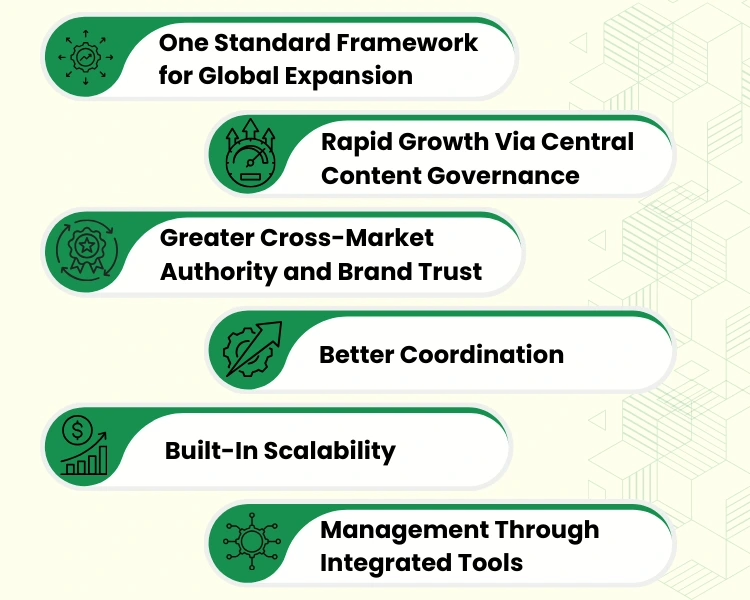
1. One Standard Framework for Global Expansion
Adoption of a global approach provides businesses with a definitive plan for the new markets without having to change their workflows. It also guarantees the consistency of content, metadata, and technical aspects across all regions.
2. Rapid Growth Via Central Content Governance
Centralised rules allow teams not only to avoid duplicating efforts but also to keep communication uniform among different languages and regions.
3. Greater Cross-Market Authority and Brand Trust
Unifying the SEO structure helps link equity, domain trust, and brand authority to be distributed across various regional sites.
4. Better Coordination
Global SEO offers a normalised arrangement where paid search, content, and local teams can synchronise their tactics for the highest possible ROI.
5. Built-In Scalability
The companies that have adopted scalable marketing strategies can easily adjust to the new search habits, AI-driven algorithms, and the new market opportunities at the quickest pace.
6. Management Through Integrated Tools
To manage multi-market SEO, modern businesses need a unified dashboard, analytics systems, and collaboration tools. The global approach captures monitoring, reporting, and optimisation in one place, thereby making it simple to see the performance going on live.
How Do Top Brands Balance Global Reach with Local Search Optimisation?
The leading brands recognise that local relevance is a necessity for global expansion. A global seo strategy might be the foundation of brand visibility in various countries, but the main impact occurs when the content in those regions is altered according to the cultural nuance, language patterns, and local desire.
The top brands are creating crossbred SEO ecosystems where global teams are in charge of the framework and technical uniformity, while the local teams are busy writing customised content, tracking market trends, and conducting competitor analysis. This technique yields efficiency and authenticity at the same time, which happen to be the two strongest drivers of search performance.
By uniting global authority with very local relevance, the brands are delivering customer experiences that are both the same and trustworthy. This is the equilibrium that finally brings about higher search rankings, increased conversions, and greater brand loyalty across different audience segments.
Which Scalable Marketing Strategies Actually Drive Multi-Market Growth?
Entering various markets isn’t just about running big campaigns; it is also about having the capabilities to rapidly replicate success. Here, global search engine optimisation is the backbone since it guarantees that every location will have the same visibility and content structures, which are optimised.
Successful brands apply a combination of automation, central governance, and localised storytelling in order to get the most influence. By doing this, the friction in operations is reduced, and at the same time, the quality and relevance that users expect in their location are preserved.
Through unified analytics, collaboration across markets, and a model of execution that can be repeated, companies can penetrate new areas with more speed and confidence. This, in turn, leads to a significant increase in sales and the brand being positioned as a strong competitor in the global markets.
How Does CRM Integration Keep Global Local SEO Efficient and Aligned?
The cooperation of CRM systems with SEO workflows gives a brand a complete and detailed understanding of the customer behaviour distributed all over the world.
At this point, the integration of crm marketing becomes the point where campaigns are kept aligned, personalised, and performance-driven.
- Unified customer profiles: Edits the access of both global and local teams to precise information and minimizes the increase of data a lot, hence maintaining communication throughout.
- Better segmentation: Makes it possible to draw customer lines in accordance with the geographical area and customers’ behaviour, preferences, and stage in the sales funnel.
- Real-time insights: The teams make quick changes to the campaigns in response to the changing trends in search and the customer’s interactions.
- Smoother automation: Lessens the manual nature of the work done and automatically synchronises the emails, ads, and localised content.
- Improved lead quality: Guarantees that the high-intent, well-categorised leads are supplied to each region.
- Stronger campaign ROI: SEO results are compared with the actual customers’ actions, which in turn enhances the quality of decisions made.
Conclusion
In a scenario where consumer demands change every moment, companies cannot just rely on being visible; they have to be notable, accurate, and uniform in every area where they operate. By associating worldwide frameworks with a systemised local seo strategy, companies can uphold their power while still interacting with consumers in significant, very-targeted ways.
The combination of the right strategy, tools, and execution supports businesses to expand into new markets with confidence while keeping their operations quick and future-ready. If you’re looking to scale your global presence without losing your local impact, Eiy Sys can lead the way. With industry expertise and technology-driven solutions, we can help you grow smarter, faster, and stronger.
Frequently Asked Questions
Businesses are typically ready when they’ve achieved stable performance in their primary market, have consistent demand from other regions, and possess the operational capacity to manage localised content, analytics, and customer interactions across different locations.
The biggest challenge is maintaining consistency while adapting to regional differences. Many companies struggle to balance standardised frameworks with the need for personalised content, local cultural understanding, and market-specific optimisation.
Brands can ensure this by using proper site structures, implementing multilingual content, and maintaining accurate regional information. Regular testing, localised user research, and strong collaboration between global and local teams also play a crucial role.
Aligned customer data helps teams understand behaviour patterns clearly and avoid fragmented insights. When data flows smoothly across regions, brands can deliver more relevant experiences and track performance more accurately.

Jasleen Kaur
Hi, I’m Jasleen, a content writer and SEO enthusiast who loves turning ideas into engaging, reader-friendly content. I create blog posts, articles, and web copy that not only inform but also help websites rank higher on search engines. Combining st...read more