
Although minimum viable product (MVP) is quite popular on the market, no one is immune to mistakes. When you are planning to build an MVP, various MVP development mistakes may arise at various stages of development, impairing further development.
An MVP allows business owners to validate their ideas quickly and cost-effectively, providing essential insights into market needs and user preferences. However, developing an MVP is fraught with setbacks that can derail even the most opportune projects.
This blog highlights some major MVP development mistakes and provides strategies to avoid them, helping business owners, entrepreneurs, and organisations navigate the complexities of MVP development successfully.
What Are the Key Pitfalls to Watch Out for When Building an MVP?
The key pitfalls for building MVP are as follows :
- Clarifying the MVP Concept : A frequent error is not fully understanding what an MVP is. It’s crucial to identify the core features that will address the main problem you’re trying to solve, avoiding unnecessary complexity.
- Conducting Market Research : One of the common MVP pitfalls is neglecting proper market research. By researching competitors and customer needs, you can ensure your MVP is in line with market demand and avoid wasting time on a product that doesn’t resonate.
- Gathering User Feedback : Overlooking user feedback is a significant oversight. Collecting insights from your users can help refine your MVP and make adjustments to improve user satisfaction and product-market fit.
- Planning for Future Growth :Even though an MVP is a simplified version, it should still be designed with scalability in mind. Preparing for future growth early on will save you from having to redo major parts of the product as your user base expands.
- Prototyping : Failing to create a prototype is a common MVP pitfall that can lead to serious design and usability issues. Prototyping allows you to test assumptions and get early feedback before investing significant resources into development.
- Maintaining a Clear Vision : A lack of clear direction can derail your MVP. Ensure your product has a focused vision to guide decisions and keep the development process aligned with the ultimate goal.
- Establishing Clear Metrics : If you don’t set specific metrics, it becomes difficult to measure your MVP’s success. Defining key performance indicators (KPIs) from the start will help you track progress and make data-driven improvements.
- Securing Adequate Funding :Running out of funding is a common pitfall that can halt your MVP’s progress. Make sure you have sufficient financial resources to cover all aspects of development, marketing, and operations.
- Avoiding Overcomplication : Trying to cram too many features into your MVP is a common mistake. Focus on the core functionality and avoid adding extra features that could complicate the product and delay its release.
- Building a Marketable Product : A product that fails to attract early adopters is one of the most serious pitfalls. Ensure that your MVP addresses a clear pain point and offers real value to users from the very beginning.
What Are The Main Reasons MVPs Fail In Business?
The main reasons for MVPs fail in business are as follows:
- Lack of a Defined Target Market : One common MVP business failure reason is launching a product without identifying a clear target market. If the market is already saturated with similar solutions, your MVP will struggle to stand out. It’s important to find a niche or identify unmet needs to ensure your product has a unique value.
- Weak Product Strategy : Even a great product can fail without a solid strategy. A clear plan for development, marketing, and positioning is essential. Ask yourself key questions like: Is this problem urgent? How is the market currently addressing it? What makes your solution different? If you don’t have answers, your strategy may not be effective.
- Solving an Unnecessary Problem : If your MVP is trying to solve a problem that doesn’t exist, it’s bound to fail. Market research and validation are key to determining if there’s a real need for your product. Always ensure people are willing to pay for a solution before moving forward.
- Identifying the Wrong Problem : An MVP may fail if it addresses the wrong problem. Understanding your target audience’s pain points is crucial for success. If the problem your product solves isn’t a priority for users, they won’t be interested in your MVP.
- Overloading with Features : One of the most common mistakes is overloading the MVP with too many features. An MVP should focus on solving the core problem with minimal functionality. Too many features can overwhelm users, delay development, and prevent proper testing of each feature.
- Not Enough Features : On the flip side, an MVP can also fail if it doesn’t have enough features to solve a key problem. Even a minimal product must deliver value, so ensure your MVP offers a workable solution, even if it’s just the core functionality.
- Confusing Features with Benefits : Offering features alone doesn’t guarantee success. It’s the benefits that matter. An MVP should focus on how each feature provides real value to the user. More features do not necessarily mean more benefits—quality is more important than quantity.
- Failing to Stand Out : Many MVPs fail because they don’t offer anything unique. To attract attention, your product must stand out, either through a new solution or a unique approach. Without a clear Unique Value Proposition (UVP), your MVP may get lost in the competition.
- Skipping Prototyping :Rushing into development without prototyping is a risky mistake. Prototypes help you validate ideas, get feedback, and refine the product before committing to full-scale development. Skipping this phase can lead to wasted resources and a product that misses the mark.
- Poor Technical Execution : No matter how many features your MVP has, if they don’t work properly, users will quickly lose interest. Buggy features and poor performance can create a frustrating user experience, leading to early failure.
- Lack of Market Research : Without proper market research, your MVP might not meet the needs of your target audience. Failing to understand the market, competition, and user needs can lead to a product that doesn’t resonate, causing it to flop.
- Neglecting Marketing : Even the best MVP can fail without the right marketing. If no one knows about your product, it won’t gain traction. Make sure to promote your MVP through the right channels to generate awareness and attract users.
- Targeting the Wrong Audience :Marketing your MVP to the wrong audience is another critical failure point. If your messaging isn’t reaching the people who need your product, it’s unlikely to succeed. Know your ideal users and tailor your marketing accordingly.
- Ignoring User Feedback : Feedback from users is invaluable for refining your MVP. If you don’t listen to your customers, your product will fail to meet their expectations. Make sure to integrate user input into your development process to improve the product continuously.
- Incompetent Development Team : A lack of technical expertise can make or break your MVP. If the development team doesn’t have the right skills, the product may fail to meet quality standards, damaging your MVP’s chances of success.
What Are the Most Common MVP Development Mistakes?
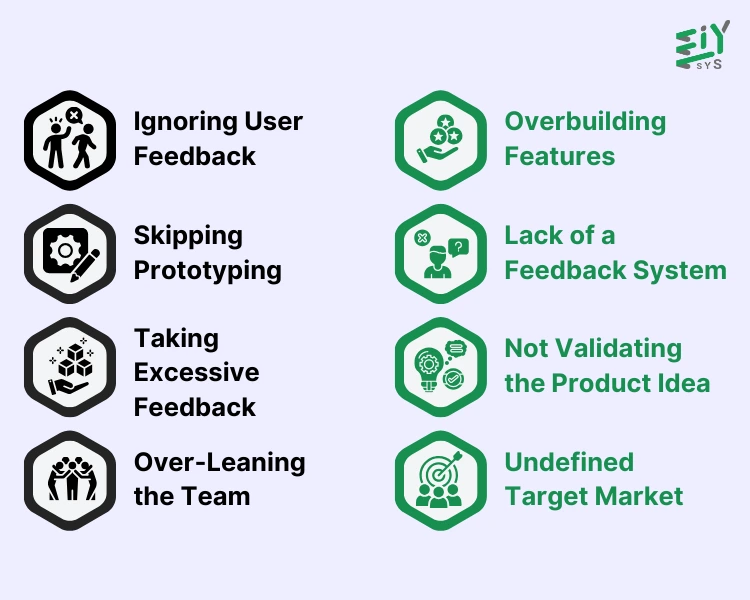
Overbuilding Features : One of the most common MVP development mistakes is adding too many features or trying to perfect the product too early. The purpose of an MVP is to include only the core features that address the primary problem for early adopters. Overloading the product with unnecessary features can delay launch and divert attention from the most important aspects.
- Lack of a Feedback System : An MVP is designed to gather insights from early users, but without a proper feedback system, you won’t have the data needed to improve the product. Failing to implement mechanisms for user feedback is a critical mistake in the MVP process.
- Not Validating the Product Idea : Before you commit significant time and resources, it’s essential to validate your product idea. Rushing into development without testing whether there’s a real demand for your solution is one of the biggest MVP development mistakes startups make. Proper validation helps ensure you’re building something people actually want.
- Undefined Target Market : Creating an MVP without a clear understanding of your target market is a recipe for failure. You need to know your customers’ needs, preferences, and pain points. Without a well-defined target audience, your MVP risks missing the mark, rendering it irrelevant to potential users.
- Skipping Prototyping : By passing the prototyping phase is another costly **MVP development mistake**. Without a prototype, you risk encountering unforeseen design problems and building a product that doesn’t align with user expectations. Prototyping helps you visualise your product early, identify issues, and validate your concept before fully committing to development.
- Taking Excessive Feedback : While user feedback is crucial, not all feedback is valuable. One of the mistakes many MVP creators make is trying to implement every suggestion, which can lead to scope creep and confusion. Focus on actionable feedback that aligns with your product’s core mission and user needs.
- Over-Leaning the Team : An MVP should be lean, but it’s important to balance this with enough resources to ensure quality development. “Starving” your team by cutting too many corners or understaffing can lead to burnout and poor execution. Ensure your team has the necessary support to build and refine the MVP without compromising its quality.
What Are the Most Common Startup MVP Errors?
Here are the most common startup MVP errors :
- Lack of a Defined Target Market : Without a clear understanding of your target audience, it’s challenging to build a product that truly addresses their needs.
- Building a Product That Won’t Sell : If your MVP doesn’t resonate with early adopters or solve a real problem, it’s unlikely to gain traction in the market.
- Neglecting User Feedback : One of the main goals of an MVP is to gather feedback from early users. Failing to collect and act on this feedback can result in missed opportunities for improvement.
- Overcomplicating the MVP :An MVP should only have the essential features that address the core problem for early adopters, rather than trying to include every possible feature or function.
- Skipping the Prototyping Phase : Neglecting to prototype your MVP can lead to a product that doesn’t resonate with your intended audience or validate your assumptions.
- Ignoring Scalability : While building your MVP, it’s important to think about how the product will perform as it grows, ensuring it can handle future demands.
- Lack of a Clear Business Strategy : Without a solid business plan, it becomes difficult to guide the development of your MVP and ensure its success in the long run.
- Choosing the Wrong Development Team : Having the right team with the appropriate skills and clear objectives is crucial, especially during the initial development and validation stages.
- Selecting the Wrong Development Approach : Opting for the wrong development methodology or working with the wrong development partner can lead to costly mistakes and delays in bringing your MVP to market.
What led to the failure of Juicero’s MVP?
Case Study: The Juicero Failure
A notable example of a failed MVP case study is Juicero , a premium juicing machine that promised a revolutionary juicing experience but ultimately failed despite raising $118 million in funding. The machine was designed to work with proprietary juice packs containing QR codes for ingredient tracking. However, it was soon revealed that the juice packs contained pre-squeezed juice, making the machine unnecessary.
The primary reasons for Juicero’s failure align closely with common mistakes seen in failed MVP case studies are :
- Poor Market Research : Juicero overestimated the demand for an expensive, high-tech juicer and consumers’ willingness to pay a premium for it.
- Misunderstood Problem : The device aimed to solve a problem that didn’t exist. People didn’t need a sophisticated machine to make juice, as the juice packs could be consumed without the device.
- Lack of Product-Market Fit : The complexity of the product, coupled with its high price, meant it didn’t meet the real needs of the target market.
- Failure to Adapt : Juicero failed to iterate based on customer feedback or criticism, leading to its rapid decline in popularity.
This case study is a powerful reminder of the pitfalls that can lead to a failed MVP. It highlights the importance of conducting proper market research, defining the right problem, achieving product-market fit, and iterating based on feedback. Even with significant funding and media hype, neglecting these fundamentals can result in failure. We’ll explore strategies to avoid these common mistakes.
Conclusion
At EIY SYS , we understand that avoiding MVP development mistakes is crucial for building a successful product. As we’ve seen through examples like Juicero , these common MVP pitfalls can quickly cause even the most promising startups. Understanding MVP business failure reasons , such as poor market research, lack of product-market fit, and failure to iterate based on user feedback, can significantly reduce the risks associated with MVP development.
By being mindful of the mistakes to avoid in MVP , like overloading features or neglecting scalability, and ensuring your MVP addresses a clear, real problem, you’ll be in a much stronger position to meet market demands. Addressing these issues early on can also help you avoid startup MVP errors that could ultimately hinder your success.
As highlighted by several failed MVP case studies, even large investments and initial hype won’t guarantee success if these foundational mistakes aren’t addressed. At EIY SYS , we specialise in guiding startups through the complexities of MVP development, ensuring a lean, validated approach that is both scalable and adaptable.Remember, the key to a successful MVP lies not only in creating a product but in refining it through research, feedback, and constant iteration. Avoiding these pitfalls and building on lessons learned from past failed MVP case studies will put your startup on a path to sustainable growth and success.
Frequently Asked Questions
An MVP (Minimum Viable Product) is a simplified version of a product that includes only the core features necessary to satisfy early adopters. It allows businesses to test ideas, gather user feedback, and validate their product in the market with minimal investment.
Mistakes during MVP development can lead to wasted resources, loss of market opportunities, and early business failure. Avoiding these pitfalls ensures efficient use of time and budget while increasing the chances of creating a product that resonates with users.
Start by conducting thorough market research to understand your target audience's pain points. Use surveys, interviews, and competitive analysis to identify the key features your MVP should include. Regularly gather and implement feedback from early users.
Overloading your MVP with features can dilute its core purpose, increase development costs, and delay launch. It also complicates the feedback process, making it harder to identify what users value most.
User feedback helps refine the product by identifying what's working and what isn’t. Iterating based on feedback ensures your MVP evolves into a product that aligns with customer expectations and market demand.